

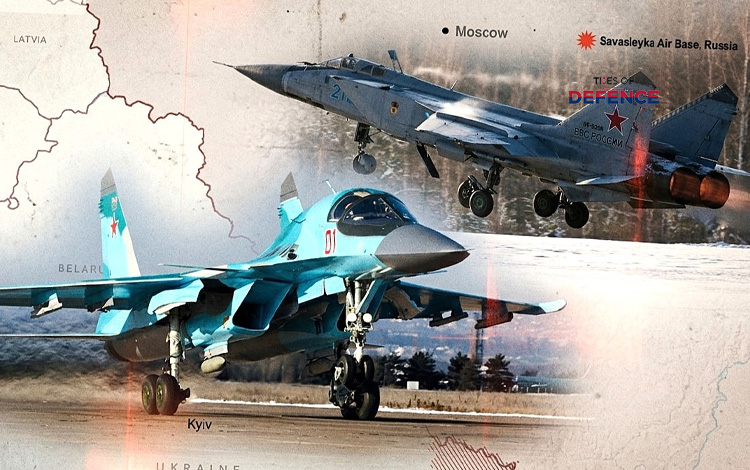
The General Staff of the Armed Forces of Ukraine announced on November 25, 2026, that Ukrainian Defense Forces conducted a long-range strike on November 24 and overnight into November 25 against Savasleyka Air Base in Russia’s Nizhny Novgorod region, reporting preliminary hits on five Russian combat aircraft—three MiG-31 interceptors and two Su-34 fighter-bombers—that will be unable to fly for an extended period.
Located roughly 12 km northwest of Kulebaki and approximately 650 to 700 km (400–435 miles) from the Ukrainian border, Savasleyka Air Base (home to the 3958th Aviation Base under the 4th Centre for Combat Application and Crew Training) serves as a primary operating hub for MiG-31 variants, including the MiG-31K carrier of the Kh-47M2 Kinzhal air-launched ballistic missile. Ukrainian military officials emphasized that battle-damage assessments and the exact number and variant breakdown of affected aircraft remain under verification—noting that the claims have not been independently confirmed by commercial satellite imagery or acknowledged by Moscow—and coincided with overnight strikes against Russia’s Kuibyshev and Syzran oil refineries in Samara Oblast as well as radar, fuel, and ammunition depots in occupied Luhansk and Donetsk oblasts.
TECHNICAL SPECIFICATIONS: SAVASLEYKA AIR BASE & TARGETED COMBAT AIRCRAFT
1. Strike Operation, Basing Profile & Verification Status
⚡ Claiming Authority & Verification Posture: General Staff of the Armed Forces of Ukraine (statement issued November 25, 2026); preliminary report claiming five aircraft hit (“unable to fly for some time”), with battle-damage assessment ongoing, no independent satellite confirmation yet published, and no official Russian MoD comment
⚡ Target Airfield & Strategic Distance: Savasleyka Air Base (Nizhny Novgorod Oblast, ~12 km northwest of Kulebaki), situated ~650–700 km from Ukrainian territory; previously targeted by Ukrainian long-range strikes in August 2024, June 2025, and August 2026
⚡ Concurrent Strike Package: Executed alongside reported Ukrainian long-range drone strikes against the Kuibyshev and Syzran oil refineries in Samara Oblast plus strikes on a P-18 radar station, fuel/lubricant depots, and an ammunition dump in occupied eastern Ukraine 
2. Targeted Russian Aerospace Forces (VKS) Aircraft Envelopes
💥 Mikoyan MiG-31 (NATO: Foxhound / MiG-31K Variant): Heavy twin-engine supersonic interceptor powered by Soloviev D-30F6 afterburning turbofans (maximum speed ~Mach 2.83 / 3,000 km/h, service ceiling >20,600 m); Ukrainian officials did not specify sub-variants, though Savasleyka bases MiG-31K aircraft—the sole operational airborne launch platform for the Kh-47M2 Kinzhal aeroballistic missile—and Russia produces no new MiG-31 airframes
💥 Sukhoi Su-34 (NATO: Fullback): Twin-engine, twin-seat supersonic all-weather fighter-bomber powered by Saturn AL-31FM1 turbofans (maximum speed ~Mach 1.8, combat radius ~1,100 km, external payload up to 8,000–12,000 kg across 12 hardpoints); serves as Russia’s primary tactical platform for delivering UMPK-guided glide bombs and Kh-59/Kh-69 standoff missiles against Ukrainian frontline positions and cities
TIMES OF DEFENCE ASSESSMENT
Ukraine’s claim of hitting three MiG-31 interceptors and two Su-34 fighter-bombers at Savasleyka Air Base—pending independent battle-damage verification—highlights three critical dynamics in deep-strike counter-air warfare, high-value fleet attrition, and active air-defense suppression:
1. Attacking Launch Platforms on the Ground to Offset Interceptor Shortages: Facing persistent shortages of high-end surface-to-air interceptors capable of defeating ballistic threats, Ukraine increasingly targets Russian missile carriers and glide-bomb aircraft at rear airbases 650–700 km inside Russia before munitions are launched.
2. High Strategic Sensitivity Around Non-Replaceable MiG-31 Airframes: Even if the three struck MiG-31s sustained repairable damage rather than total destruction—and regardless of whether any were confirmed as Kinzhal-capable MiG-31K variants—grounding airframes from a finite, out-of-production fleet imposes lasting operational strain on Russian long-range strike tempo.
3. Disrupting Daily Glide-Bomb Sorties Through Su-34 Attrition: Because Su-34 fighter-bombers carry the heaviest burden of Russia’s daily UMPK guided glide-bomb campaign, taking even two airframes out of flight status directly reduces tactical strike sortie capacity while forcing Moscow to disperse high-value jets farther from the front.