

Raytheon (an RTX business) announced on November 24, 2026, that the U.S. Navy awarded it an Other Transaction Authority (OTA) agreement to move its design for the Nuclear-Armed Sea-Launched Cruise Missile (SLCM-N) from initial concept work into a focused development phase ahead of future prototype demonstrations, bringing in Anduril Rocket Motor Systems, Divergent, and Williams International as industrial contributors.
Neither Raytheon nor the Navy disclosed the contract’s dollar value, execution period, prototype count, or exact workshare split under the announcement, which follows the Navy’s October 2026 disclosure of five SLCM-N prototype agreements totaling $743.6 million signed on September 23, 2026 through December 31, 2027—including missile development and integration awards to Raytheon, Leidos subsidiary Dynetics, and Northrop Grumman, alongside canister work for Northrop Grumman Mission Systems and Pacific Engineering. Revived from the 2018 Nuclear Posture Review after the Cold War-era TLAM-N retired in 2013, SLCM-N is slated to carry a new W80-5 warhead variant for deployment aboard Virginia-class attack submarines equipped with the Virginia Payload Module (VPM) and planned Trump-class surface combatants, against statutory milestones targeting limited operational capability by September 2032 and initial operational capability by September 2034.
TECHNICAL SPECIFICATIONS: SLCM-N PROGRAMME & SUBSYSTEM ARCHITECTURE
1. Contracting Structure, Industrial Team & Schedule Milestones
⚡ Prime Contractor & Industrial Contributors: Raytheon Advanced Technology leads design maturation, subsystem integration, and prototype demonstration preparation using a “composable weapons” modular architecture, supported by Williams International (small turbofan propulsion heritage), Anduril Rocket Motor Systems (solid rocket motors), and Divergent (additive manufacturing structures)
⚡ Contracting Vehicle & Preceding Awards: Other Transaction Authority (OTA) prototype agreement announced November 24, 2026 (undisclosed value/duration), following five September 23, 2026 SLCM-N prototype agreements worth $743.6 million through December 31, 2027 (with Raytheon, Dynetics, and Northrop Grumman on missile systems/integration), a $194.1 million General Dynamics Mission Systems fire-control modification, and $47.4 million in JRC Integrated Systems support
⚡ Statutory & Budgetary Timeline: Fiscal 2024 NDAA sets an initial operational capability (IOC) target of September 30, 2034, while fiscal 2026 legislation mandates limited operational deployment readiness by September 2032; program funding includes $2 billion set aside in 2025 for missile acceleration alongside $400 million for the warhead, with NNSA leadership indicating inclusion in the fiscal 2028 budget request after omission from the fiscal 2027 request 
2. Warhead, Host Platforms & Delivery Concept
💥 Nuclear Payload & Historical Lineage: Planned to carry the W80-5 warhead variant (identified by Sandia National Laboratories in January 2026) within the W80 warhead family tracing back to the retired TLAM-N sea-launched nuclear cruise missile (fielded in the mid-1980s and retired by 2013)
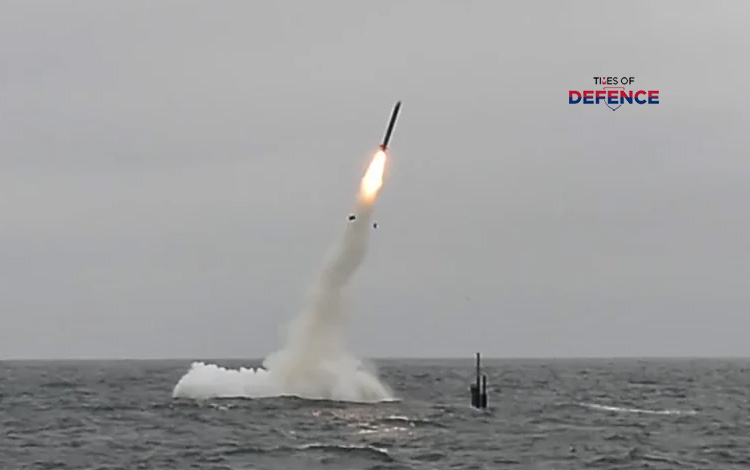
💥 Host Platforms & Launch Integration: Engineered for Virginia-class nuclear-powered attack submarines fitted with Virginia Payload Modules (VPM) and planned Trump-class battleships, with launcher/canister interfaces connecting through Virginia Payload Tubes
💥 Propulsion & Flight Profile: Expected to utilize a solid-fuel booster stage for launch/clear-breach followed by a small turbofan engine for sustained low-altitude cruise flight, though Raytheon has not released official range, speed, dimensions, or booster-staging details
TIMES OF DEFENCE ASSESSMENT
The U.S. Navy’s decision to advance Raytheon’s SLCM-N design into focused development with Anduril, Divergent, and Williams International highlights three critical tensions in sea-based nuclear deterrence, industrial modularization, and schedule realism:
1. Blending Legacy Propulsion Heritage With Non-Traditional Additive and Rocket Suppliers: Pairing established small-turbofan expertise with additive manufacturing and solid rocket motor suppliers reflects an effort to compress prototype lead times and expand industrial capacity ahead of 2030s milestones.
2. Expanding Forward Sea-Based Deterrence While Raising Dual-Capable Ambiguity: Deploying a sea-launched nuclear cruise missile on forward-deployed submarines and surface combatants adds flexible regional deterrence against Russia and China, but also creates potential ambiguity over whether an incoming cruise missile carries a conventional or nuclear warhead.
3. Ambitious 2032–2034 Deadlines Amid Budget and Integration Hurdles: Meeting statutory 2032 limited-deployment and 2034 initial-capability targets requires synchronizing W80-5 warhead development, VPM/fire-control integration, and multi-year appropriations across competing defense priorities.