


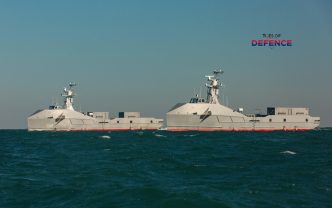
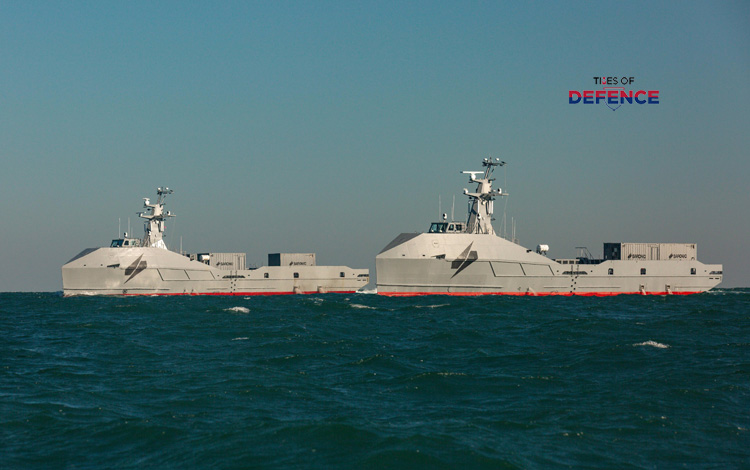
Defense technology firm Saronic Technologies has released underway trial imagery of two 180-foot (55-meter) Marauder autonomous surface vessels (ASVs) operating at sea, highlighting progress under the U.S. Navy’s Medium Unmanned Surface Vessel (MUSV) initiative.
Selected in June 2026 as one of seven industry contenders advancing to the at-sea testing phase of the Navy’s MUSV Marketplace program, Saronic validated the Marauder platform across more than 140 test scenarios during continuous multi-day ocean trials out of its Gulfport, Mississippi testing and commissioning center. That performance culminated in a U.S. Navy production Other Transaction (OT) award announced on September 30, 2026—followed by initial fleet orders—as the Navy moves to field up to 30 MUSVs under its hybrid fleet architecture. Built at Saronic’s shipyard in Franklin, Louisiana, the modular 180-foot vessel combines a 5,400-nautical-mile unrefueled range, 150-metric-ton payload capacity, and Saronic’s Echelon autonomy stack to execute distributed logistics, intelligence, surveillance, and reconnaissance (ISR), electronic warfare, and payload deployment without onboard crews.
TECHNICAL SPECIFICATIONS: SARONIC MARAUDER 180-FOOT ASV ARCHITECTURE
1. Hull Geometry, Endurance & Modular Payload Capacity
⚡ Prime Designer & Builder: Saronic Technologies (Austin, Texas; serial construction at Franklin, Louisiana shipyard and commissioning at Gulfport, Mississippi)
⚡ Hull Dimensions & Payload Class: Overall length of 180 feet (~55 meters) with a modular open-deck payload capacity of up to 150 metric tons—accommodating four 40-foot ISO containers, eight 20-foot ISO containers, or custom mission modules
⚡ Speed & Endurance Envelope: Top speed exceeding 25 knots, 12-knot economic cruise speed, and an unrefueled operational range of up to 5,400 nautical miles at base load (25 MT) or 4,100 nautical miles at maximum 150-MT payload
⚡ Structural & Environmental Resilience: Purpose-built for uncrewed blue-water operations, engineered to withstand 15g+ shock loads and operate reliably across high sea states without life-support hotel systems 
2. Autonomy Stack, Command-and-Control & Multi-Mission Roles
💥 Autonomy & Fleet C2 Software: Driven by Saronic’s Echelon command-and-control layer and onboard mission-level autonomy software featuring adaptive sea-state path planning, cross-platform sensor fusion, and digital-twin simulation
💥 Resilient Multi-Channel Communications: Equipped with multi-band, contested-environment datalinks enabling manned-unmanned teaming (MUM-T) with U.S. Navy surface combatants and the Robotic and Autonomous Systems Warfighting Development Center (RASWDC)
💥 Distributed Maritime Mission Set: Configurable for contested littoral logistics and resupply, persistent maritime ISR, electronic warfare, communications relay, decoy/deception, and autonomous deployment of smaller uncrewed surface or underwater assets
TIMES OF DEFENCE ASSESSMENT
Saronic’s multi-vessel underway trials with the 180-foot Marauder and its progression from MUSV at-sea evaluation to a U.S. Navy production contract highlight three critical shifts in naval shipbuilding and unmanned fleet employment:
1. Validating Non-Traditional Shipbuilding Speed Through Commercial-Style Iteration: Moving a 180-foot autonomous ship from hull launch in May 2026 through intensive Gulf Coast sea trials to a production contract within four months demonstrates how vertically integrated design, software, and modular shipyard manufacturing can bypass traditional multi-year naval acquisition bottlenecks.
2. Scaling Containerized Payload Capacity for Distributed Maritime Operations: Providing 150 metric tons of ISO-containerized payload over a 4,100-to-5,400-nautical-mile range enables commanders to rapidly swap sensors, electronic warfare suites, or sustainment cargo across dispersed Indo-Pacific theaters without risking crewed logistics vessels.
3. Maturing Multi-Vessel Autonomous Teaming Before Fleet Induction: Testing two Marauder hulls concurrently at sea accelerates collective autonomy validation—allowing the Navy’s Robotic and Autonomous Systems Warfighting Development Center to refine swarm coordination, collision avoidance, and command-and-control tactics ahead of broader 30-vessel MUSV fielding.

