


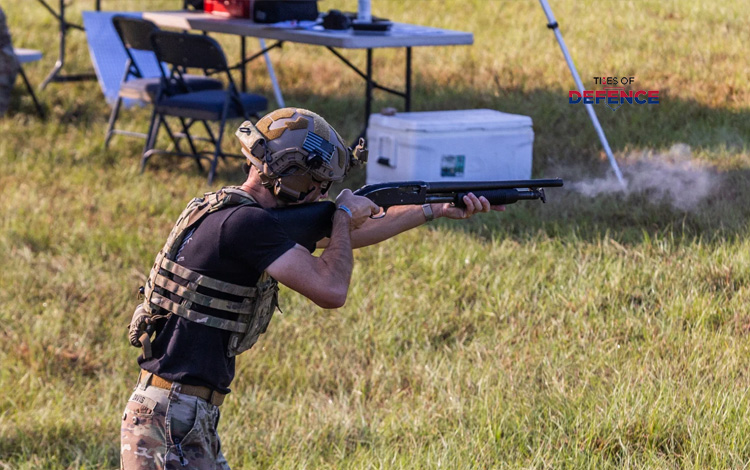
The U.S. Army Maneuver Battle Lab (MBL) conducted a live-fire counter-small unmanned aircraft system (counter-sUAS) shotshell assessment at Bryant Range, Fort Benning, Georgia, on September 21–22, 2026, pitting one government-issued 12-gauge target load against three commercial off-the-shelf shotshell types against 3D-printed target drones, with official findings announced in late November 2026 and formal evaluation reporting due to Army leadership before the end of 2026.
Executed in coordination with the Maneuver Future Capability Directorate (MFCD) Lethality Team and Product Manager for Small Caliber Ammunition (PdM SC) under the Soldier Enhancement Program, the range event utilized marksmanship instructors from Charlie Company, 1st Battalion, 29th Infantry Regiment firing at 3D-printed target drones flown out of sight of the firing line across crossing, low straight-in, and diving terminal attack profiles. Building on an August 18–19, 2026 baseline rifle assessment that compared an experimental 5.56mm drone round against standard M855A1 ball ammunition fired from M4 carbines, MBL analysts recorded time-to-hit, rounds expended, and engagement distances across varying recoil, shot material, and pattern-spread characteristics to inform squad-level counter-drone ammunition and training decisions.
TECHNICAL SPECIFICATIONS: BRYANT RANGE COUNTER-SUAS SHOTSHELL ASSESSMENT
1. Test Parameters, Munition Variants & Target Profiles
⚡ Executing & Supporting Organizations: U.S. Army Maneuver Battle Lab (MBL), Maneuver Future Capability Directorate (MFCD) Lethality Team, and Product Manager for Small Caliber Ammunition (PdM SC), with shooters from Charlie Company, 1st Battalion, 29th Infantry Regiment
⚡ Evaluated 12-Gauge Ammunition: Four total loads—one government-standard 12-gauge target load (traditionally used for skeet and trap training) and three commercial off-the-shelf shotshells differentiated by shot material, pellet spread, and recoil impulse
⚡ Target & Flight Profiles: 3D-printed small unmanned aircraft targets operated remotely out of view of shooters, executing lateral crossing passes at ~25 meters (82 feet), low straight-in approaches, and dives from ~30 meters (100 feet) toward firing positions
⚡ Measured Metrics & Reporting Timeline: Analysts logged time to hit, round count per engagement, and effective hit ranges, with formal findings scheduled for delivery to the MFCD Lethality Team and PdM SC before the end of 2026 
2. Program Context & Squad Counter-UAS Integration
💥 Soldier Enhancement Program Pathway: Evaluates mature commercial off-the-shelf (COTS) munitions to determine whether existing commercial loads can be adopted directly or require targeted engineering refinement for military reliability and terminal effect
💥 Preceding Small-Arms Counter-UAS Baseline: Follows an August 18–19, 2026 M4 carbine range evaluation comparing an experimental specialized 5.56mm counter-drone cartridge against standard M855A1 ball ammunition
💥 Broader Squad Architecture: Aims to pair low-cost kinetic last-resort dispersal munitions with squad-level detection, electronic warfare, and marksmanship training as small attack and reconnaissance drones proliferate at the tactical edge
TIMES OF DEFENCE ASSESSMENT
The U.S. Army’s live-fire evaluation of commercial and government 12-gauge shotshells against 3D-printed drones at Fort Benning highlights three critical shifts in infantry counter-UAS tactics, small-arms munitions, and rapid commercial testing:
1. Re-Examining Shot Pattern Dispersion for Close-Range Terminal Drone Defense: Once a small reconnaissance or FPV drone closes to tens of meters, precision rifle fire against a fast-moving, small airframe becomes difficult; multi-pellet shot patterns offer wider probability of hitting critical control, rotor, or propulsion components at short range.
2. Leveraging Commercial Off-the-Shelf Ammunition to Speed Tactical Experimentation: Using the Soldier Enhancement Program to test commercial shotshells alongside government target loads allows the Army to gather empirical ballistic and human-factors data quickly without waiting years for bespoke military munition development.
3. Treating Kinetic Shotshells as One Layer of a Holistic Squad Counter-UAS Concept: As MBL officials emphasize, close-in kinetic rounds address last-meter engagement mechanics and shooter tracking limits, but effective squad defense against drones requires pairing suitable ammunition with detection, electronic countermeasures, and dedicated infantry training.