

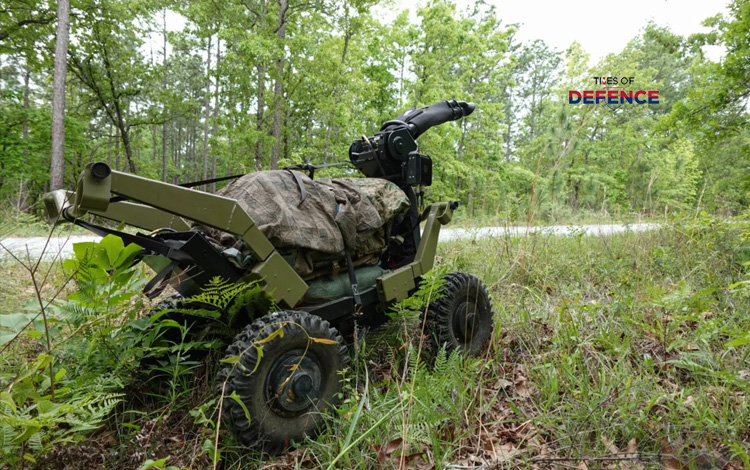
American Rheinmetall demonstrated the Wild Goose—officially designated the Infantry Modular Robotic System (IMRS) and developed by Israeli robotics firm Marom Dolphin—to U.S. special operations personnel during the Global SOF Foundation’s Modern Warfare Week held November 16–19, 2026, at a range complex in Autryville near Fort Bragg, North Carolina.
Marketing the compact electric unmanned ground vehicle (UGV) to U.S. defense customers, American Rheinmetall showcased equipment hauling, tactical mobility over complex terrain, and simulated casualty evacuation scenarios alongside dismounted elements. Following an initial U.S. Marine Corps pitch at Modern Day Marine in April 2026, multi-day U.S. Army soldier training in June 2026, and operational evaluations by the Italian Army’s 187th Paratroopers Regiment “Folgore” starting in February 2026, the Fort Bragg demonstration positions Wild Goose as a mature, TRL-9 squad-level robotic pack mule capable of internal vehicle stowage, rotary-wing door-bundle deployment, and modular mission kits.
TECHNICAL SPECIFICATIONS: WILD GOOSE (IMRS) UNMANNED GROUND VEHICLE ARCHITECTURE
1. Variants, Payload Capacity & Mobility Envelope
⚡ System & Industrial Partners: Developed by Marom Dolphin (Israel) as the Infantry Modular Robotic System (IMRS); marketed and supported for U.S. defense customers by American Rheinmetall
⚡ Variants & Payload Class: Offered in a four-wheel (4×4) configuration carrying up to 150 kg (330 lbs) of payload—with a self-weight around 60 kg (and up to ~68 kg / 150 lbs depending on battery/kit configuration)—and a lighter two-wheel (2×2) configuration rated up to 75 kg payload
⚡ Range, Electric Drive & Signature Reduction: All-electric propulsion with swappable lithium-ion battery packs, ~800 mm width, puncture-proof tires, ~22–25 km (14–15.5 mile) range under cargo load, and low acoustic/thermal signature designed for near-silent dismounted movement
⚡ Air & Ground Transportability: Compact knee-high profile sized to fit inside or aboard Infantry Squad Vehicles (ISV), HMMWVs, Joint Light Tactical Vehicles (JLTV), and UH-60 Black Hawk helicopters, with airborne door-bundle airdrop readiness 
2. Modular Mission Kits, Control & Operational Maturity
💥 Multi-Mission Kit Integration: Supports logistics cargo carriage, litter/stretcher casualty evacuation (CASEVAC), communications relays, decoy/deception payloads, and weapon/accessory mounts via CANbus 2.0 and Picatinny interfaces
💥 Operator Control & Autonomy Readiness: Controlled via a wireless one-hand remote controller with haptic feedback and cruise control, with autonomous/manned-unmanned teaming (MUM-T) support and minimal operator training requirements
💥 Fielding & Allied Evaluation Status: Marketed as a mature, fielded TRL-9 system, with ongoing evaluation interest across NATO/allied forces including Italy’s 187th Paratroopers Regiment “Folgore” and prior U.S. Army and USMC engagements
TIMES OF DEFENCE ASSESSMENT
American Rheinmetall’s demonstration of the Wild Goose UGV for U.S. special operations forces at Modern Warfare Week highlights three critical shifts in dismounted logistics, small-unit robotics, and special operations mobility:
1. Offloading Dismounted Burden Without Sacrificing Stealth or Terrain Access: Carrying up to 150 kg of equipment or supporting casualty evacuation across rugged terrain with low acoustic and thermal signatures directly addresses chronic dismounted load strain on special operations and airborne infantry.
2. Prioritizing Door-Bundle and Vehicle-Stowable Form Factors for Rapid Insertion: Because special operations and light forces rely on rotary-wing insertion, small tactical vehicles, and austere resupply drops, a compact UGV that stows inside an ISV, JLTV, or Black Hawk—or exits via helicopter door-bundle—fits expeditionary mission profiles far better than large ground drones.
3. Bridging Commercial-Off-the-Shelf Maturity Into Special Operations Experimentation: Demonstrating a ready-to-field TRL-9 platform already undergoing paratrooper trials in Italy allows U.S. special operations units to evaluate practical tactics, CASEVAC workflows, and payload modularity without waiting on multi-year R&D cycles.