


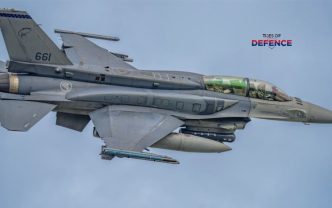
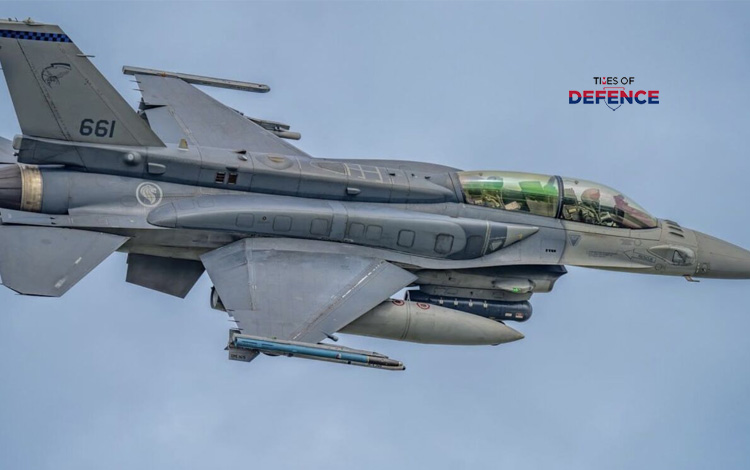
The Republic of China (Taiwan) Ministry of National Defense (MND) has expanded its F-16C/D Block 70 fighter acquisition budget by roughly 17 to 19 percent, committing an additional NT$42.8 billion (approximately U.S. $1.33–1.4 billion) to equip all 66 ordered aircraft with L3Harris Technologies’ internal AN/ALQ-254(V)1 Viper Shield electronic warfare (EW) suite, raising total programme expenditure from NT$247.2 billion to NT$290 billion (roughly U.S. $8.8 billion, or ~$133.3 million per airframe).
Whereas the original NT$247.2 billion “Peace Phoenix Soaring” budget funded Viper Shield installations for only 22 fighters—one-third of the fleet—the expanded allocation covers EW systems for the remaining 44 jets alongside associated munitions, ground support equipment, and storage infrastructure so the entire 66-aircraft fleet (56 single-seat F-16Cs and 10 two-seat F-16Ds) enters service with standardized electronic self-protection. Following the arrival of Taiwan’s first two F-16 Block 70 fighters at Chihhang Air Base in Taitung on October 2, 2026—after multi-year production delays pushed deliveries into the 2026–2028 timeframe—Defense Minister Wellington Koo confirmed that while initial hardware is fitted, full software maturation and aircraft-level integration testing remain ongoing on schedule.
TECHNICAL SPECIFICATIONS: F-16C/D BLOCK 70 & AN/ALQ-254(V)1 VIPER SHIELD
1. Airframe, Powerplant & Fleet Programme Baseline
⚡ Prime Airframe Manufacturer: Lockheed Martin Aeronautics (Greenville, South Carolina assembly line), procured for the Republic of China Air Force (ROCAF) 7th Tactical Fighter Wing at Chihhang Air Base
⚡ Fleet Size & Budget Structure: 66 new-build aircraft (56 F-16C, 10 F-16D), increasing total programme budget by NT$42.8 billion (~$1.33–1.4B) to NT$290 billion (~$8.8B) to achieve 100-percent fleet-wide EW parity
⚡ Propulsion & Airframe Enhancements: Powered by a General Electric F110-GE-129 turbofan (~29,500 lbf afterburning thrust) with structural life extended to 12,000 flight hours, Conformal Fuel Tanks (CFTs), and Automatic Ground Collision Avoidance System (Auto GCAS)
⚡ Delivery & Operational Posture: First two airframes arrived at Chihhang Air Base on October 2, 2026, with remaining deliveries stretching through 2027–2028 alongside Taiwan’s 139 upgraded F-16A/B Block 20 (F-16V) fighters 
2. Integrated Electronic Warfare, Radar & Sensor Fusion Suite
💥 Electronic Warfare System: L3Harris Technologies internal AN/ALQ-254(V)1 Viper Shield all-digital, software-defined EW architecture utilizing Digital Radio Frequency Memory (DRFM) jamming and wide-band digital radar warning receiver (DRWR) receivers
💥 Radar & Sensor Interoperability: Engineered for seamless electromagnetic compatibility and simultaneous operation alongside Northrop Grumman’s AN/APG-83 Scalable Agile Beam Radar (SABR) AESA fire-control radar, Center Pedestal Display (CPD), and Joint Helmet Mounted Cueing System II (JHMCS II)
💥 Software & Integration Status: Installed internally in new-build Block 70 airframes (distinct from the podded ALQ-254(V)2 variant for legacy F-16s); final operational flight program software and whole-aircraft integration testing continue post-delivery
TIMES OF DEFENCE ASSESSMENT
Taipei’s NT$42.8 billion allocation to outfit all 66 F-16 Block 70 fighters with the AN/ALQ-254(V)1 Viper Shield suite highlights three critical realities in Taiwan Strait air defense, fourth-plus-generation survivability, and defense acquisition:
1. Eliminating Split-Fleet Vulnerability in High-Threat Electromagnetic Environments: Limiting internal Viper Shield suites to only 22 of 66 new jets would have created a two-tier combat force unable to deploy uniformly in contested airspace. Funding full-fleet installation ensures every Block 70 airframe possesses digital radar warning and DRFM jamming against PLA Air Force fifth-generation fighters, long-range air-to-air missiles, and coastal surface-to-air missile networks.
2. Navigating Software-Defined EW Maturation After Hardware Delivery: Taking delivery of the initial Block 70 airframes in October 2026 while Viper Shield operational software completes integration testing underscores a recurring modern aviation reality—physical airframe handovers increasingly precede full software-defined sensor and electronic-warfare combat readiness.
3. Extending Non-Stealth Fighter Relevance Through Sensor and Jamming Parity: Because Taiwan relies on upgraded F-16V and new F-16 Block 70 fighters rather than stealth aircraft, pairing the AN/APG-83 AESA radar with modern digital electronic countermeasures is essential to complicating adversary kill chains and preserving air-defense sortie survivability across the Taiwan Strait.

