


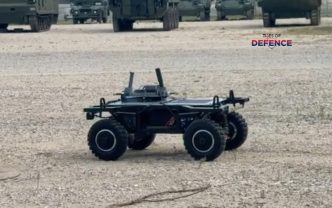
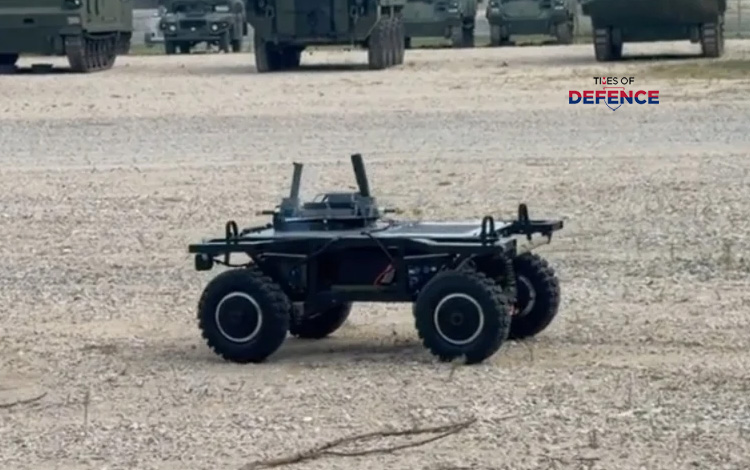
Defense robotics startup Raptor Defense Company has advanced into Phase II of the U.S. Army’s GroundBreaker 1 Unmanned Ground Vehicle (UGV) demonstration at Camp Grafton, North Dakota, while simultaneously securing a finalist position in the U.S. Army xTech G-TEAD USARPAC autonomous logistics competition.
Engineered as a compact, squad-level “Personal Combat Vehicle” (PCV), the PIT VIPER platform is designed for high-density, low-cost fielding directly to individual dismounted infantry warfighters. Advancing following government technical evaluations under the Department of Defense Drone OTA Consortium, the PIT VIPER is undergoing realistic field maneuvering and usability trials at Camp Grafton alongside competing platforms—including HDT Robotics’ Hunter WOLF and Liminal Industries’ DUEL-V. Concurrently, as one of nine finalists in the Army xTech G-TEAD USARPAC ACE 27-01 competition, Raptor will conduct live autonomous resupply and sustainment demonstrations on Oahu, Hawaii, evaluating the platform’s ability to maintain logistics chains across contested island terrain in the Indo-Pacific theater.
TECHNICAL SPECIFICATIONS: RAPTOR DEFENSE COMPANY PIT VIPER UGV ARCHITECTURE
Developer, Program Leadership & Institutional Backing
⚡ Lead Platform Prime: Raptor Defense Company (Philadelphia, Pennsylvania)
⚡ Institutional Investor: Ben Franklin Technology Partners of Southeastern Pennsylvania
⚡ Sponsoring Contracting Authority: U.S. Army Contracting Command / Drone OTA Consortium / Army xTech Program
⚡ Operational Evaluations: GroundBreaker 1 (Camp Grafton, ND) & xTech G-TEAD USARPAC ACE 27-01 (Oahu, HI) 
Airframe Engineering & Payload Kinematics
💥 Platform Classification: Compact Modular Wheeled Unmanned Ground Vehicle / Personal Combat Vehicle (PCV)
💥 Curb Weight vs Payload Envelope: Curb Weight: 250 lb (113 kg) | Maximum Payload Capacity: 600 lb (272 kg) (Delivering a 2.4:1 payload-to-weight ratio)
💥 Chassis Mobility & Ruggedization: All-terrain wheeled drive system engineered for high obstacle negotiation, mud, sand, and dismounted squad pacing
💥 PIT VIPER Link Technology: Patent-pending mechanical and electrical multi-vehicle coupling system enabling multiple units to link together to increase aggregate payload capacity, power distribution, and endurance
Modular Mission Payloads & Autonomy Architecture
🚀 Quick-Swap Payload Architecture: Modular deck interfaces for rapid mission reconfiguration across casualty evacuation (CASEVAC), tactical resupply, ISR, counter-mine operations, and communications relay
🚀 Aerial Drone Deployment Package: Integrated drone launch and recovery payload bay (developed in partnership with AG3 Labs) supporting organic tethered or free-flying micro-UAV operations
🚀 C2 & System Integration: Android Tactical Assault Kit (ATAK) software integration paired with resilient, multi-radio mesh network links for low-latency command and autonomous waypoint navigation
TIMES OF DEFENCE ASSESSMENT
Raptor Defense Company’s progress in both the GroundBreaker 1 and xTech USARPAC competitions highlights a growing operational pivot within the U.S. Army toward low-cost, mass-producible ground robotics. Historically, military UGV procurements favored large, multi-ton, highly complex platforms. While capable, high unit acquisition costs limited those systems to specialized units and engineering detachments rather than frontline dismounted infantry squads.
From an engineering and force-structure perspective, the PIT VIPER addresses the demand for dismounted squad-level logistics and tactical mass. Weighing 250 lb while carrying up to 600 lb of cargo, the vehicle delivers an exceptional payload-to-weight ratio. Its patent-pending “PIT VIPER Link” capability—allowing multiple UGVs to connect mechanically and electrically into a larger unified system—offers flexible scalability for last-mile logistics. By testing the platform’s autonomous delivery capabilities across both arctic/rugged terrain in North Dakota and island-chain environments in Hawaii, the Army is evaluating whether low-cost, dismounted UGVs can reliably sustain distributed forces in contested theaters.

