


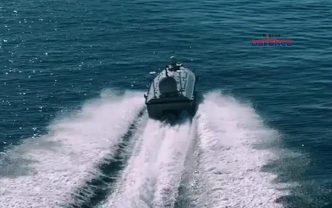
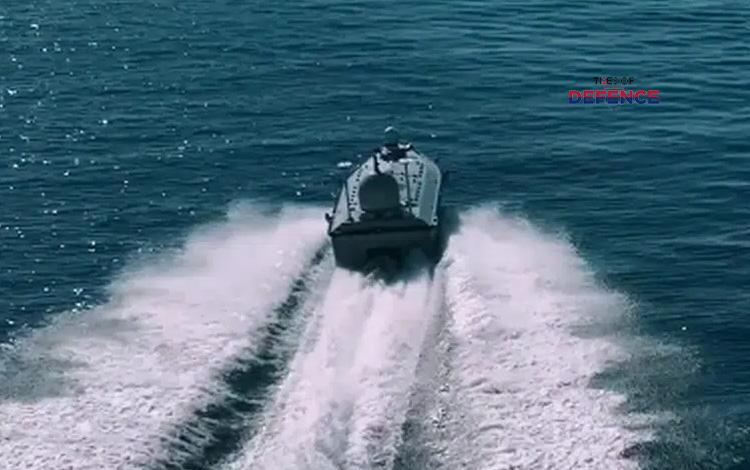
Operational demonstrations during the Distinguished Observer Day of Exercise TURNAs-2026 on October 25, 2026, featured a live-fire integration test involving Makine ve Kimya Endüstrisi (MKE)’s PİRANA Kamikaze Unmanned Surface Vehicle (KUSV) and Baykar’s Bayraktar TB2 tactical Unmanned Aerial Vehicle (UAV).
During the live-fire phase of the exercise, a Bayraktar TB2 airborne platform acted as an over-the-horizon line-of-sight (LOS) data-link relay and command-and-control (C2) node for the surface vessel. Utilizing guidance telemetry relayed directly through the overhead TB2 UAV, the PİRANA KUSV navigated toward a designated surface combatant target, scoring a direct kinetic strike with its integrated 100 kg explosive warhead. The joint demonstration—executed under the oversight of the Turkish Ministry of National Defense and the Presidency of Defense Industries (SSB)—validates cross-domain aerial-to-maritime drone communication links, extending operational strike ranges beyond coastal radar horizon limits without requiring direct shore/ship-to-surface line-of-sight control.
TECHNICAL SPECIFICATIONS: MKE PİRANA KAMIKAZE USV (KUSV) ARCHITECTURE
Developer, Program Office & Operational Philosophy
⚡ Lead Platform Prime: Makine ve Kimya Endüstrisi A.Ş. (MKE — Ankara, Türkiye)
⚡ Operational Integration Partner: Baykar Tech (Bayraktar TB2 C2 data-link relay integration)
⚡ Design Philosophy: Developed under MKE’s “Effective, Simple and Affordable” (Etkili, Basit ve Ucuz — EBU) asymmetric warfare design framework
⚡ Combat Concept: Low-observable high-speed single-use strike vessel designed for autonomous target terminal engagement, swarm interdiction, and amphibious raid force protection 
Hull Geometry, Hydrodynamics & Kinematics
💥 Hull Architecture & Design: V-shaped composite planing hull optimized for low radar cross-section (RCS) and low acoustic/thermal signature profile
💥 Dynamic Velocity: Maximum Speed: >40 knots (74+ km/h)
💥 Operational Strike Radius: Operational Range: >200 nautical miles (~370 km)
💥 Wave Handling & Maneuverability: Engineered for high-G defensive evasion maneuvers in high sea states to saturate and bypass shipborne CIWS and automated remote weapon stations
Guidance, C4ISR & Airborne Relay Linkage
🚀 Warhead Payload: 100 kg high-explosive blast-fragmentation / shaped-charge warhead fitted with dual impact/proximity fuzing systems
🚀 Primary Guidance Modes: Radio Frequency (RF) line-of-sight, satellite communications (SATCOM), and optical/IR camera tracking for autonomous terminal homing
🚀 Aerial C2 Relay Linkage: Multi-band airborne data-link architecture allowing MALE/tactical UAVs (Bayraktar TB2 / TB3) to take over flight/steering control, extending C2 operational range far beyond surface-ship horizon constraints
🚀 Swarm Autonomy (Sürü Konsepti): AI-driven swarming logic enabling networked PİRANA units to conduct multi-vector simultaneous target saturation strikes
TIMES OF DEFENCE ASSESSMENT
The successful live-fire engagement of the MKE PİRANA KUSV under Bayraktar TB2 aerial relay control during Exercise TURNAs-2026 marks an important operational evolution in Turkish unmanned maritime warfare doctrine. Historically, kamikaze USVs operating via surface-to-surface RF data-links faced strict operational limits imposed by Earth curvature and maritime radar horizons, restricting non-SATCOM uncrewed vessels to short-range engagements near host ships or coastline stations.
From an engineering and force-projection perspective, establishing a real-time command-and-control bridge between a tactical UAV (Bayraktar TB2) and a high-speed kamikaze surface drone (PİRANA) effectively eliminates the traditional line-of-sight barrier. Serving as an airborne relay, the TB2 extends the tactical kill web, allowing operators to deploy low-cost, mass-produced 40-knot surface drones against adversary surface combatants hundreds of miles away. Furthermore, combining low-RCS hull profiles, 100 kg warheads, and airborne-assisted target tracking equips naval forces with a low-cost, asymmetric sea-denial asset capable of saturating shipborne close-in weapon systems (CIWS) across contested littoral theater environments.

