


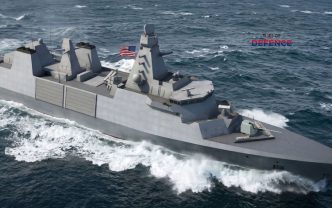
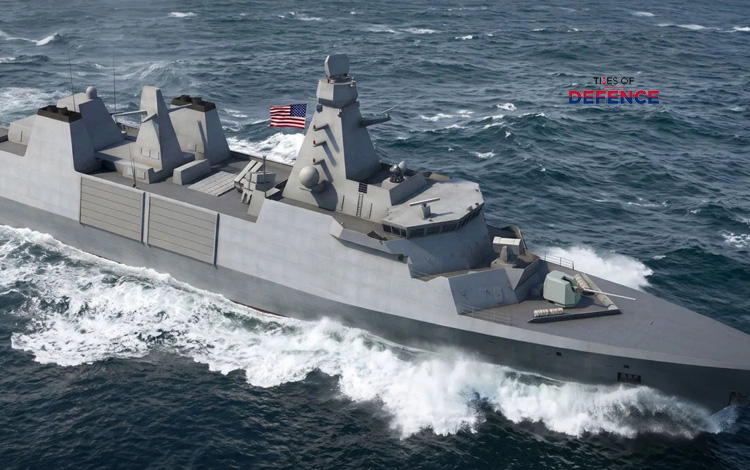
British defense prime Babcock International Group has confirmed its intention to offer the Arrowhead 140 (AH140) general-purpose frigate—the export baseline for the Royal Navy’s Type 31 Inspiration-class—to the U.S. Department of the Navy under a potential industrial partnership with Huntington Ingalls Industries (HII).
The move follows executive directives authorizing the evaluation of mature foreign combatant designs under the “Finland Model” procurement framework, which permits initial foreign build options transitioning to domestic U.S. naval shipyards to rapidly bridge fleet capacity deficits. Babcock has initiated preliminary discussions with U.S. Department of War and Navy acquisition officials to pitch the AH140 as a low-risk, production-ready surface combatant option. The platform enters an international field under U.S. evaluation, competing alongside Japan’s Mogami class (Mitsubishi Heavy Industries), South Korea’s Chungnam class (HD Hyundai Heavy Industries/Hanwha Ocean), and Türkiye’s Istanbul class (TAİS/STM). The Secretary of War and the U.S. Navy are scheduled to present their formal surface combatant evaluation and acquisition report by mid-November 2026.
TECHNICAL SPECIFICATIONS: BABCOCK ARROWHEAD 140 (TYPE 31 BASELINE)
Developer, OEM Integrators & Global Program Footprint
⚡ Primary Design Authority: Babcock International Group (Rosyth, Scotland, UK)
⚡ Proposed U.S. Build Partner: Huntington Ingalls Industries (HII — Pascagoula, MS / Newport News, VA)
⚡ Baseline Hull Derivative: Royal Danish Navy *Iver Huitfeldt*-class frigate platform (OMT design)
⚡ Active Export & Build Programs:
• Royal Navy (UK): 5× Type 31 Inspiration-class (HMS *Ventrue*, HMS *Active* in active construction at Rosyth)
• Polish Navy (Miecznik Program): 3× frigates (ORP *Wicher*, ORP *Burza*, ORP *Huragan* under construction at PGW Gdynia)
• Indonesian Navy (TNI AL): 2× Red White (Merah Putih) frigates (under construction at PT PAL Surabaya) 
Airframe Geometry, Displacement & Modular Construction
💥 Platform Dimensions & Tonnage: Length: 138.7 meters (455 ft) | Beam: 19.8 meters (65 ft) | Draft: 4.8 meters | Full Load Displacement: ~5,700 tonnes
💥 Propulsion Architecture: Combined Diesel and Diesel (CODAD) configuration powered by 4× MTU 20V 8000 M71L diesel engines generating 32.8 MW (44,000 hp) total driving 2 controllable-pitch propellers
💥 Kinematic Performance: Max Speed: >28 knots (52 km/h) | Operational Range: 9,000 nmi (16,600 km) at 12 knots | Mission Endurance: 28 days
💥 Structural Volume & Margins: High internal deck space volume (originally sized for 5,700t hull) designed with generous growth margins for power, cooling, and adaptive weapons payload integration
Sensors, Command Suite & Flexible Payload Envelope
🚀 Open Architecture C2 Baseline: Thales TACTICOS Combat Management System (CMS) or adaptable to U.S. Aegis Baseline / COMBATSS-21 systems
🚀 Primary Radar Array: Thales NS110 3D E/F-band Active Electronically Scanned Array (AESA) radar
🚀 Vertical Launch System (VLS) Options: Adaptable for 32-cell or 64-cell Mk 41 VLS modules capable of firing SM-2, SM-6, ESSM Block II, or Mk 54 VL-ASROC missiles
🚀 Auxiliary & Organic Aviation Capabilities: Stern flight deck and enclosed hangar accommodating MH-60R Seahawk ASW helicopters or large vertical takeoff and landing (VTOL) uncrewed aerial systems; stern launch ramp for 2× 11-meter Rigid Inflatable Boats (RIBs) or Uncrewed Surface Vessels (USVs)
TIMES OF DEFENCE ASSESSMENT
Babcock’s entry of the Arrowhead 140 into the U.S. Navy’s foreign frigate evaluation introduces a contender with significant structural volume to an already complex international field. Prompted by severe delivery delays and cost escalations within domestic combatant programs (notably the *Constellation*-class FFG-62 series), the Department of War’s decision to assess off-the-shelf allied ship designs highlights an urgent operational demand to increase surface fleet mass in response to naval expansion in the Indo-Pacific.
From an engineering and acquisition perspective, each of the primary international contenders offers distinct operational trade-offs:
1. **Babcock Arrowhead 140 (UK/Denmark baseline)**: Offers the largest displacement envelope (~5,700 tonnes) among the contenders. Its modular design provides massive internal volume, allowing U.S. systems integrators to easily backfit standardized Mk 41 VLS cells, U.S. radar suites, and high-margin power/cooling systems without radical airframe re-engineering. Partnering with HII leverages established U.S. naval ship construction infrastructure.
2. **Mogami-class (Japan — MHI)**: Highly automated design requiring a small crew (~90 personnel), addressing U.S. Navy manpower shortages. Offers strong anti-submarine and surface warfare capabilities with 32 VLS cells.
3. **Chungnam-class (South Korea — HD HHI/Hanwha)**: High production velocity and low unit acquisition cost (~18-month build timelines in Korean yards), providing rapid delivery schedules under potential early-tranche foreign builds.
4. **Istanbul-class (Türkiye — TAİS/STM)**: Proven indigenous 3,000-tonne modular design featuring high local sensor integration and flexible multi-role strike options.
The ultimate determination will hinge on whether U.S. acquisition authorities prioritize the extreme internal growth margin and established NATO/US system compatibility of the Arrowhead 140, the manpower-reducing automation of the *Mogami*, or the rapid shipbuilding output demonstrated by South Korean shipyards.

