


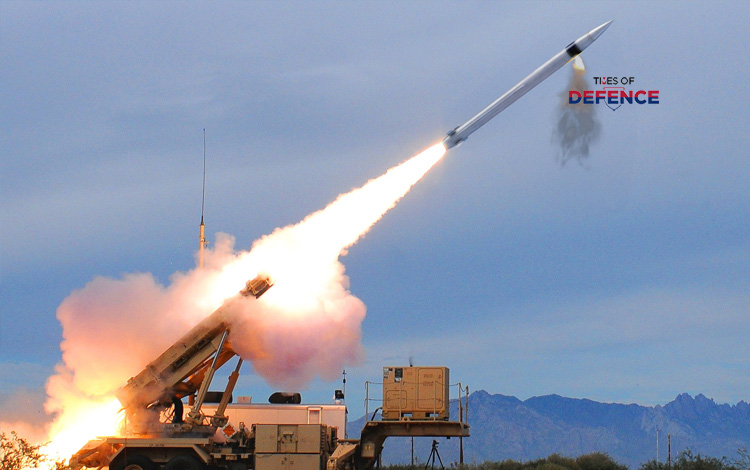
Defense prime Lockheed Martin Missiles and Fire Control has been awarded a $1.1 billion engineering and manufacturing development (EMD) contract modification by the U.S. Army for the PAC-3 Edge interceptor under the service’s Future Interceptor initiative.
The contract finances system integration, ground testing, and initial low-rate initial production (LRIP) preparations. Prototype flight testing is scheduled to begin in 2027, targeting rapid operational deployment by 2031. Building upon the operational baseline of the combat-proven Patriot Advanced Capability-3 Missile Segment Enhancement (PAC-3 MSE), the PAC-3 Edge incorporates a new Northrop Grumman multi-pulse solid rocket motor, an upgraded dual-mode seeker designed by Lockheed Martin’s Strigo Product Center, and enhanced attitude control motor (ACM) suites. The architecture significantly expands the kinetic engagement ceiling and slant range against maneuvering hypersonic glide vehicles (HGVs), high-altitude ballistic missiles, and advanced air-breathing threats within the Army’s Integrated Air and Missile Defense (IAMD) ecosystem.
TECHNICAL SPECIFICATIONS: LOCKHEED MARTIN PAC-3 EDGE INTERCEPTOR ARCHITECTURE
Contractual Governance, OEM Partnerships & Program Milestones
⚡ Lead Systems Prime: Lockheed Martin Missiles and Fire Control (Dallas, Texas)
⚡ Major Propulsion Subcontractor: Northrop Grumman Propulsion Systems (Solid Rocket Motor Design & Production)
⚡ Seeker & Avionics Development: Lockheed Martin Strigo Product Center
⚡ Contracting Authority: U.S. Army Program Executive Office Missiles and Space (PEO MS) / ACC Redstone
⚡ Contract Value & Schedule: $1.1 Billion USD; Flight Testing: Starts 2027; Targeted Operational Deployment: 2031
⚡ Program Framework: U.S. Army Future Interceptor Program / Lower Tier Air and Missile Defense System (LTAMDS) Integration 
Kinematics, Propulsion & Seeker Upgrades
💥 Kinetic Engagement Concept: Hit-to-Kill (HTK) lethality utilizing direct kinetic energy impact to neutralize incoming warheads
💥 Propulsion Architecture: Northrop Grumman multi-pulse solid rocket motor providing staged thrust management, allowing re-ignition during the terminal phase for high-altitude maneuvering
💥 Advanced Seeker Suite: Strigo Product Center-designed dual-mode Ka-band AESA active radar / electro-optical seeker with improved counter-electronic protection (EP) against dense RF jamming
💥 Maneuverability & Control: Upgraded solid-fuel Attitude Control Motors (ACMs) surrounding the forward airframe to execute high-G lateral divert maneuvers during terminal hit-to-kill interception
💥 Expanded Kinematic Envelope: Delivers higher burnout velocity, increased slant range, and elevated altitude ceilings compared to baseline PAC-3 MSE airframes
Launcher, C2 & Architecture Interoperability
🚀 Integrated Air & Missile Defense C2: Native integration with the U.S. Army’s Integrated Battle Command System (IBCS) open-architecture C2 network
🚀 Radar Interface: Fully compatible with the Raytheon Lower Tier Air and Missile Defense Sensor (LTAMDS / AN/MPQ-65A) 360-degree radar
🚀 Multi-Platform Launch Integration: Operational compatibility with standard M903 Patriot launchers, containerized palletized launch arrays, and HIMARS Flex multi-domain launcher configurations
TIMES OF DEFENCE ASSESSMENT
The $1.1 billion development contract for the PAC-3 Edge reflects the U.S. Army’s efforts to address gaps in lower-tier ballistic and hypersonic missile defense. While the current PAC-3 MSE is highly effective against short-to-medium-range ballistic missiles, the proliferation of maneuvering hypersonic glide vehicles (such as China’s DF-17 or Russia’s Kinzhal variants) demands interceptors capable of executing high-G terminal maneuvers at higher altitudes.
From an engineering and missile defense perspective, the PAC-3 Edge architecture offers several key advantages:
1. **Multi-Pulse Thrust Management**: Traditional solid rocket motors burn continuously until fuel depletion, leaving the missile with reduced kinetic energy during terminal maneuvers at high altitudes. Integrating Northrop Grumman’s multi-pulse solid rocket motor allows the PAC-3 Edge to conserve rocket energy during the mid-course phase and ignite a second or third pulse in the upper atmosphere, maintaining velocity to intercept maneuvering hypersonic threats.
2. **Flexible Launcher Integration**: Engineering the PAC-3 Edge to fire from standard M903 Patriot trailers as well as HIMARS Flex and containerized launchers allows the Army to deploy point-defense missile shields in austere, dispersed forward bases—aligning with multi-domain operation doctrines.
3. **Open Architecture C2 Integration**: By integrating natively into the Army’s IBCS network, the PAC-3 Edge can receive off-board target tracks from diverse sensors (such as LTAMDS, Sentinel A4 radars, or naval Aegis assets), launching without requiring an organic Patriot radar co-located at the firing battery.

