


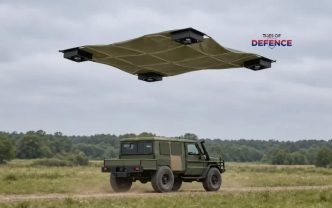
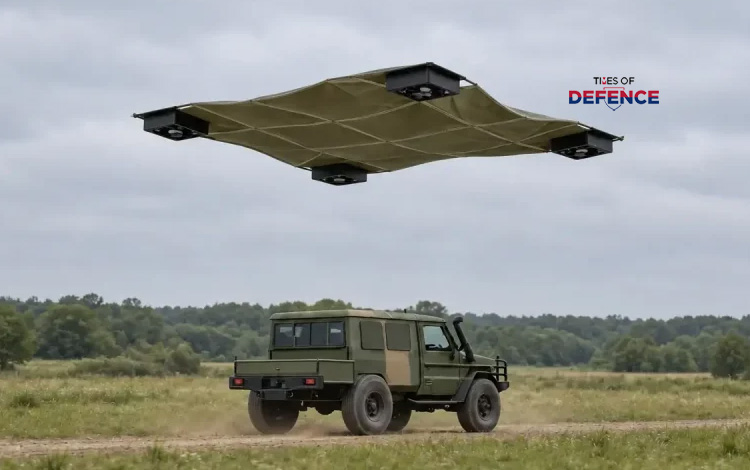
U.S. defense technology startup Vigil Autonomy has officially unveiled “Air Cover,” an autonomous, tethered aerial camouflage platform designed to deliver persistent multispectral signature management over military vehicles, command posts, and field equipment.
The system utilizes an autonomous aerial lift platform capable of operating up to a maximum altitude of 10 meters. Built on open architecture interfaces, Air Cover is designed to mitigate enemy aerial detection from electro-optical (EO), thermal infrared (MWIR/LWIR), and synthetic aperture radar (SAR) recon sensors. The platform offers interchangeable camouflage payloads, dual operational modes (“Stealth Mode” for physical asset concealment and “Decoy Mode” for signature spoofing), and active lift capability to reposition decoys away from protected high-value assets.
TECHNICAL SPECIFICATIONS: VIGIL AUTONOMY AIR COVER SYSTEM ARCHITECTURE
Developer, Program Governance & Platform Concept
⚡ Developer & OEM: Vigil Autonomy (Austin, Texas, USA)
⚡ Platform Designation: Air Cover™ Autonomous Camouflage System
⚡ Core Capability: Rapid, persistent aerial camouflage mesh deployment and signature management over static or moving tactical assets
⚡ Maximum Operating Altitude: 10 meters (33 ft) AGL (Above Ground Level)
⚡ Interoperability Baseline: Open payload interfaces supporting multi-vendor camouflage textiles, signature management foils, and electronic emitter decoys 
System Variants & Physical Performance Metrics
💥 Personal Configuration:
• Camouflage Mesh Footprint: 2 × 2 meters (4 m² coverage)
• Active Flight Target Endurance: 4 hours (240 minutes)
• Operational Target: Dismounted personnel, sniper hides, small crew-served weapon positions
💥 Unit Configuration:
• Camouflage Mesh Footprint: 3 × 3 meters (9 m² coverage)
• Active Flight Target Endurance: 3 hours (180 minutes)
• Operational Target: Tactical light wheeled vehicles (JLTV, HMMWV), field command posts, mortar positions
💥 Asset Configuration:
• Camouflage Mesh Footprint: 10 × 10 meters (100 m² coverage)
• Active Flight Target Endurance: 2 hours (120 minutes)
• Operational Target: Heavy armored combat vehicles (MBTs, IFVs), mobile radar units, field artillery batteries
Multispectral Signature Management & Operational Modes
🚀 Multispectral Shielding: Modular textiles manage thermal infrared (NIR/SWIR/MWIR/LWIR) dissipation and synthetic aperture radar (SAR) scatter
🚀 Stealth Mode (Asset Concealment): Deploys airborne mesh directly over target assets to match local environmental textures and break up visual/thermal vehicle contours
🚀 Decoy Mode (Active Lift Spoofing): Uses temporary active lift flight to elevate and position secondary thermal/radar signature payloads away from the real asset, drawing enemy precision strikes toward false targets
🚀 Static Ground Fallback: Unpowered operational state allows the mesh to function as a conventional ground-spread camouflage net without requiring flight ops
TIMES OF DEFENCE ASSESSMENT
The introduction of Vigil Autonomy’s Air Cover represents a response to the pervasive overhead threat facing modern ground forces. The rapid proliferation of FPV strike drones, thermal-equipped reconnaissance UAVs, and satellite synthetic aperture radar (SAR) has rendered conventional static camouflage nets inadequate for maneuvering mechanized columns.
From an engineering and tactical survivability perspective, the Air Cover platform offers key operational advantages:
1. **Dynamic Concealment for Moving Vehicles**: Traditional static netting requires soldiers to manually unpack, stake, and drape nets over vehicles whenever they halt—a labor-intensive process that leaves armor exposed during short tactical pauses. Air Cover’s autonomous active lift enables overhead netting to hover over a moving or briefly halted vehicle, maintaining continuous overhead disruption against thermal and visual drone sensors.
2. **Flexible Stealth and Decoy Roles**: The platform’s ability to switch between “Stealth Mode” (suppressing the real vehicle’s thermal/radar signature) and “Decoy Mode” (elevating an active emitter payload away from the vehicle) creates tactical confusion for enemy drone operators. Forces can spoof enemy targeting algorithms into attacking empty space or sacrificial decoys.
3. **Open Architecture Payload Interchangeability**: Designing the system with open interfaces ensures forces are not locked into a single camouflage supplier. Units operating in desert, woodland, or arctic environments can rapidly swap the flying mesh payload without modifying the underlying autonomous flight propulsion mechanism.

