


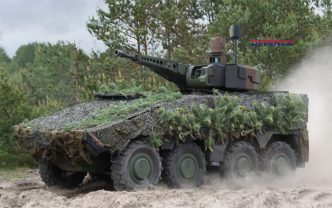
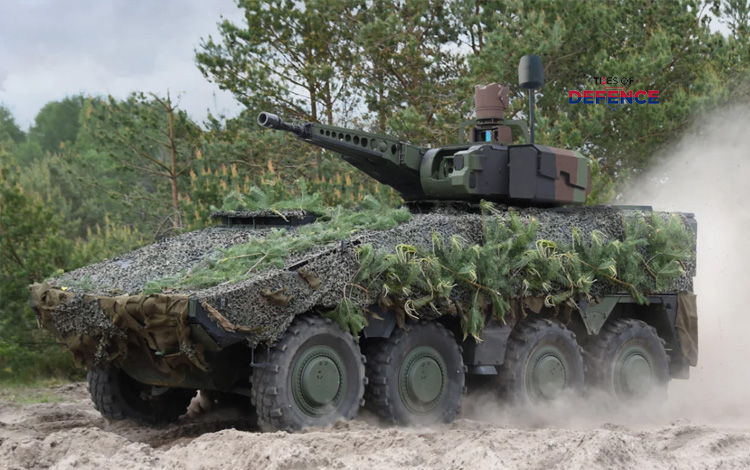
The Organisation for Joint Armament Cooperation (OCCAR) has exercised the first contractual option under the joint German-Dutch procurement framework, ordering an additional 69 Schakal (Boxer RCT30) wheeled infantry fighting vehicles (IFVs).
Executed through ARTEC GmbH—the joint venture between Rheinmetall and KNDS Deutschland—the order allocates 35 platforms to the German Bundeswehr and 34 to the Royal Netherlands Army. Approved by the Bundestag Budget Committee in late June 2026, the call-off elevates the total firm order to 291 vehicles (185 for Germany, 106 for the Netherlands). Rheinmetall confirmed its share of the option is valued in the mid-hundreds of millions of euros, with delivery of this specific tranche scheduled between May 2032 and November 2033. The procurement leaves 131 unexercised options remaining from the original October 2025 contract envelope for up to 400 total units.
TECHNICAL SPECIFICATIONS: SCHAKAL (BOXER RCT30) WHEELED IFV ARCHITECTURE
Contractual Governance, Industrial Consortium & Fleet Allocation
⚡ Program Management Agency: Organisation for Joint Armament Cooperation (OCCAR — Bonn, Germany)
⚡ Industrial Prime Consortium: ARTEC GmbH (Joint Venture: Rheinmetall Military Vehicles & KNDS Deutschland)
⚡ Order Structure: October 2025 Baseline: 222 Units (€4.7B / $5.24B) | October 2026 Option: +69 Units (35 DE / 34 NL) | Fleet Total: 291 Units
⚡ Industrial Partners: Rheinmetall, KNDS Deutschland, MTU Friedrichshafen (Propulsion), Hensoldt (Optronics/Sensors)
⚡ Delivery Horizon: Initial production deliveries starting late 2027; Option tranche deliveries scheduled from May 2032 to November 2033 
Chassis Engineering & Drive Module Dynamics
💥 Mobility Baseline: Built on the Boxer 8×8 armored vehicle Future Common Drive Module (FCDM) featuring heavy-duty suspension and all-wheel drive
💥 Propulsion Architecture: MTU 8V 199 TE21 multi-fuel turbocharged diesel engine producing 805 hp (600 kW), coupled to an Allison automatic transmission
💥 Kinematics & Range: Maximum Road Speed: >100 km/h | Operational Cruising Range: 1,000 km | Trench Crossing: 2.0 meters | Fording: 1.2 meters (unprepared)
💥 Modular Crew Compartment: Accommodates a 3-person crew (Commander, Gunner, Driver) and up to 6 fully equipped dismounted infantry soldiers with rapid rear-ramp egress
Unmanned Turret, Primary Armament & Sensor Suite
🚀 Turret Architecture: Remote Control Turret 30 (RCT30) — the unmanned, low-profile turret digitized from the tracked Puma IFV
🚀 Autocannon Performance: Rheinmetall 30mm MK 30-2/ABM (Airburst Munition) automatic cannon firing 200 rounds/min with dual-belt feeding (APFSDS-T and KETF airburst rounds)
🚀 Anti-Tank Guided Missile (ATGM): Integrated twin-launcher for MELLS (Spike LR/LR2) anti-tank guided missiles, delivering non-line-of-sight (NLOS) kinetic punch out to 5.5+ km
🚀 Fire Control & C4ISR: Fully digital dual-axis stabilized sight suite (PERI RTWL for Commander, IBMS for Gunner) with integrated hunter-killer capability, laser rangefinder, and NATO STANAG-compliant C4I data links
TIMES OF DEFENCE ASSESSMENT
The expansion of the German-Dutch Schakal procurement to 291 units underscores a major structural doctrine shift within NATO ground forces: establishing “Medium Forces” (Mittlere Kräfte). Placed between heavy tracked armored formations (Leopard 2 / Puma) and light airborne/infantry units, wheeled 8×8 IFV formations prioritize rapid tactical and operational road mobility over inter-theater transport aircraft dependency.
From an engineering and force structure perspective, the Schakal platform provides three key operational advantages:
1. **Puma Firepower on a Wheeled Chassis**: By integrating the Puma IFV’s unmanned RCT30 turret onto the 8×8 Boxer chassis, the Bundeswehr and Royal Netherlands Army achieve heavy IFV firepower—including 30mm airburst capability for C-UAS/infantry suppression and MELLS anti-tank missiles—without sacrificing the 100 km/h road mobility of a wheeled vehicle.
2. **Standardized Logistics Footprint**: Because Germany and the Netherlands already operate extensive fleets of Boxer command, ambulance, and cargo variants, introducing the Schakal creates commonality in spare parts, drivetrain maintenance, MTU engine overhauls, and driver training pipelines.
3. **Industrial Acceleration and Arminius Synergy**: Rheinmetall and KNDS noted that exercising options provides supply chain stability. Furthermore, if Germany approves the larger “Arminius” Boxer framework—a initiative to procure thousands of multi-role Boxer platforms—German industry has pledged to accelerate delivery schedules for remaining option vehicles.

