


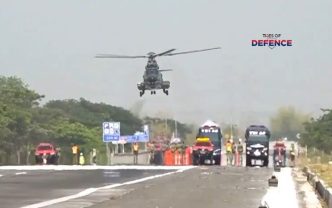
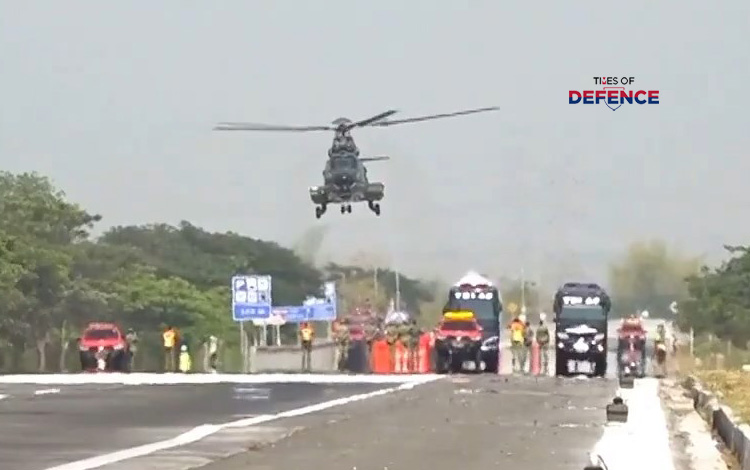
The Indonesian Air Force (Tentara Nasional Indonesia Angkatan Udara — TNI AU) has successfully executed tactical highway take-off and landing exercises using multi-role combat aircraft along a converted civilian highway segment in East Java.
Led by Air Force Chief of Staff Air Chief Marshal Mohamad Tonny Harjono, the readiness exercise validated a 3-kilometer long, 24-meter wide designated emergency strip along the Pasuruan–Probolinggo Toll Road as an operational contingency airfield. The maneuvers featured tactical operations by Lockheed Martin F-16 C/D Fighting Falcons and Embraer EMB-314 Super Tucano light attack aircraft, supported by Airbus H225M Caracal combat search and rescue (CSAR) helicopters. The exercise advances Indonesia’s contingency basing initiative, designed to ensure dispersed air operations and platform survival if primary military airbases suffer kinetic strikes, runway cratering, or operational disruption.
TECHNICAL SPECIFICATIONS: TNI AU DISPERSED HIGHWAY RUNWAY OPERATIONS
Executing Authority & Air Base Resilience Framework
⚡ Operating Force: Indonesian Air Force (TNI AU — Tentara Nasional Indonesia Angkatan Udara)
⚡ Lead Executive Authority: Air Chief Marshal Mohamad Tonny Harjono (Chief of Staff, TNI AU)
⚡ Infrastructure Concept: Contingency Basing & Dispersed Airpower Operational Readiness Program
⚡ Tactical Objective: Preserving combat aircraft sortie generation and air defense continuity during airbase interdiction 
Emergency Highway Runway Geometry & Preparedness
💥 Location Vector: Pasuruan–Probolinggo Toll Road (Tol Paspro), East Java Province, Indonesia
💥 Strip Dimensions: Operational Length: 3,000 meters (3.0 km) | Operational Width: 24 meters
💥 Pavement Specification: Reinforced asphalt concrete with temporary barrier removal, mobile air traffic control (ATC) deployment, and mobile arresting gear/FOD clearance sweeping
Participating Combat Aircraft & Kinematic Parameters
🚀 Lockheed Martin F-16 C/D Fighting Falcon (Multi-Role Fighter):
• Dynamic Role: Point air defense, counter-air, and tactical precision strike interdiction
• Landing Kinematics: Touchdown speed ~135–150 knots (250–278 km/h); short-field landing using drag chute and heavy wheel braking
🚀 Embraer EMB-314 / A-29 Super Tucano (Turboprop Light Attack):
• Dynamic Role: Close air support (CAS), counter-insurgency (COIN), and short-field rough-strip interdiction
• Landing Kinematics: Low landing speed (~90 knots) enabling short-distance touchdown and rapid turnaround on narrow strips
🚀 Airbus H225M Caracal (Tactical Transport & CSAR):
• Dynamic Role: Mobile forward arming and refueling point (FARP) support, crash rescue, and perimeter security logistics
Support Architecture & Dispersed Logistics
🚀 Forward Arming & Refueling (FARP): Fuel bowsers and mobile munitions trucks deployed to execute hot-pit refueling and re-arming on civilian access roads
🚀 Tactical C4I Integration: Deployable Mobile Air Traffic Control (ATC) vans paired with tactical VHF/UHF radio communication links and visual glide-slope indicators
TIMES OF DEFENCE ASSESSMENT
The TNI AU’s successful landing of F-16 and Super Tucano aircraft on the Pasuruan–Probolinggo Toll Road represents a practical application of dispersed airpower doctrine tailored to an archipelagic operating environment. Given Indonesia’s vast geography and reliance on a small number of static military airbases, those facilities represent primary targets for long-range cruise missile or ballistic strikes in a high-intensity regional conflict.
From an engineering and operational perspective, converting civilian highways into functional runways requires precise logistics coordination. Beyond pilot proficiency on a narrow 24-meter strip, the success of highway landing programs depends on mobile support infrastructure—such as deployable communications, mobile arresting gear, fuel supply, and foreign object debris (FOD) clearance crews. Validating both fast-jet (F-16) and turboprop (Super Tucano) platforms on civilian toll roads provides the Indonesian Air Force with flexible alternative bases, helping ensure continuous air defense operations during operational contingencies.

