


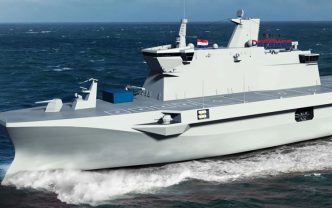
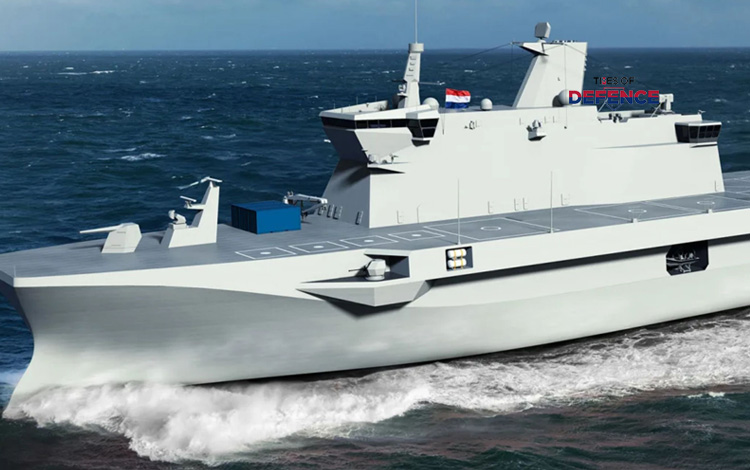
Dutch shipbuilder Damen Naval unveiled the initial design of the new 15,000-tonne Amphibious Transport Ship (ATS) at the NIDV Exhibition Defence & Security (NEDS) 2026 in Rotterdam on November 19, 2026, showcasing the shared 164-metre flat-top vessel architecture developed for the Royal Navy and the Royal Netherlands Navy.
Forming the centerpiece of the £2.4 billion Anglo-Dutch amphibious shipbuilding partnership signed in July 2026, the programme plans for eight total vessels—four for the United Kingdom and four for the Netherlands—with first-of-class entry into service targeted for the early 2030s. Designed to replace aging amphibious assault ships and ocean-going patrol vessels across both navies (such as the Royal Netherlands Navy’s Rotterdam-class LPDs and Holland-class OPVs, alongside the Royal Navy’s retired Albion-class and aging Bay-class fleet), the ATS shifts away from traditional close-in beach assault dock designs toward a versatile flight-deck and vehicle-deck architecture capable of projecting Royal Marines and Netherlands Marine Corps (Korps Mariniers) forces from standoff distances via medium-to-heavy helicopters, uncrewed aerial vehicles (UAVs), and surface craft.
TECHNICAL SPECIFICATIONS: DAMEN AMPHIBIOUS TRANSPORT SHIP (ATS) ARCHITECTURE
1. Hull Form, Displacement & Programme Structure
⚡ Prime Naval Architect & Design Lead: Damen Naval (Netherlands), developing a shared Anglo-Dutch baseline alongside British and Dutch industrial partners (including electrical/systems integrator Alewijnse)
⚡ Hull Dimensions & Displacement: Overall length of 164 metres and a displacement of approximately 15,000 metric tons, featuring a continuous flat-top flight deck with an integrated island superstructure
⚡ Fleet Size & Budget Framework: Eight-ship joint acquisition—four vessels for the Royal Navy and four vessels for the Royal Netherlands Navy—under a £2.4 billion bilateral agreement signed in July 2026, with UK build work planned in British shipyards alongside ongoing discussions regarding Dutch hull construction
⚡ Operational Replacement Scope: Engineered to consolidate amphibious lift, littoral strike, maritime security patrol, and humanitarian assistance/disaster relief (HADR) into a single common hull class 
2. Aviation Flight Deck, Autonomous Systems & Embarked Lift
💥 Aviation & Rotorcraft Operations: Features a full-length flat-top flight deck incorporating two primary landing spots at the stern sized for medium-to-heavy troop-carrying helicopters such as the NH90 NFH/TTH and Royal Navy AW101 Merlin
💥 Uncrewed Systems & Hybrid Warfare Integration: Designed from the keel up to launch, recover, and support uncrewed aerial vehicles (UAVs) and autonomous maritime systems as part of NATO’s emerging hybrid naval force structure
💥 Vehicle Deck & Standoff Logistics: Connects internal vehicle and cargo decks directly to flight-deck transit routes to move palletized stores, light tactical vehicles, and embarked marine detachments rapidly onto helicopters for over-the-horizon insertion
TIMES OF DEFENCE ASSESSMENT
Damen’s unveiling of the 164-metre Amphibious Transport Ship design at NEDS 2026 highlights three critical shifts in European amphibious warfare, bilateral procurement, and littoral force posture:
1. Shifting from Vulnerable Beachheads to Standoff Aviation-Led Insertion: Modern anti-ship cruise missiles and coastal sensor networks make closing within sight of contested shores increasingly hazardous for large amphibious ships. Prioritizing a flat-top flight deck for Merlin and NH90 helicopters alongside UAV operations allows Anglo-Dutch marine forces to project power from beyond coastal threat envelopes.
2. Deepening UK-Netherlands Marine Integration Through Hull Commonality: Building eight identical 15,000-tonne vessels across the Royal Navy and Royal Netherlands Navy institutionalizes decades of UK-NL Amphibious Force cooperation, lowering lifecycle support costs while streamlining joint training, spare parts, and combined task-group deployments.
3. Balancing Industrial Workshare Across Allied Shipyards: While a common Damen design unlocks economies of scale across an eight-ship run, finalizing the industrial division between British shipyards and Damen’s Dutch and Romanian construction facilities will be decisive in keeping the £2.4 billion programme on schedule for early-2030s delivery.

