


European aerospace defense prime Airbus Defense and Space is set to enter preliminary industrial discussions with BAE Systems regarding a potential role in the tri-national Global Combat Air Programme (GCAP).
The exploratory engagement comes as the German Federal Ministry of Defence (BMVg) evaluates alternative 6th-generation combat aircraft procurement pathways following the structural collapse of the Franco-German-Spanish Future Combat Air System (FCAS / SCAF) initiative in mid-2026. Lead industrial prime BAE Systems—operating alongside Italy’s Leonardo S.p.A. and Japan’s Mitsubishi Heavy Industries (MHI) within the core GCAP consortium—will assess potential workshare, software/hardware integration, and systems engineering entry points for Airbus. However, integrating Germany’s domestic defense industrial base (represented by Airbus Defence and MTU Aero Engines) presents complex negotiation challenges, given that core airframe, sensor, propulsion, and avionics work packages have already been finalized among the founding UK, Italian, and Japanese partners for the targeted 2035 entry-into-service timeline.
TECHNICAL SPECIFICATIONS: GCAP 6TH-GEN BASELINE & GERMAN INTEGRATION HYPOTHESES
Program Governance, OEM Consortia & Emerging Participants
⚡ Core Lead Industrial Primes: BAE Systems (United Kingdom), Leonardo S.p.A. (Italy), Mitsubishi Heavy Industries (Japan)
⚡ Strategic Engine Consortium: Rolls-Royce (UK), Avio Aero (Italy), IHI Corporation (Japan)
⚡ Advanced Avionics & Sensors Suite: Leonardo UK, Leonardo Italy, Mitsubishi Electric (ISAP Joint Venture)
⚡ Prospective Industrial Entrants: Airbus Defence and Space (representing German industrial interests) & MTU Aero Engines
⚡ Target Entry into Service (EIS): 2035 operational deployment (replacing RAF Eurofighter Typhoon FGR4, Italian Air Force Typhoons, and JASDF F-2 platforms) 
Airframe Geometry, Stealth & Propulsion Engineering
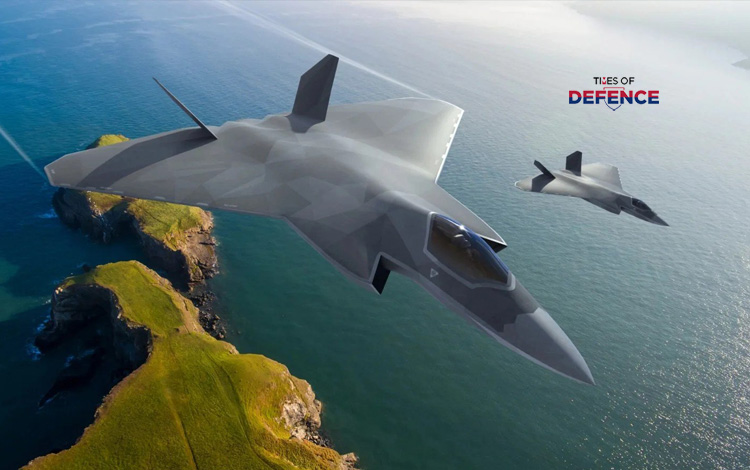
💥 Platform Design Class: 6th-Generation Low-Observable Multi-Role Combat Aircraft (Heavy Long-Range Fighter Geometry)
💥 Aerodynamic Configuration: Modified delta wing-body blend with double-swept outer wings, optimized for long-range supersonic persistence, heavy internal payload capacity, and deep A2/AD penetration
💥 Propulsion Architecture: Twin next-generation variable-cycle turbofan engines (co-developed by Rolls-Royce, IHI, and Avio Aero) generating high-density power takeoff to feed high-energy sensor arrays and directed-energy weapons (DEW)
💥 Thermal & Power Management: Closed-loop advanced thermal management systems engineered to absorb high electrical heat loads generated by GaN-based active sensors and digital signal processors
Avionics, C4ISR & Uncrewed Autonomous Teaming
🚀 Integrated Sensor Suite (ISAP): Multi-function Active Electronically Scanned Array (AESA) radar array utilizing Gallium Nitride (GaN) modules, offering 10,000× more data throughput than legacy systems for combined radar, passive SIGINT, and high-power electronic attack (EA)
🚀 Software-Defined Architecture: Real-time mission system powered by cloud-native edge processing, ultra-secure high-bandwidth directional data-links, and artificial intelligence-assisted sensor fusion
🚀 Collaborative Combat Aircraft (CCA): Native command-and-control interface for directing swarms of autonomous loyal wingman uncrewed aerial systems (UAS) executing forward reconnaissance, SEAD, and sensor relay missions
TIMES OF DEFENCE ASSESSMENT
The initiation of talks between Airbus and BAE Systems marks a pivotal moment in the reorganization of European air combat architecture. For nearly a decade, European 6th-generation fighter development was divided between the UK-Italy-Japan GCAP initiative and the Franco-German-Spanish FCAS program. The collapse of FCAS—driven by chronic disputes over industrial leadership between Dassault Aviation and Airbus, operational requirement mismatches (naval carrier capability vs. heavy land-based interception), and export control policies—left Germany searching for an alternative to prevent a technological capability gap.
From an engineering and program management perspective, bringing Airbus into GCAP involves significant friction:
1. **Workshare Re-Allocation**: GCAP’s primary industrial workshares are firmly locked between BAE Systems, Leonardo, and MHI. Carving out significant manufacturing, software, or flight-control packages for Airbus (Germany) without diluting existing domestic shares or delaying the rigid 2035 EIS timeline will require delicate negotiations.
2. **Propulsion Integration**: MTU Aero Engines’ desire for a significant share in the GCAP propulsion line faces established commitments between Rolls-Royce, IHI, and Avio Aero.
3. **FCAS IP Leverage**: Airbus brings advanced work in Unmanned Remote Carriers (drones), stealth composites, and combat cloud infrastructure developed during the early phases of FCAS. Integrating these elements into GCAP’s core architecture could provide valuable sub-system capability if a mutually acceptable tier-1 or tier-2 supplier framework is established.

