

The United Kingdom and United States have successfully launched a U.S.-made Mk 48 heavyweight torpedo from the Royal Navy’s XV Excalibur extra-large uncrewed underwater vehicle, marking a major milestone for AUKUS undersea warfare technology.
The live firing took place on September 13, 2026, at the British Underwater Test & Evaluation Centre (BUTEC) in Scotland.
It was the first time a torpedo had been launched from an uncrewed underwater vehicle by either the United Kingdom or United States, according to the UK government and U.S. Navy.
The demonstration was conducted under AUKUS Pillar II, which focuses on advanced military technologies and interoperability between Australia, the United Kingdom and the United States.
From Experimental UUV to Armed Platform
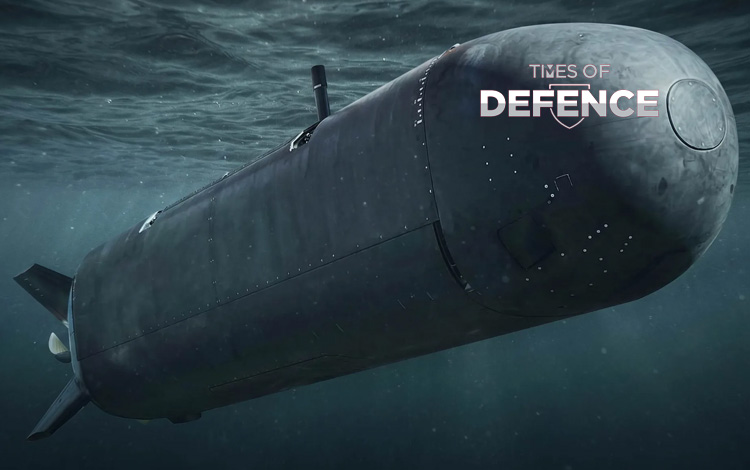
XV Excalibur is the Royal Navy’s first Extra-Large Uncrewed Underwater Vehicle (XLUUV).
The 12-meter-long vehicle was developed under Project Cetus by the UK Submarine Delivery Agency in partnership with Plymouth-based MSubs.
The Royal Navy describes Excalibur as an experimental platform rather than an operational combat system. It was specifically created to test autonomy, payloads and future concepts for mixed crewed and uncrewed undersea operations.
The vehicle has a displacement of approximately 19 tonnes and is about 2 meters in diameter.
Its large size gives the Royal Navy significantly more payload and endurance potential than conventional small autonomous underwater vehicles.
The Mk 48 Integration
The weapon used during the demonstration was the U.S. Mk 48 heavyweight torpedo.
The U.S. Navy describes the Mk 48 as a heavyweight acoustic-homing torpedo designed for both anti-submarine warfare (ASW) and anti-surface warfare (ASuW).
The latest Mk 48 Mod 7 incorporates digital guidance and control, advanced sonar and upgraded propulsion and software capabilities. The Mod 7 was developed jointly with Australia and reached initial operational capability in 2006.
Mk 48 Technical Profile
| Parameter | Mk 48 |
|---|---|
| Type | Heavyweight torpedo |
| Primary roles | ASW / ASuW |
| Guidance | Acoustic homing |
| Diameter | 21 in / 533 mm |
| Weight | 3,744 lb / ~1,698 kg |
| Warhead | 650 lb / ~295 kg high explosive |
| Propulsion | Liquid propellant |
| Latest major version | Mk 48 Mod 7 |
The U.S. Navy has not publicly disclosed the precise performance parameters of the torpedo used in the Excalibur demonstration, including the engagement range and speed configuration.
Three Interfaces Had to Work Together
The significance of the test lies partly in what had to happen before the torpedo could even be fired.
According to the U.S. Navy, the demonstration validated the mechanical, electrical and software integration of a U.S. kinetic weapon onto a British autonomous underwater platform.
That means the trial was not simply about putting a torpedo inside an underwater vehicle.
The two countries had to establish compatibility between:
UUV → weapon interface → power/data connections → software → launch sequence
The successful demonstration shows that an allied weapon can be integrated with an autonomous platform without developing an entirely new torpedo specifically for that vehicle.
That is an important principle for future distributed undersea warfare.
Why This Matters for AUKUS
AUKUS Pillar II is increasingly focused on technologies that can be developed and integrated rapidly between the three partner nations.
The Excalibur demonstration provides a practical example of that approach.
A British autonomous underwater vehicle successfully employed an American heavyweight torpedo, demonstrating a degree of cross-national weapon and platform interoperability.
The concept could eventually allow allied forces to deploy different payloads from a common family of autonomous underwater vehicles.
Potential future payload categories could include:
- Heavyweight torpedoes
- Intelligence, surveillance and reconnaissance sensors
- Mine warfare systems
- Electronic or acoustic payloads
- Communications equipment
- Other mission-specific systems
However, the Excalibur test itself only demonstrates the Mk 48 launch capability. It does not establish that all of these payloads are operationally integrated.
The Beginning of a Larger Programme
The U.S. Navy says the Excalibur test was conducted under Project Broadsword, approved by the Department of the Navy Rapid Capabilities Office in February 2026.
The project was executed in less than seven months through cooperation involving the U.S. Navy, Royal Navy, Defense Innovation Unit, Naval Undersea Warfare Center Keyport and industry partners.
The next phase is expected to move beyond the Excalibur demonstration.
The U.S. Navy says Project Cutlass will use the Anduril Dive-XL platform to continue work on advanced payload integration, command-and-control architectures and tactical employment concepts.
This points toward a broader AUKUS effort to develop autonomous underwater platforms capable of carrying increasingly sophisticated mission payloads.
From “Uncrewed Sensor” to “Uncrewed Weapon Carrier”
The strategic importance of the test is the transition it represents.
Many autonomous underwater vehicles have traditionally focused on missions such as:
Survey → Mine hunting → ISR → Oceanographic sensing
The Excalibur demonstration adds another possibility:
Detect → Track → Decide → Launch
An armed XLUUV could potentially operate for extended periods without exposing a crewed submarine to the same risks.
It could also operate in areas where persistent underwater presence is difficult to maintain using conventional submarines alone.
That does not mean Excalibur itself is now an operational combat submarine. The Royal Navy explicitly describes it as an experimental demonstrator intended to develop understanding of autonomous underwater operations and future mixed crewed-uncrewed forces.
A New Undersea Warfare Architecture
The longer-term significance could therefore lie less in the individual torpedo launch and more in the architecture behind it.
A future force could combine:
Crewed submarines + XLUUVs + autonomous sensors + heavyweight torpedoes + networked command and control
Such a force could distribute sensors and weapons across a much larger underwater battlespace.
The Excalibur test demonstrates one of the most difficult pieces of that architecture: making a heavyweight weapon designed for crewed submarines physically, electrically and digitally compatible with an autonomous underwater platform.
For AUKUS, that is a critical step toward a more modular and interoperable undersea force.
Bottom Line
The September 13 test did not demonstrate an operational armed autonomous submarine.
It demonstrated something more specific—and technically important:
A Royal Navy XLUUV successfully launched a U.S. Mk 48 heavyweight torpedo after the mechanical, electrical and software interfaces between the weapon and autonomous platform were integrated.
The next question is no longer whether an uncrewed underwater vehicle can launch a heavyweight torpedo.
The question is how quickly this capability can evolve from a proof of concept into a scalable operational system.