


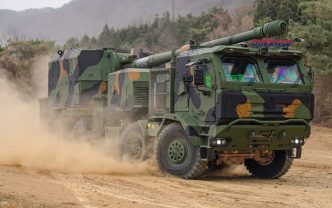
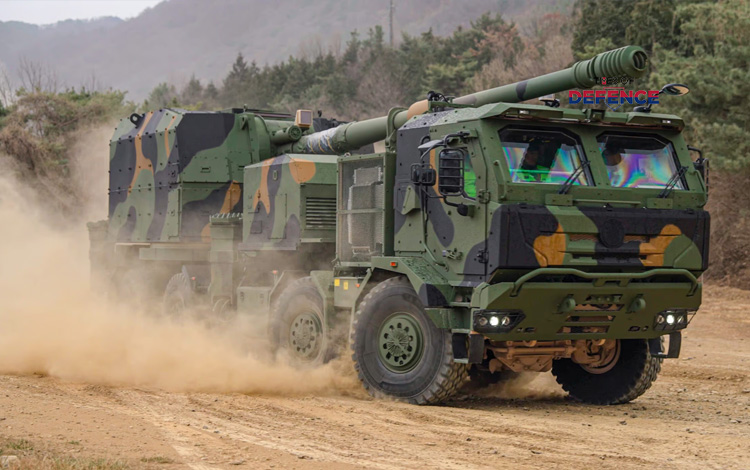
The U.S. Army has ordered three additional prototypes of South Korea’s Hanwha K9 Mobile Howitzer (K9MH)—locally designated by the service as the XM1776 Mobile Tactical Cannon (MTC)—under its Mobile Tactical Cannon programme, expanding prototype volume after an initial order of six units and prior contract options for up to 12 additional systems.
Unveiled formally under the XM1776 designation at the Association of the U.S. Army (AUSA) annual meeting in Washington in October 2026 following an initial Other Transaction Authority (OTA) award in August 2026, the wheeled 155 mm self-propelled howitzer pairs a 52-caliber artillery turret derived from the combat-proven K9 Thunder family with a high-mobility 8×8 wheeled truck chassis. Designed to modernize tactical indirect fires and evaluate wheeled mobility alternatives for formations transitioning away from towed howitzers such as the M777, the XM1776 programme is supported by Hanwha Defense USA’s industrial footprint and its Phase I integration, testing, and production facility in Opelika, Alabama.
TECHNICAL SPECIFICATIONS: K9MH / XM1776 MOBILE TACTICAL CANNON
1. Armament, Chassis Architecture & Crew Configuration
⚡ Prime Contractors & Industrial Footprint: Hanwha Aerospace and Hanwha Defense USA (HDUSA), with U.S. integration, testing, and production activities advancing at HDUSA’s Opelika, Alabama facility
⚡ Programme Order Trajectory: Builds on an initial six-prototype purchase and previously cited contract options for up to 12 additional units with the addition of three further K9MH/XM1776 prototypes under evaluation
⚡ Main Armament & Firepower: 155 mm / 52-caliber cannon system and automated turret architecture adapted from the K9 family, supporting modern fire-control integration, automated ammunition handling, and extended-range 155 mm munitions
⚡ Wheeled Chassis & Crew Reduction: Mounts a K9-derived turret on an 8×8 tactical truck chassis (evaluated across platforms including Tatra Force / 815-7, Mack, or Doosan architectures), operated by a reduced crew of roughly two to three soldiers 
2. Tactical Mobility, Shoot-and-Scoot & Sustainment Profile
💥 Operational & Strategic Mobility: High-speed road march capability and off-road cross-country mobility paired with lower per-kilometer road wear and reduced logistics demands compared to heavy tracked self-propelled howitzers
💥 Rapid Emplacement & Displacement: Engineered for responsive shoot-and-scoot artillery tactics to shorten reaction times and mitigate counter-battery radar and loitering-munition threats
💥 Proven Family Lineage: Leverages combat-tested K9 engineering—fielded across more than a dozen countries with over 2,500 K9-family howitzers globally—while adapting subassemblies to U.S. Army requirements and domestic U.S. assembly
TIMES OF DEFENCE ASSESSMENT
The U.S. Army’s order for three additional K9MH (XM1776) prototypes under the Mobile Tactical Cannon programme highlights three critical shifts in U.S. artillery modernization, wheeled self-propelled fires, and allied defense industrial integration:
1. Expanding Prototype Fleet Size Ahead of Operational Evaluation: Ordering three additional units beyond the initial six prototypes gives the U.S. Army broader test availability to stress-test mobility, fire control, and reliability across training ranges and operational concepts.
2. Balancing Road Speed, Crew Efficiency, and Survivability in Tactical Fires: Pairing a 155 mm / 52-caliber automated howitzer with an 8×8 wheeled chassis and a smaller crew addresses road-march speed, logistics footprint, and rapid displacement requirements in contested environments.
3. Deepening Allied Industrial Localization on U.S. Soil: Combining South Korean artillery engineering with U.S. integration and production in Opelika, Alabama, illustrates how foreign-origin designs are being localized to expand U.S. manufacturing capacity and speed delivery schedules.