

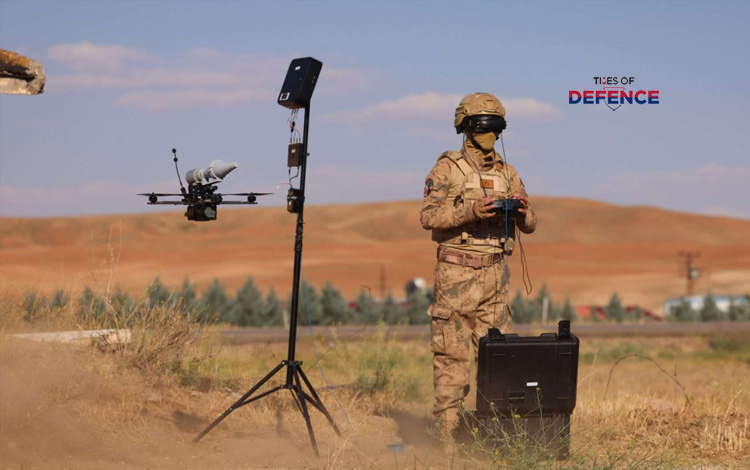
Turkish defense engineering firm STM (Savunma Teknolojileri Mühendislik ve Ticaret A.Ş.) announced on November 23, 2026, that its ALKAN FPV (First-Person View) kamikaze drone system—previously unveiled under the KARGU FPV designation—has completed formal acceptance testing and entered service with Turkish security forces following initial deliveries.
Expanding STM’s tactical unmanned aerial vehicle portfolio beyond platforms such as KARGU, BOYGA, TOGAN, and ALPAGU (systems already fielded domestically and exported to more than 15 countries across four continents), ALKAN FPV marks the company’s entry into operational FPV strike systems. Incorporating image-processing-assisted autonomous terminal dive after operator target designation, dual RF and fiber-optic command-and-control resilience against electronic warfare, a MIL-STD-331-compliant military safety fuze with proximity detonation options, and full munitions commonality with the KARGU loitering munition, ALKAN FPV is engineered for precision engagement of stationary and moving targets in contested, GPS/RF-denied, and asymmetric environments.
TECHNICAL SPECIFICATIONS: STM ALKAN FPV KAMIKAZE / RECONNAISSANCE SYSTEM
1. Flight Envelope, Endurance & Electronic-Warfare Resilience
⚡ Prime Developer & Lineage: STM (Ankara, Türkiye); evolved from the earlier KARGU FPV concept into STM’s dedicated FPV strike platform alongside combat-proven KARGU, BOYGA, TOGAN, and ALPAGU systems
⚡ Speed, Range & Altitude Envelope: Maximum speed up to 140 km/h (with prior KARGU FPV configuration data citing up to 160 km/h), operational mission range of 10 km, nominal operating altitude of 500 m, and maximum service ceiling of 5,500 m above sea level
⚡ Mission Endurance Configurations: Over 20 minutes of endurance in kamikaze strike configuration and up to 44 minutes in surveillance configuration (operating without warhead or fuze)
⚡ RF & Fiber-Optic Control Links: Operates via real-time RF video/control links as well as fiber-optic cable tether, enabling interference-free flight and targeting without reliance on GPS or RF emissions in heavy electronic-jamming environments 
2. Warhead Commonality, Fuze Safety & Autonomous Terminal Guidance
💥 Shared KARGU Warhead & Fuze Architecture: Directly compatible without modification with anti-personnel and armor-piercing warheads and STM military-standard fuzes used on KARGU, allowing security forces to employ existing KARGU munitions in FPV missions
💥 MIL-STD-331 Fuze & Proximity Detonation: Features an STM-engineered safety fuze compliant with MIL-STD-331 military safety standards for transport and handling, paired with a proximity sensor supporting automatic detonation at an adjustable standoff distance
💥 Computer-Vision Terminal Dive: Integrates STM image-processing and autonomy algorithms so once an operator designates a target, the drone can execute an autonomous terminal dive to reduce pilot workload and improve hit accuracy against static or moving targets
TIMES OF DEFENCE ASSESSMENT
The entry of STM ALKAN FPV into service with Turkish security forces highlights three critical shifts in tactical FPV drone doctrine, electronic-warfare survivability, and munition logistics commonality:
1. Transitioning FPV Drones From Improvised Craft to Military-Standard Systems: Unlike ad-hoc commercial quadcopters, ALKAN FPV pairs FPV agility with MIL-STD-331 fuze safety, day/night optics, low radar cross-section, and image-assisted terminal guidance to meet formal military acceptance standards.
2. Sustaining Precision Strike in Contested Electromagnetic Environments: Adding fiber-optic cable control alongside RF links gives operators a practical way to fly and guide strike drones through dense jamming or GPS/RF-denied corridors where conventional wireless links fail.
3. Maximizing Stockpile Flexibility Through KARGU Munitions Commonality: Sharing anti-personnel and armor-piercing warheads and fuzes with KARGU without modification lets forces leverage existing inventory and streamline logistics across rotary-wing loitering munitions and FPV platforms.