


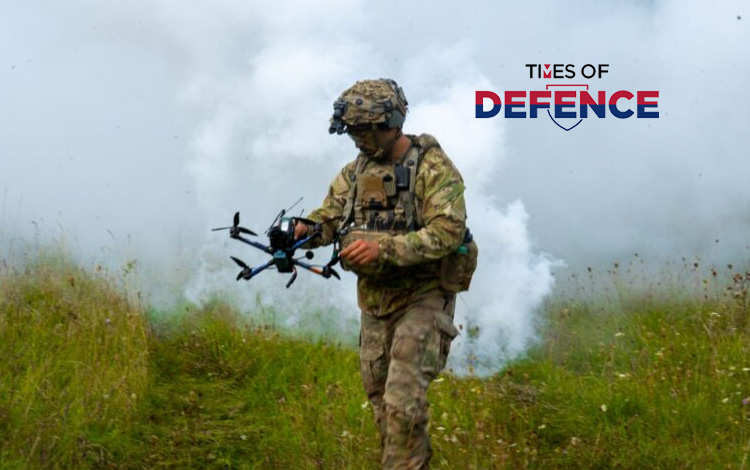
WASHINGTON — The US Army has successfully amassed sufficient small unmanned aerial systems (sUAS) to supply every platoon, but is now redirecting its efforts toward training squad-level operators to pilot these assets in heavily contested electromagnetic environments.
Col. Gregory Merkl, Director of the Army’s Drone Dominance program, revealed that while the Defense Department’s expedited procurement initiatives have successfully scaled drone inventory across the force, significant training gaps remain at the tactical level. The current operational priority centers on preparing operators to navigate spectrum jamming, signal disruption, and electronic warfare (EW) countermeasures deployed by peer adversaries.
PROCUREMENT MILESTONES & SQUAD-LEVEL FIELDING
The fielding push aligns with the Pentagon mandate issued under the Drone Dominance program, which directed that every Army squad receive small, one-way attack (OWA) drones by the end of fiscal year 2026.
* Gauntlet 1 Deliveries: Defense procurement metrics show Army units have already accepted 12,080 drones out of a total 24,320 small drones contracted across 11 suppliers during the first procurement round.
* Gauntlet 2 Scaling: Nine defense firms were recently selected as winners from Gauntlet 2, which specialized in long-range strike capabilities and tactical assault missions in confined environments. The Department of Defense expects to order up to 60,000 platforms from this secondary phase.
* Tactical Integration: While drones are currently fielded across every platoon, the Army is working to certify qualified operators down to the individual squad level before the end of the fiscal year.
TACTICAL SPECTRUM NAVIGATION & LESSONS FROM SABER JUNCTION
To address the electromagnetic warfare challenge, the Army headquarters is establishing interagency working groups alongside partners such as the Federal Aviation Administration (FAA) to define protocols for safe and effective spectrum utilization during high-jamming combat operations.
Lessons learned during recent multinational exercises—including Saber Junction in Germany, involving the 504th Parachute Infantry Regiment alongside Ukrainian and NATO forces—highlighted that soldiers must learn to navigate the electromagnetic spectrum with the same fluidity and tactical discipline as physical ground terrain.
TECHNICAL OVERVIEW: US ARMY SMALL UAS OPERATIONAL ARCHITECTURE
* Target Deployment Scale: Squad-level fielding across infantry and armored formations
* Mission Profiles: Short-range reconnaissance, tactical indoor/confined-space assault, and one-way attack (OWA) strikes
* Primary Operational Challenge: Navigation, control links, and image transmission in severe GPS-denied and jammed environments (Contested EMS)
* Spectrum Interoperability: Integration of adaptive frequency-hopping, directional antennas, and low-probability-of-intercept (LPI) control links
* Interagency & NATO Coordination: Operational airspace and spectrum management alignment with the FAA and allied electronic warfare units
