


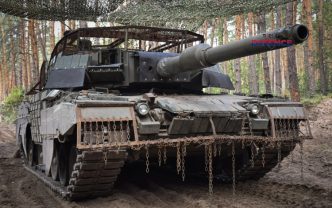
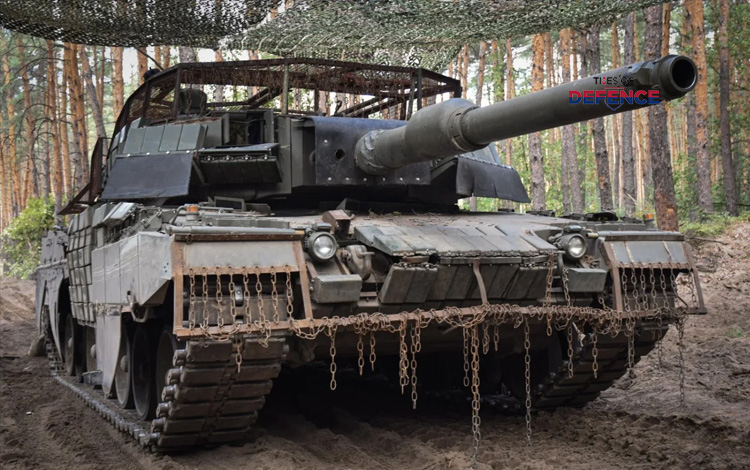
A Ukrainian brigade commander participating in the 3rd Army Corps’ recent counteroffensive—codenamed **Operation Vivaldi**—confirmed that a German-designed **Leopard** main battle tank under his command absorbed **45 first-person-view (FPV) kamikaze drone strikes** and remains fully operational.
Shared via military analyst Rob Lee (Senior Fellow at the Foreign Policy Research Institute), the account challenges widespread assumptions that heavy armored vehicles have been rendered obsolete by low-cost unmanned aerial threats. Executed near Lyman in northern Donetsk Oblast between May and October 19, 2026, Operation Vivaldi saw Ukrainian forces retake between 176 and 277 square kilometers of territory. Complementary battlefield reports from Ukrainian defense veteran Dmytro Putyata (Kriegsforscher) noted a parallel survivability event on the opposing side—where a Russian T-62M obr. 2022 absorbed 52 FPV hits over several hours without suffering a catastrophic hull fire due to the absence of onboard propellant charges.
TECHNICAL SPECIFICATIONS: LEOPARD 2A4 SURVIVABILITY & COUNTER-DRONE ARCHITECTURE
Base Armor, Propulsion & Firepower Architecture
⚡ Prime Developer: Krauss-Maffei Wegmann / KNDS Deutschland (Germany)
⚡ Base Armor Composition: Third-generation spaced multi-layer composite armor (combining high-hardness steel, tungsten, ceramics, and non-metallic filler) engineered to defeat shaped-charge High-Explosive Anti-Tank (HEAT) jets
⚡ Powerplant & Mobility: MTU MB 873 Ka-501 12-cylinder twin-turbocharged multi-fuel diesel engine generating 1,500 hp (1,100 kW) paired with a Renk HSWL 354 hydro-mechanical transmission; combat weight of ~55–62 metric tons (depending on add-on kits) enabling rapid tactical repositioning
⚡ Primary Armament: Rheinmetall 120mm L/44 smoothbore cannon firing kinetic APFSDS and multi-purpose HEAT-MP rounds 
Compartmentalized Stowage & Battlefield Counter-Drone Retrofits
💥 Blow-Out Panel Ammunition Stowage: Unlike legacy Soviet designs with exposed carousel autoloaders inside the crew compartment, the Leopard 2A4 isolates 15 ready-use 120mm rounds in an armored, isolated rear turret bustle equipped with top-mounted blow-out panels (with 27 additional rounds housed in a protected forward hull magazine), drastically reducing catastrophic cook-off risks
💥 Field-Applied Counter-FPV Upgrades: Ukrainian units routinely reinforce Leopard 2A4 and Leopard 1A5 hulls and turrets with Kontakt-1 Explosive Reactive Armor (ERA) bricks, anti-drone slat/cage screens, rubber anti-spall skirts, and multi-band electronic warfare (EW) roof jammers to detonate or disrupt single-stage RPG-7/PG-7V shaped-charge FPV warheads prior to hull contact
TIMES OF DEFENCE ASSESSMENT
The survival of a Leopard main battle tank after 45 FPV strikes—alongside similar extreme-durability accounts—underscores three critical realities of modern armored warfare:
1. **Correcting Selection Bias in Drone Warfare Footage**: Social media feeds disproportionately highlight catastrophic ammo cook-offs, creating the illusion that single FPV drones effortlessly destroy heavy armor. In practice, standard FPVs carry lightweight shaped-charge warheads that frequently fail to penetrate multi-layer composite armor, ERA blocks, and anti-drone cages without repeated precision hits on vulnerable hatches or engine decks.
2. **Validating Compartmentalized Survivability Design**: Both the Leopard’s isolated turret bustle with blow-out panels and the T-62M example demonstrate that catastrophic tank losses stem primarily from internal ammunition detonation rather than kinetic hull failure. Reducing exposed onboard ammunition directly multiplies crew and vehicle survival.
3. **Evolving Toward Integrated Tank-Infantry-EW Formations**: Rather than signaling the death of the main battle tank, frontline commanders emphasize that heavy armor remains indispensable for breakthrough operations—provided vehicles evolve with unmanned turrets, reduced internal ammo loads, organic EW, and tight infantry-drone coordination.

