


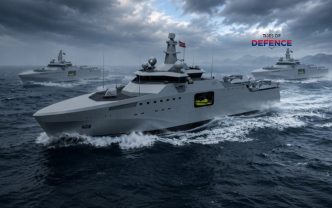
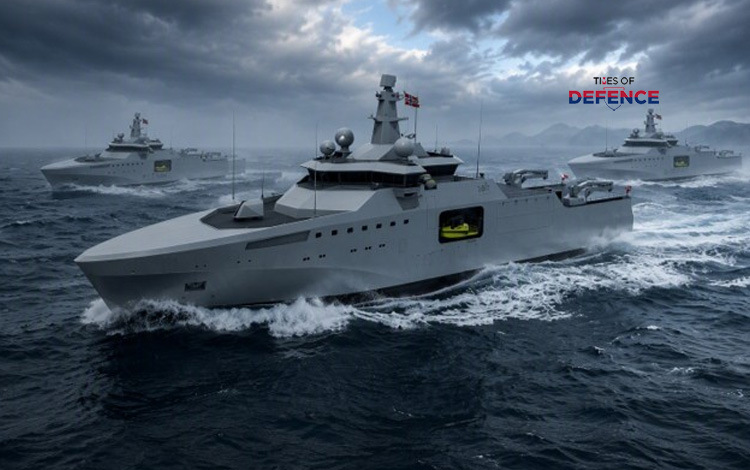
UK Defence Secretary Wes Streeting and Norwegian Defence Minister Tore O. Sandvik formally confirmed at the Atlantic Future Forum in Oslo that the Royal Navy will acquire three Offshore Support Vessels (OSVs) to operate as dedicated motherships for uncrewed mine-hunting systems.
Executed through the government-to-government Maritime Capability Partnership Framework (MCPF) and backed by an additional £90 million ($119 million) allocation in the UK Defence Investment Plan, the agreement brings Britain into Norway’s P1118 Standardised Vessel Programme. The contract includes an option for three additional hulls, with the first mothership scheduled for Royal Navy delivery in 2031. The acquisition forms a reciprocal pillar alongside Norway’s landmark £10 billion procurement of British Type 26 frigates signed in December 2025.
TECHNICAL SPECIFICATIONS: P1118 OFFSHORE SUPPORT VESSEL & HYBRID MCM ARCHITECTURE
Programme Structure, Procurement & Delivery Schedule
⚡ Bilateral Framework: Government-to-Government Maritime Capability Partnership Framework (MCPF), rooted in the UK-Norway Lunna House strategic agreement
⚡ Base Design Architecture: Norwegian P1118 Standardised Vessel Programme (Offshore Support Vessel configuration)
⚡ Acquisition Volume & Funding:
• Firm Order: 3 × Mine-Hunting Motherships (OSVs), with contractual options for 3 additional vessels
• Dedicated Budget Allocation: Additional £90 million (~$119 million / €107 million) earmarked in the UK Defence Investment Plan
⚡ Operational Timeline: First vessel slated to enter Royal Navy service in 2031 
Operational Role, Uncrewed Integration & Mission Envelope
💥 Hybrid Navy Concept: Serves as a stand-off command, launch, and recovery platform for autonomous underwater vehicles (AUVs), uncrewed surface vessels (USVs), and remotely operated mine-disposal systems—keeping human crews outside active minefields
💥 Modular Multi-Role Flexibility: Built around Norway’s standardised hull philosophy, enabling rapid reconfiguration for mine countermeasures (MCM), seabed infrastructure monitoring, and anti-submarine warfare (ASW) support across NATO’s northern flank
💥 Global Expeditionary Reach: Engineered for sustained blue-water and high-latitude operations—from the North Atlantic and High North to strategic maritime chokepoints such as the Strait of Hormuz
TIMES OF DEFENCE ASSESSMENT
The UK’s entry into Norway’s P1118 vessel programme highlights three core strategic and industrial shifts in European naval modernization:
1. **Transitioning from Crewed Minehunters to Stand-Off Hybrid Fleets**: By replacing legacy crewed mine countermeasures vessels with modular OSV motherships deploying autonomous systems, the Royal Navy removes sailors from direct blast zones while expanding wide-area seabed surveillance under its Hybrid Navy doctrine.
2. **Cementing Reciprocal UK-Norway Industrial Interdependence**: Paired with Norway’s £10 billion Type 26 frigate order, the P1118 acquisition establishes a two-way defense-industrial corridor that standardizes hulls, spare parts, and operational procedures between two primary North Atlantic allies.
3. **Securing NATO’s Northern Flank and Critical Maritime Chokepoints**: Operating common, ice-capable, globally deployable support platforms enhances seamless bilateral interoperability for countering Russian undersea activity in the High North while safeguarding freedom of navigation across contested global trade arteries.

