


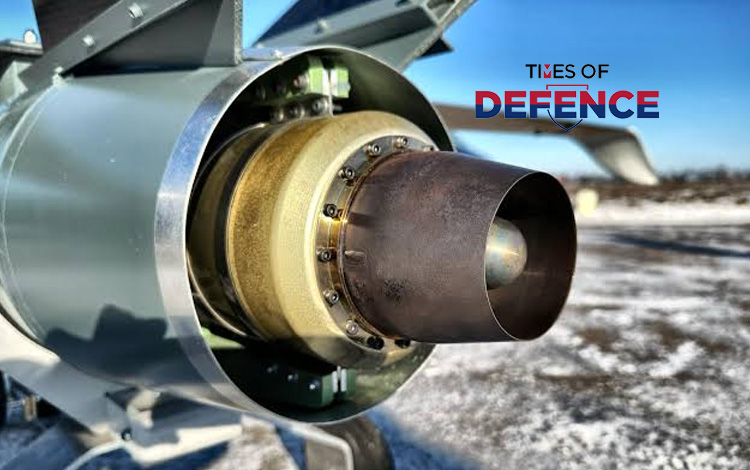
LONDON — The United Kingdom is developing a new family of digitally manufactured turbojet engines that could significantly shorten the time and cost required to produce propulsion systems for unmanned aircraft.
The programme is being led by the UK Ministry of Defence’s Strategic Capabilities Office in partnership with British technology company Alloyed. The engines are being designed, manufactured and tested domestically, with the programme covering thrust classes from 30 newtons to 2,000 newtons for applications ranging from small drones to larger aircraft.
The most significant achievement is the development of a larger 1,100 N-class turbojet from initial concept to flight-ready status in less than seven months. A smaller 300 N-class engine has already completed flight testing and entered serial production in the UK.
From Digital Design to Flight in Months
Traditional aircraft-engine development can require years of engineering, testing, qualification and industrial preparation. The UK programme is attempting to compress that cycle through digital engineering, additive manufacturing and modular engine architecture.
Alloyed uses digitally designed components and advanced metal manufacturing techniques to produce complex engine parts. This approach reduces the need for conventional tooling and allows designs to be modified and manufactured much more rapidly.
The UK Ministry of Defence says the programme has established a digital design and modelling process capable of taking new propulsion concepts into production in months rather than years.
That development speed is arguably as important as the engine itself.
A Family from 30N to 2,000N
The programme is not centered on a single engine.
The family currently spans approximately 30–2,000 N of thrust, equivalent to roughly 6.7–450 lbf. This provides a common technological base for different classes of unmanned aircraft and other platforms.
Two engines have already reached particularly important milestones:
| Engine | Thrust | Status |
|---|---|---|
| A300-class | ~300 N / 67 lbf | Flight tested; serial production |
| A1100-class | ~1,100 N / 247 lbf | Flight-ready in <7 months |
| Family | 30–2,000 N | Development range |
The Ministry of Defence has not announced that every engine size within the 30–2,000 N range has reached flight testing or production.
The A300: A Small Engine With Strategic Importance
The 300 N-class engine is particularly important because it has already moved beyond development into UK serial production.
Alloyed’s approach combines its expertise in advanced metals with additive manufacturing to produce complex components without relying on lengthy conventional tooling processes.
Publicly available Alloyed material has described the A300 as a compact turbojet intended for applications requiring lightweight propulsion. Earlier published figures for the A300 include approximately 300 N of peak thrust and a dry mass of around 3 kg, although configuration-specific figures should be treated separately from the broader MOD programme specifications.
The significance is therefore not simply the size of the engine. It is the ability to design and manufacture a new propulsion system domestically at relatively small scale and then transition it into production rapidly.
Why Jet Engines Matter for Drones
Propeller-driven UAVs remain extremely useful for surveillance, loitering and many strike missions. However, jet propulsion can provide substantially higher speed and thrust-to-size performance.
That creates a different challenge for air-defence networks.
A faster unmanned aircraft can:
- reduce the time available for detection and engagement;
- cross defended areas more rapidly;
- complicate interceptor timing;
- support higher-speed reconnaissance or strike missions;
- potentially carry more fuel or payload within a compact airframe.
Recent developments in Ukraine have reinforced this trend. Russia has increasingly employed jet-powered versions of the Geran/Shahed family, while Ukraine has been pursuing new interceptor concepts to deal with faster aerial threats. The UK programme’s announcement comes against this wider shift toward jet-powered unmanned systems.
However, jet propulsion does not automatically make a drone difficult to intercept. Detectability, radar cross-section, infrared signature, altitude, flight profile, electronic warfare and the capabilities of the defending sensor/interceptor network remain decisive factors.
The Economics Could Be More Important Than Speed
The most interesting aspect of the British programme is arguably its industrial model.
Modern warfare has demonstrated that relatively inexpensive unmanned systems can be produced in very large quantities. But propulsion can become a bottleneck when an aircraft requires a sophisticated engine manufactured using traditional aerospace processes.
The Alloyed-MOD approach attempts to address that bottleneck.
If propulsion systems can be digitally redesigned and manufactured using additive processes without extensive tooling changes, manufacturers could potentially produce different engines for different airframes without rebuilding an entire conventional production ecosystem.
Alloyed’s CEO Michael Holmes has said the company’s longer-term objective is to tailor engines to specific missions much faster, with a goal of making them up to 30% cheaper and up to 30% more power-efficient than existing market alternatives. Those figures are company targets, not independently verified programme results.
A Sovereign UK Propulsion Capability
The programme also has a strategic industrial dimension.
The UK Ministry of Defence says the initiative is intended to establish a sovereign propulsion capability, reducing dependence on overseas suppliers for critical engine technology.
More than 60 engineering and advanced-manufacturing jobs have already been created, with another 45 positions expected over the following year as production expands. The programme also involves more than 40 UK suppliers, most of them small and medium-sized enterprises.
The British government is simultaneously pursuing low-cost air-defence and autonomous-system programmes under its broader Low-Cost Effectors & Autonomous Platforms (LEAP) initiative, reflecting a wider push toward systems that can be manufactured rapidly and in quantity.
Additive Manufacturing Changes the Production Equation
The use of additive manufacturing is particularly significant for small turbine engines.
Instead of manufacturing every component through multiple machining, casting and tooling operations, complex metal components can be produced directly from digital designs.
That can provide several advantages:
Rapid iteration:
A component can be redesigned digitally and manufactured without producing an entirely new set of conventional tooling.
Reduced tooling requirements:
Small production runs become more economically viable.
Complex geometries:
Additive manufacturing can enable internal structures and geometries that are difficult to produce conventionally.
Distributed manufacturing potential:
Digital production instructions can potentially allow compatible facilities to manufacture components closer to where they are needed.
Alloyed has also discussed a future franchise-style manufacturing model in which digital production information could allow allied manufacturers to produce engines locally. That remains an ambition rather than an established operational capability.
From Drones to Interceptors
The technology is not necessarily limited to offensive drones.
A 300 N or 1,100 N-class turbojet could potentially support a range of small autonomous aircraft, including reconnaissance systems, target drones and interceptor concepts.
This is particularly relevant because the UK is already funding the development of low-cost air-defence effectors intended to counter mass drone attacks.
The Ministry of Defence awarded £3.16 million in July 2026 to three companies developing low-cost drone interceptors under the LCADE programme, part of the multinational LEAP initiative involving the UK, France, Germany, Italy and Poland.
A future ecosystem could therefore involve both sides of the problem:
Low-cost drones and interceptors + low-cost, rapidly produced propulsion.
That could make engine production itself an important part of the mass-production equation.
Technical Snapshot
| Characteristic | UK MOD / Alloyed Programme |
|---|---|
| Developer | UK Ministry of Defence + Alloyed |
| MOD lead | Strategic Capabilities Office |
| Technology | Digitally designed turbojet engines |
| Manufacturing | UK-based additive/advanced manufacturing |
| Thrust family | ~30–2,000 N |
| A300 class | ~300 N |
| A1100 class | ~1,100 N |
| A300 status | Flight tested; serial production |
| A1100 development | Concept to flight-ready in <7 months |
| Intended applications | Small drones to larger aircraft |
| Architecture | Modular |
| Development model | Digital engineering + rapid manufacturing |
| UK suppliers | 40+ |
| Jobs created | 60+ |
| Additional jobs planned | 45 |
| Sovereign production | Yes |
The Real Innovation Is the Production Model
The UK programme should not be viewed simply as “Britain has built a new drone engine.”
The more important development is the attempt to create a rapid digital propulsion pipeline.
Instead of treating an engine as a major, long-term aerospace programme, the UK is experimenting with a model in which propulsion can be digitally designed, rapidly manufactured, tested and modified according to the requirements of a particular unmanned platform.
That could become increasingly valuable in a battlefield where aircraft are being produced in large numbers and where technological cycles are becoming shorter.
The 300 N engine has already entered serial production, while the 1,100 N design demonstrates that the same development philosophy can be applied to a larger propulsion class.
The next test is scale. Developing an engine in seven months is impressive; demonstrating that it can be produced cheaply, reliably and in large quantities is the much harder industrial challenge.
If the UK succeeds, the propulsion system itself could become one of the key enablers of the next generation of mass-produced unmanned aircraft.
