

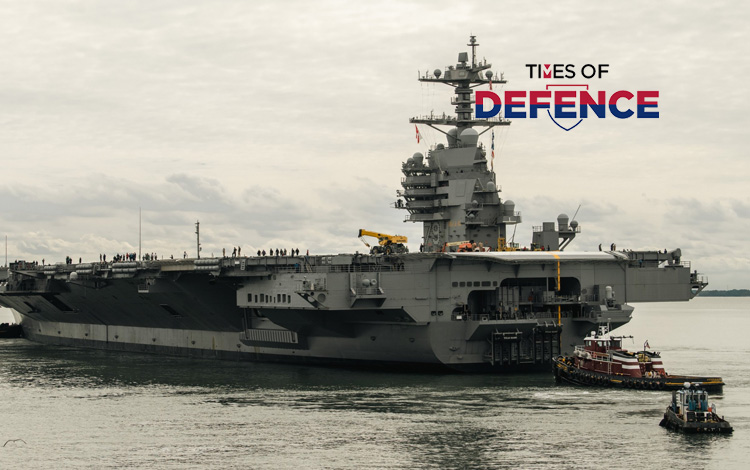
NORFOLK, Va. — The U.S. Navy has taken preliminary acceptance of its second Gerald R. Ford-class nuclear-powered aircraft carrier, the future USS John F. Kennedy (CVN 79), from Huntington Ingalls Industries’ Newport News Shipbuilding (HII-NNS) division on September 29. The milestone follows the successful completion of initial sea acceptance trials in August and marks a major transition toward formal fleet integration.
The carrier departed Newport News Shipbuilding and transit-sailed to its homeport at Naval Station Norfolk. Under the preliminary acceptance framework, Navy personnel and ship crew will conduct at-sea training, crew certification, and operational proficiency evolutions while shipbuilder engineers complete final integration testing on remaining onboard systems—including the final four Advanced Weapons Elevators (AWEs)—ahead of full operational delivery scheduled for Spring 2027. Currently assessed at 99 percent complete, CVN 79 incorporates critical technological enhancements over lead-ship USS Gerald R. Ford (CVN 78), including the integration of the AN/SPY-6(V)3 Enterprise Air Surveillance Radar (EASR) and direct operational compatibility with 5th-generation F-35C Lightning II stealth fighters.
TECHNICAL SPECIFICATIONS: USS JOHN F. KENNEDY (CVN 79) GERALD R. FORD-CLASS CARRIER
* System Classification: Nuclear-Powered Aircraft Carrier (CVN) / Capital Surface Combatant
* Prime Contractor & Shipbuilder: HII Newport News Shipbuilding (Newport News, Virginia)
* Primary Customer & Operator: United States Navy (U.S. Fleet Forces Command / Naval Air Forces)
* Program Status: Preliminary acceptance achieved; final systems testing underway prior to Spring 2027 formal delivery
* Hull & Dimensional Parameters:
* Overall Length: 337 meters (1,106 feet)
* Flight Deck Width: 78 meters (256 feet) | Waterline Beam: 41 meters (134 feet)
* Full Load Displacement: ~100,000 long tons
* Powerplant & Energy Architecture:
* Nuclear Propulsion: 2x Bechtel A1B pressurized water nuclear reactors
* Shaft Configuration: 4x propulsion shafts driving fixed-pitch propellers
* Electrical Generation: ~300 MW total power capability (threefold increase over legacy Nimitz-class architecture)
* Operational Range & Endurance: Unlimited (25-year reactor core service life between refueling overhauls)
* Flight Performance Envelope:
* Maximum Speed: >30 knots (56+ km/h / 35+ mph)
* Ship’s Complement: ~4,539 personnel (ship’s company + air wing staff)
* Aviation Infrastructure & Launch Capabilities:
* Launch System: Electromagnetic Aircraft Launch System (EMALS) across 4 bow/waist catapult positions
* Recovery System: Advanced Arresting Gear (AAG) 3-wire recovery configuration
* Ordnance Transport: 11x electro-mechanically driven Advanced Weapons Elevators (AWEs)
* Sortie Generation Rate (SGR): Designed for 160 sustained sorties/day (up to 220 surge sorties/day)
* Radar & Sensor Suite:
* Primary Radar: Raytheon AN/SPY-6(V)3 Enterprise Air Surveillance Radar (EASR) 3-faced active electronically scanned array (AESA)
* Combat Direction System: Ship Self-Defense System (SSDS) Mark 2 integrated with Cooperative Engagement Capability (CEC)
* Carrier Air Wing (CVW) Capacity (75+ Aircraft): F-35C Lightning II, F/A-18E/F Block III Super Hornet, EA-18G Growler, E-2D Advanced Hawkeye, MQ-25A Stingray uncrewed tanker, and MH-60R/S Seahawk helicopters
* Self-Defense Armament Suite: RIM-162 Evolved SeaSparrow Missile (ESSM) launchers, RIM-116 Rolling Airframe Missile (RAM) launchers, and 20 mm Phalanx Close-In Weapon Systems (CIWS)