


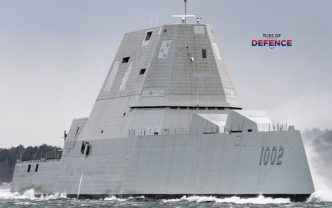
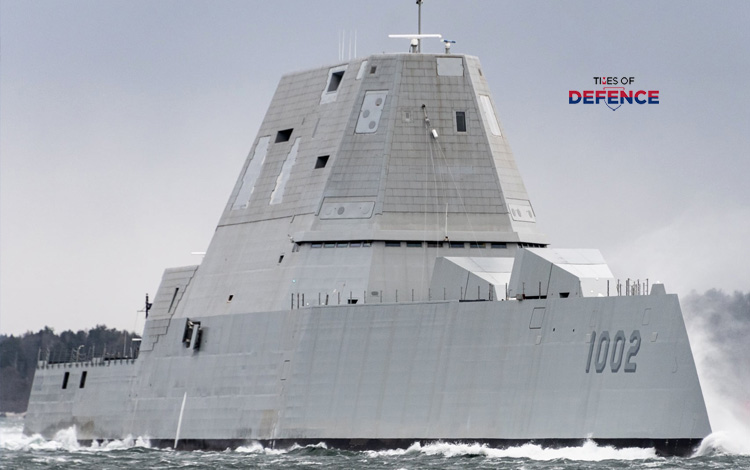
HII’s Ingalls Shipbuilding division has been awarded a $99 million contract modification by the U.S. Navy to conduct comprehensive combat system testing and sea trials for the third and final Zumwalt-class stealth guided-missile destroyer, the future USS Lyndon B. Johnson (DDG 1002).
The funding supports the final phase of the Navy’s multi-stage delivery strategy at Ingalls Shipbuilding in Pascagoula, Mississippi, where the warship arrived in January 2022 following initial construction at General Dynamics Bath Iron Works. Beyond initial combat system activation, integration, and sea trial validation, the vessel is undergoing extensive modernization to remove legacy 155 mm Advanced Gun Systems (AGS) and integrate four large-diameter 87-inch Multiple Launch Tubes. This structural overhaul enables the platform to launch Intermediate-Range Conventional Prompt Strike (CPS) hypersonic glide vehicles. Following sister ship USS Zumwalt (DDG 1000), DDG 1002 becomes the Navy’s second stealth destroyer converted into a long-range strategic hypersonic strike platform.
TECHNICAL SPECIFICATIONS: USS LYNDON B. JOHNSON (DDG 1002) & CPS HYPERSONIC INTEGRATION
Shipbuilder, Modernization Yard & Contract Scope
⚡ Primary Shipbuilder: General Dynamics Bath Iron Works (Bath, ME)
⚡ Combat System / CPS Retrofit Yard: HII Ingalls Shipbuilding Division (Pascagoula, MS)
⚡ Award Value: $99 Million Contract Modification for Sea Trials & System Qualification Testing 
Platform Class & Mission Envelope
⚡ Class & Type: Zumwalt-class Multi-Mission Stealth Guided Missile Destroyer (DDG)
⚡ Operational Roles: Deep Standoff Strategic Strike, Surface Warfare, Power Projection, Air & Missile Defense, and C2 Operations
Hull Architecture & Physical Parameters
💥 Displacement: ~15,900 Long Tons (Full Load)
💥 Dimensions: Length: 190 m (610 ft) | Beam: 24.6 m (80.7 ft) | Draft: 8.4 m (27.6 ft)
💥 Stealth Profile: Wave-piercing tumblehome composite hull geometry with integrated composite deckhouse, engineered to reduce Radar Cross-Section (RCS) and acoustic signatures
Propulsion, Electrical & Kinematic Performance
🚀 Power Plant: Integrated Power System (IPS) generating ~78 MW of total electrical capacity
🚀 Turbines & Generators: 2× Rolls-Royce MT30 gas turbines driving 2× RR4500 gas turbine generator sets
🚀 Propulsion Motors: 2× Advanced Induction Motors (AIM) delivering dual-shaft power
🚀 Speed Envelope: Maximum speed exceeding 30 knots (56 km/h)
Armament Upgrade & Conventional Prompt Strike (CPS) Suite
💥 Primary Hypersonic Strike Suite: 4× 87-inch Multiple Launch Tubes replacing twin 155 mm AGS mounts, housing up to 12 Common-Hypersonic Glide Body (C-HGB) CPS missiles
💥 CPS Performance: Intermediate-range hypersonic boost-glide weapon with speeds exceeding Mach 5 and effective strike ranges >2,775 km (>1,725 miles)
💥 Vertical Launch Cells: 20× MK 57 Peripheral Vertical Launch System (PVLS) modules totaling 80 cells (housing RIM-162 ESSM Block II, Tactical Tomahawk Cruise Missiles, and SM-2/SM-6 variants)
💥 Close-In Defense: 2× 30 mm Mk 46 Mod 2 Naval Gun Systems
TIMES OF DEFENCE ASSESSMENT
The $99 million award to HII Ingalls for sea trials on the future USS Lyndon B. Johnson marks a vital milestone in the U.S. Navy’s strategic effort to transition the Zumwalt class into hypersonic precision-strike warships. Originally designed around the cancelled 155 mm Advanced Gun System (AGS) for naval gunfire support, the Zumwalt class faced operational redundancy after long-range projectile procurement was abandoned due to unsustainable unit costs. By replacing non-functional gun mounts with four 87-inch launch tubes for Conventional Prompt Strike (CPS) hypersonic missiles, the Navy restores these stealth destroyers into tier-one power projection assets.
From a technical perspective, the Zumwalt airframe remains the ideal surface platform for early hypersonic integration. The ship’s Integrated Power System (IPS) generates up to 78 MW of electricity—sufficient power to support intense launch sequences, advanced sensor integration, and potential future energy weapons. Combining a wave-piercing tumblehome hull (which reduces radar signatures) with Mach 5+ CPS missiles capable of striking high-value targets over 2,775 km away establishes a potent, highly survivable standoff capability tailored for deep A2/AD penetration across the Indo-Pacific theatre.

