



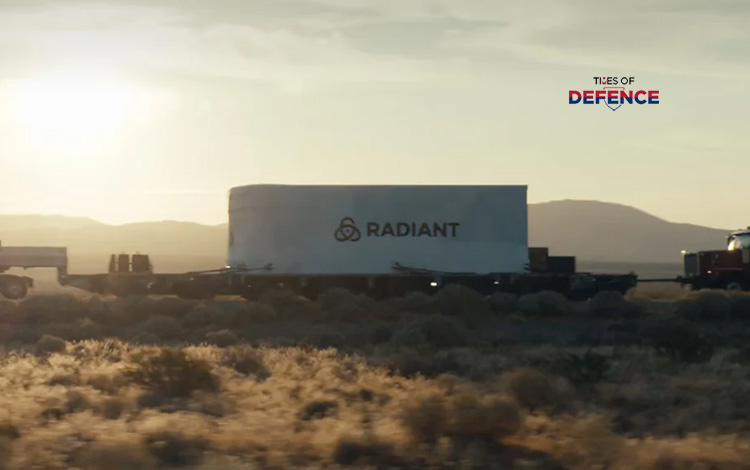
The Department of the Navy has selected commercial clean-energy firm Radiant Industries to design, deliver, and operationalize a 1-megawatt (MW) “Kaleidos” nuclear microreactor prototype at Naval Weapons Station (NWS) Crane in Indiana.
Initiated under the Department of War’s interagency Janus Program—led by the U.S. Army—the contract establishes the U.S. Navy’s first shore-based advanced microreactor installation. The program aims to achieve full power generation and operational readiness at NWS Crane no later than September 2028. Functioning as an off-grid, zero-emission microgrid base-load power supply, the transportable reactor is engineered to protect critical defense research infrastructure—including Naval Surface Warfare Center (NSWC) Crane Division’s microelectronics, high-voltage systems, and strategic weapons testing facilities—from regional electrical grid disruption. Designed for rapid transport via land, air, or sea, the waterless microreactor relies on TRISO fuel and passive helium cooling, offering up to 5 years of uninterrupted 1 MW electrical output before refueling.
TECHNICAL SPECIFICATIONS: RADIANT KALEIDOS PORTABLE NUCLEAR MICROREACTOR (JANUS PROGRAM)
Developer, Manufacturer & Managing Agencies
⚡ Lead Developer & Manufacturer: Radiant Industries, Inc. (El Segundo, California, USA)
⚡ Procurement & Interagency Framework: U.S. Department of the Navy & U.S. Department of the Army (Janus Program)
⚡ Regulatory & Technical Partners: Naval Nuclear Propulsion Program (Naval Reactors) & U.S. Nuclear Regulatory Commission (NRC) 
Reactor Core Architecture & Fuel Specifications
💥 Reactor Classification: High-Temperature Gas-Cooled Thermal-Spectrum Microreactor (HTGR)
💥 Thermal & Electrical Power Output: 3.5 MW Thermal (MWt) | 1.0 MW Electrical (MWe)
💥 Core Fuel Matrix: High-Assay Low-Enriched Uranium (HALEU) contained within Tri-structural Isotropic (TRISO) particle compacts embedded in graphite blocks
💥 Core Control Mechanism: External rotating control drums equipped with boron absorber material surrounding the pressure vessel
Cooling, Power Conversion & Passive Safety Systems
🚀 Primary Coolant Loop: Pressurized Helium gas forced through graphite fuel blocks and metal hydride moderator channels
🚀 Power Conversion Cycle: Supercritical Carbon Dioxide (sCO2) Brayton power conversion cycle
🚀 Secondary/Emergency Cooling: Zero-water requirement; uses ambient air passive decay heat removal via an annular cooling channel surrounding the pressure vessel
Logistics, Kinematics & Operational Lifespan
🚀 Mobility & Transportability: Factory-assembled, containerized module transportable by standard semi-trucks, cargo aircraft (C-17), or naval vessels
🚀 Refueling Interval & Service Life: 5 years of continuous full-power operation per fuel charge | 20-year total design life
🚀 Deployment Requirements: Zero major excavation, zero cooling water supply, and zero complex civil construction needed
TIMES OF DEFENCE ASSESSMENT
The selection of Radiant’s Kaleidos microreactor for Naval Weapons Station Crane marks a strategic evolution in Western defense energy resilience, shifting military installations from vulnerable civilian electrical grids toward autonomous microgrids. Critical defense research centers—such as NSWC Crane, which specializes in strategic microelectronics, radar, and hypersonic weapon testing—require high-availability, uninterrupted power. Grid disruption caused by physical sabotage, cyber attacks, or extreme weather threatens national security operations; deploying local, grid-independent microreactors mitigates this single point of failure.
From a engineering standpoint, the Kaleidos design solves critical logistical hurdles associated with legacy nuclear infrastructure. By adopting a gas-cooled TRISO fuel architecture paired with a supercritical CO2 Brayton cycle, the system eliminates the need for massive cooling water reservoirs, making it fully water-independent. Furthermore, its containerized form factor allows rapid deployment and setup without extensive civil engineering works. As the Department of War expands the Janus Program across Army, Navy, and Air Force facilities, portable 1 MWe nuclear microreactors will form the baseline for secure, zero-emission expeditionary and shore-based military energy architectures.

