


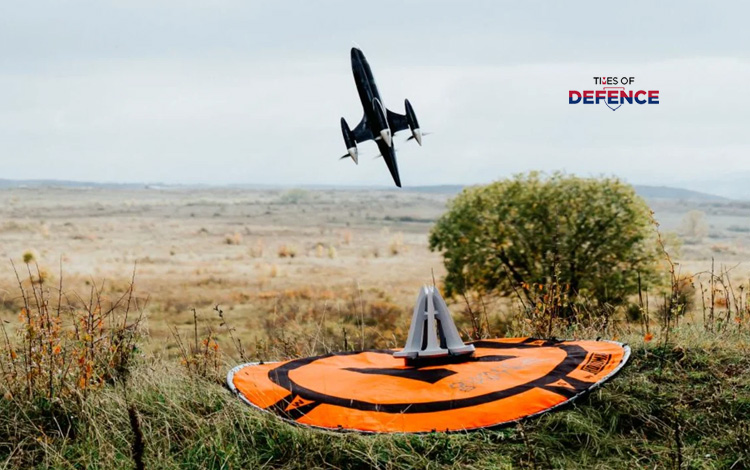
German unmanned aerial systems developer Quantum Systems announced that its experimental, battery-powered “Apex Recordhunter” drone achieved an unverified velocity of 777 km/h (483 mph / 419.5 knots) during flight trials conducted by its specialized N3XT experimental division.
The milestone surpasses the platform’s previous horizontal benchmark of 699 km/h (434 mph) set in June 2026, advancing high-speed electric propulsion capabilities beyond the standing official electric aircraft record of ~658 km/h. While a dual-direction return run is still required to account for wind effects and formalize an official world record under international aviation bodies, the technology demonstrator validates thermal management, aerodynamics, and battery discharge parameters for next-generation Counter-Unmanned Aerial Systems (C-UAS). Insights derived from the demonstrator directly inform high-speed interceptor development under Quantum WIY Industries—a joint venture between Quantum Systems and Kyiv-based WIY Drones—aimed at neutralizing jet-powered loitering munitions, such as Russia’s jet-propelled Geran variants operating at speeds between 500 and 600 km/h.
TECHNICAL SPECIFICATIONS: QUANTUM SYSTEMS APEX RECORDHUNTER DEMONSTRATOR & INTERCEPTOR VECTOR
Developer, Joint Venture & Operational Framework
⚡ Developer & Manufacturer: Quantum Systems (Gilching / Munich, Germany) — N3XT Experimental Division
⚡ Joint Venture Partner: Quantum WIY Industries (Kyiv, Ukraine)
⚡ Combat Interceptor Integration: Technology feeds directly into the “Strila” high-speed C-UAS interceptor program (15,000 units ordered for Ukraine’s National Guard) 
Airframe Architecture & Aerodynamic Design
💥 Configuration: Four-rotor / high-speed quad-rotor hybrid experimental technology demonstrator
💥 Aerodynamic Optimization: Custom low-drag carbon-composite airframe engineered to endure extreme dynamic pressure and drag forces exceeding 200 m/s velocity thresholds
Propulsion, Power Storage & Energy Management
🚀 Energy Storage: Advanced high-discharge lithium-ion battery cells developed in partnership with a Porsche subsidiary
🚀 Power Generation & Discharge: Specialized battery management systems (BMS) optimized for extreme C-rate energy discharge without thermal runaway
🚀 Motor Integration: High-RPM brushless electric motors driving rigid, high-pitch composite propellers built to sustain structural integrity at transonic tip speeds
Kinematic Performance Metrics & Interceptor Counter-Capabilities
🚀 Apex Recordhunter Peak Velocity: 777 km/h (483 mph / 215.8 m/s) in level flight test run
🚀 Previous Benchmark: 699 km/h (434 mph) horizontal flight recorded on June 26, 2026
🚀 Target Threat Spectrum: High-speed jet-powered one-way attack (OWA) drones (e.g., jet-propelled Geran-series OWA UAVs flying at 500–600 km/h) and MALE ISR platforms
TIMES OF DEFENCE ASSESSMENT
The 777 km/h velocity achieved by Quantum Systems’ Apex Recordhunter highlights a major shift in non-kinetic and kinetic counter-drone technology, demonstrating that battery-electric platforms can match and exceed the speed profiles of jet-powered loitering munitions. As Russia deploys jet-propelled Geran variants across the Ukrainian theatre, conventional propeller-driven interceptors face severe kinematic disadvantages, allowing high-speed attack drones to bypass low-altitude point defenses.
From a technical perspective, the primary engineering obstacle in high-speed electric flight has been battery thermal limits and high C-rate power discharge. By pairing specialized battery chemistry developed with Porsche’s subsidiary with low-drag airframe geometries, Quantum Systems solves the speed deficit without relying on expensive jet-turbine engines. Applying these lessons to production interceptors like the WIY Strila provides frontline forces with a cost-effective, reusable, or low-cost kinetic interceptor capable of catching high-speed aerial threats, preserving multi-million-dollar surface-to-air missile (SAM) inventories for high-tier ballistic and cruise missile threats.

