

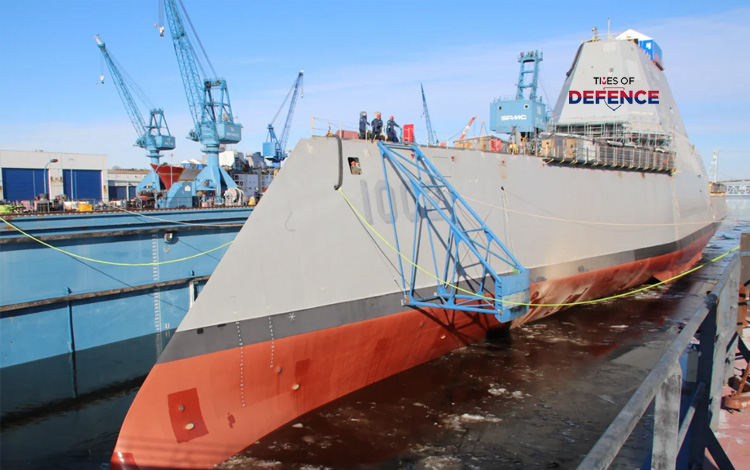
PASCAGOULA, Miss. — The U.S. Department of War awarded Huntington Ingalls Industries (HII) Ingalls Shipbuilding division a $99.1 million contract modification to execute comprehensive builder’s and acceptance sea trials for the USS Lyndon B. Johnson (DDG 1002).
The contract modification covers the final activation phase for the third and final Zumwalt-class stealth destroyer, which entered dry dock at HII Pascagoula in January 2025 to undergo hull modifications for the integration of the Navy’s Conventional Prompt Strike (CPS) hypersonic missile system. Following the removal of the forward twin 155 mm Advanced Gun Systems (AGS), Ingalls installed four large-diameter Advanced Payload Modules (APMs), each housing three CPS hypersonic missiles for a total loadout of 12 missiles per vessel. The sea trials will evaluate propulsion, steering, C4ISR combat systems, and structural integrity following the major engineering overhaul, with final contract completion scheduled for October 2028.
TECHNICAL SPECIFICATIONS: USS LYNDON B. JOHNSON (DDG 1002) HYPERSONIC CONVERSION 
* Prime Contractor & Shipyard: Huntington Ingalls Industries (Ingalls Shipbuilding / Pascagoula, MS)
* Vessel Class & Dimensions:
* Class: Zumwalt-class Guided Missile Destroyer (DDG 1002)
* Full Load Displacement: ~16,000 metric tons
* Length & Beam: 190.0 m (610 ft) length | 24.6 m (80.7 ft) beam
* Airframe/Hull Profile: Tumblehome wave-piercing stealth hull architecture with integrated composite deckhouse
* Propulsion & Power Generation:
* Integrated Power System (IPS): 2 x Rolls-Royce MT30 gas turbines + 2 x Rolls-Royce RR4500 turbine generators producing 78 MW total electrical power
* Propulsors: Dual Advanced Induction Motors driving twin fixed-pitch propellers
* Primary Hypersonic Ordnance Architecture:
* System Nomenclature: Conventional Prompt Strike (CPS) Hypersonic Weapon System
* Missile Launcher Suite: 4 x Large-Diameter Advanced Payload Modules (APMs)
* Missile Capacity: 12 CPS hypersonic missiles per ship (3 missiles per APM)
* Kinematics & Payload: Solid-fueled booster carrying a Common Hypersonic Glide Body (C-HGB) shared with the U.S. Army Dark Eagle LRHW; speed >Mach 5, range >2,700 km
* Secondary Armament & Air Defense Suite:
* Peripheral VLS: 80 x MK 57 Peripheral Vertical Launch System (PVLS) cells (RIM-162 ESSM, SM-2, SM-6, BGM-109 Tomahawk)
* Close-In Defense: 2 x MK 46 30 mm Naval Gun Systems
TIMES OF DEFENCE ASSESSMENT:
The conversion of the Zumwalt-class stealth destroyers into hypersonic strike platforms represents a successful operational pivot for a program originally hamstrung by the cancellation of the 155 mm Long-Range Land-Attack Projectile (LRLAP) ammunition. By leveraging the class’s massive 78 MW Integrated Power System (IPS) and spacious hull form to install large-diameter payload tubes, the U.S. Navy establishes a persistent, low-observable prompt global strike capability in contested maritime theatres like the Western Pacific.
With the USS Zumwalt (DDG 1000) having completed sea trials in January 2026 and DDG 1002 progressing toward its trial phase, the U.S. Navy achieves critical surface-based standoff deterrence against peer adversary anti-access/area-denial (A2/AD) networks. However, program scalability remains inherently constrained by the small fleet size of three vessels, making the rapid delivery and magazine replenishment of the underlying C-HGB glide bodies the ultimate pacing factor for operational readiness.