

WASHINGTON — The U.S. Army has released “How the Army Fights,” a foundational warfighting guidance document detailing operational concepts to sustain high-intensity maritime and littoral combat against the People’s Liberation Army (PLA) across the First and Second Island Chains.
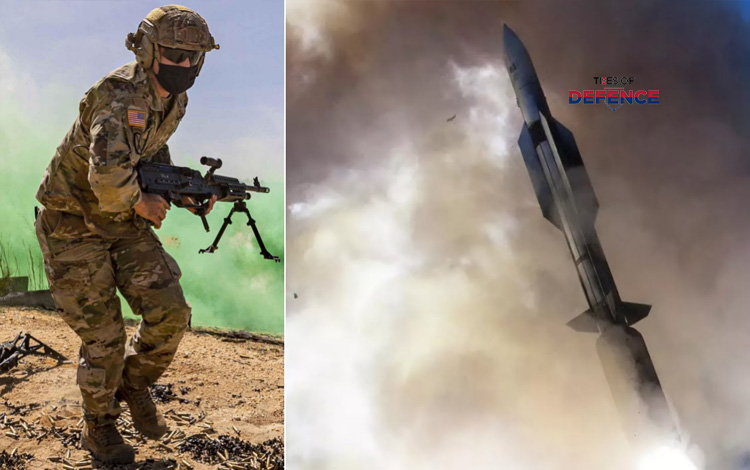
Acknowledging PLA Anti-Access/Area-Denial (A2/AD) capabilities designed to interdict trans-Pacific force flows from the continental United States, the doctrine establishes a forward-deployed, persistent posture. Key initiatives include replacing legacy Army Prepositioned Stock (APS) with the Total Army Power Projection Equipment framework, embedding Multi-Domain Task Forces (MDTFs) along the First Island Chain, and operationalizing land-based precision strike systems—such as the Mid-Range Capability (MRC) Typhon system firing RIM-174 Standard EAM-6 (SM-6) and BGM-109 Tomahawk land-attack cruise missiles. The Second Island Chain (supported by logistics hubs in Guam, Japan, Australia, Singapore, and the Philippines) is designated as operational depth to sustain day-one combat readiness.
TECHNICAL SPECIFICATIONS: U.S. ARMY INDO-PACIFIC FORWARD POSTURE & STRIKE SUITE 
* Primary Strategic Doctrine: “How the Army Fights” Operational Guidance (U.S. Army Pacific / INDOPACOM)
* Pre-Positioning & Logistics Architecture:
* Equipment Framework: Total Army Power Projection Equipment (Replacing legacy APS designation)
* Regional Logistics Nodes: Hardened fuel, medical, engineering, and Class V ammunition depots in Japan, Philippines, Australia, Singapore, and Guam
* Multi-Domain Task Force (MDTF) Integration:
* Tactical Focus: Integrates long-range precision fires, IAMD (Integrated Air and Missile Defense), cyber, electronic warfare (EW), and space capabilities
* Primary Land-Based Strike Assets:
* Mid-Range Capability (MRC) Typhon Launcher: Trailer-mounted 4-cell Mark 41 Vertical Launch System (VLS) derivative
* Ordnance Spectrum:
* RIM-174 Standard EAM-6 (SM-6 Dual I/II): Multi-mission surface-to-air, anti-ship, and terminal ballistic missile defense interceptor with anti-surface capability
* BGM-109 Tomahawk (Block V/Va/Vb): Subsonic land-attack and Maritime Strike Tomahawk (MST) anti-ship cruise missile (1,600+ km range)
* Long-Range Hypersonic Weapon (LRHW) Dark Eagle: Two-stage solid-fuel boost-glide hypersonic missile system deployed to INDOPACOM
TIMES OF DEFENCE ASSESSMENT:
The U.S. Army’s “How the Army Fights” warfighting guidance fundamentally redefines the role of ground power in a potential Indo-Pacific conflict. Designed to counter China’s Anti-Access/Area-Denial (A2/AD) envelope—which threatens to delay trans-Pacific reinforcements—the strategy prioritizes pre-positioned combat power to ensure immediate operational capability from day one.
By deploying Multi-Domain Task Forces armed with land-based anti-ship and cruise missile systems like Typhon (SM-6 and Tomahawk) along the First Island Chain, the U.S. Army aims to establish a sea-denial footprint that complements naval and air operations. However, the ultimate success of this forward-deployed posture hinges on the physical survivability and magazine depth of hardened logistics hubs across the First and Second Island Chains against massed PLA ballistic and hypersonic precision strikes.