


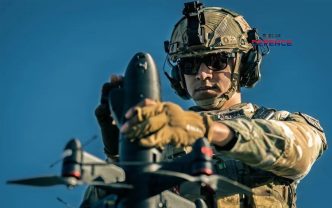
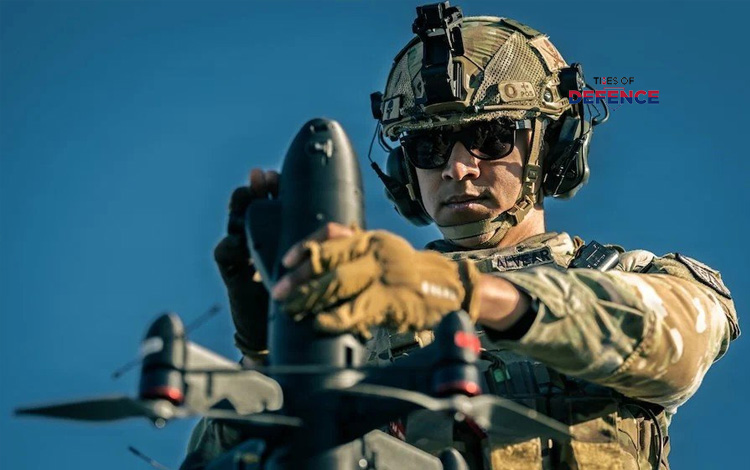
The U.S. Department of War announced on November 5, 2026, the completion of a rapid procurement and deployment surge delivering more than 25,000 unmanned systems and Counter-Unmanned Autonomous Systems (C-UAS) to U.S. Central Command (CENTCOM). Managed by the Direct Reporting Portfolio Manager for Unmanned Systems (DRPM-UxS), the $782 million operational initiative fields a multi-domain autonomous capability matrix to protect deployed forces, installations, and maritime choke points across the Middle East.
The accelerated acquisition surge establishes low-cost autonomous mass across aerial, surface, and undersea operational domains while fielding layered point-defense systems to defeat asymmetric strike networks, kamikaze quadcopters, and loitering munitions.
TECHNICAL SPECIFICATIONS: DRPM-UxS SURGE FIELDING ARCHITECTURE
Program Structure, Governance & Financial Allocation
⚡ Managing Executive Office: Direct Reporting Portfolio Manager for Unmanned Systems (DRPM-UxS / Pentagon)
⚡ Operational Recipient: U.S. Central Command (U.S. CENTCOM Operational Area)
⚡ Total Investment Footprint: $782 million allocated across rapid commercial off-the-shelf (COTS) and modified military-grade acquisition lines
⚡ Operational Capability Goal: Build immediate “low-cost autonomous mass” while deploying a “dense multi-layered counter-drone shield” around forward operating bases, strike groups, and logistics hubs 
Mass Unmanned & Counter-Drone Inventory Breakdown
💥 Heavy One-Way Attack (OWA) Unmanned Aerial Vehicles (UAVs):
• Quantity Fielded: 1,300+ long-range OWA strike platforms
• Operational Profile: Extended-range precision kinetic strike assets designed to saturate adversary air defense networks and conduct standoff interdiction missions
💥 Unmanned Surface Vessels (USVs) & Unmanned Undersea Vehicles (UUVs):
• Quantity Fielded: 100+ maritime surface and subsurface autonomous assets
• Operational Profile: Specialized reconnaissance, undersea mapping, and strike variants supporting maritime security operations across critical sea lines of communication
💥 Multi-Layered Counter-UAS Interceptor & Defense Systems:
• Quantity Fielded: 24,000+ counter-drone systems, kinetic interceptors, and electronic warfare nodes
• Defense Architecture: Integrates kinetic drone-on-drone interceptors, soft-kill RF jamming effectors, and automated optical/radar tracking grids into forward-deployed defensive networks
TIMES OF DEFENCE ASSESSMENT
The delivery of 25,000+ autonomous and counter-drone systems to CENTCOM highlights key tactical and defense acquisition shifts:
1. **Shift to Low-Cost “Mass vs. Mass” Counter-Drone Warfare**: Equipping forward units with over 24,000 counter-drone interceptors and C-UAS systems provides a practical answer to swarming drone attacks. Relying solely on high-cost surface-to-air missiles (e.g., SM-2, RAM, Patriot) to defeat low-cost loitering munitions causes magazine depletion; fielding high-density interceptors restores economic sustainability to point defense.
2. **Accelerating Commercial Off-the-Shelf (COTS) Acquisition Pipelines**: Executed under DRPM-UxS, the $782 million surge demonstrates the Pentagon’s capacity to bypass multi-year acquisition cycles to field operational hardware at scale. Rapidly deploying 1,300+ OWA strike UAVs and 100+ uncrewed maritime vessels validates agile procurement models for high-intensity conflicts.
3. **Operationalizing Multi-Domain Autonomous Integration**: Integrating hundreds of maritime USVs and UUVs alongside long-range aerial strike platforms establishes a sensor-to-shooter network across the CENTCOM AOR. Unifying autonomous ISR feeds with automated C-UAS defensive layers improves operational survivability across contested maritime choke points and forward operating bases.

