



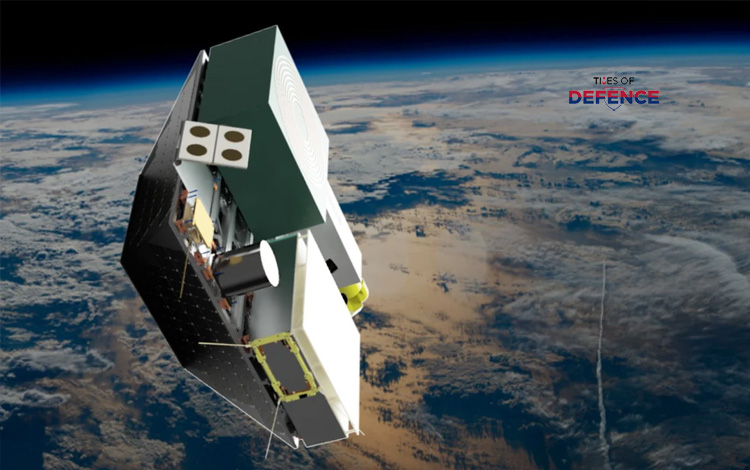
The UK Ministry of Defence (MoD) and UK Space Command announced on November 7, 2026, the successful launch and orbital deployment of Titania, the United Kingdom’s second sovereign military spacecraft.
Built in Hampshire by BAE Systems in partnership with the Defence Science and Technology Laboratory (Dstl) under a £9.5 million ($12.7 million) contract, the 100 kg optical-communications demonstrator launched in October 2026 into Low Earth Orbit (LEO). Operating at an orbital speed of ~27,000 km/h with a 90-minute period, Titania acts as a high-bandwidth optical laser communications testbed for intelligence, surveillance, and reconnaissance (ISR) data. Concurrently, the MoD announced trialing Project Inaros—a multi-site ground-based space domain awareness (SDA) sensor network powered by neuromorphic vision processing to track orbital threats.
TECHNICAL SPECIFICATIONS: TITANIA SATELLITE & PROJECT INAROS ARCHITECTURE
Orbital Asset Baseline & ISTARI Constellation Roadmap
⚡ Operating Authority: UK Space Command (Operational command via No. 1, 2, and 3 Space Squadrons)
⚡ System Developers: BAE Systems (Payload/Integration) & Dstl (Defence Science and Technology Laboratory)
⚡ Financial Allocation: £9.5 million ($12.7 million) development contract under the broader £3 billion+ UK Defence Investment Plan space allocation
⚡ Satellite Mass & Dimensions: ~100 kg (~220 lbs) class small satellite architecture
⚡ ISTARI Constellation Framework:
• Tyche: First wholly owned UK military optical imaging satellite (built by Surrey Satellite Technology Ltd / launched 2024)
• Titania: Laser communications demonstrator for multi-gigabit ISR downlinking (launched Oct 2026)
• Juno: Future ISR imagery payload (Surrey Satellite Technology Ltd / in development)
• Oberon: Future Synthetic Aperture Radar (SAR) spacecraft (Airbus Defence and Space / in development) 
Laser Communications & Project Inaros Neuromorphic Sensing
💥 Space-to-Ground Optical Datalink: Employs direct optical laser communications delivering multi-gigabit per second data transfer rates down to ground stations, bypassing traditional RF bandwidth bottlenecks while providing high immunity to jamming and interception
💥 Project Inaros Sensor Network: Integrated ground-based sensor stations located in the UK, Australia, and British bases in Cyprus, developed by Optera and the National Security Strategic Investment Fund
💥 Neuromorphic Vision Architecture: Employs event-based “neuromorphic” optical sensors that mimic human retinal processing—registering only dynamic changes in light intensities to detect, track, and flag maneuvering satellites and debris against sky noise in real time
TIMES OF DEFENCE ASSESSMENT
The operational deployment of Titania and field-testing of Project Inaros reflect important strategic developments in space capability:
1. **Overcoming RF Bottlenecks with Optical Laser Downlinks**: Modern high-resolution optical and SAR reconnaissance satellites generate terabytes of raw ISR imagery. Legacy Radio Frequency (RF) downlinks suffer from limited spectrum bandwidth and are highly vulnerable to directional jamming or electronic interception. Validating space-to-ground laser communications aboard Titania gives the UK military high-speed, secure data transport capable of moving massive ISR datasets directly to tactical commanders.
2. **Mitigating Counter-Space and Co-Orbital Threats**: Russian and Chinese inspector satellites have increasingly demonstrated aggressive rendezvous and proximity operations (RPO) near Western military constellations. Deploying Project Inaros’ neuromorphic sensors across a global tri-node grid (UK, Australia, Cyprus) gives UK Space Command continuous, real-time warning of adversary orbital maneuvers.
3. **Establishing Sovereign Intelligence, Surveillance, and Reconnaissance (ISR)**: Historically dependent on allied intelligence architectures (e.g., U.S. National Reconnaissance Office feeds), the UK’s incremental build-out of the ISTARI constellation—combining optical imaging (Tyche), laser datalinks (Titania), and upcoming SAR capabilities (Oberon)—secures sovereign orbital collection for independent national defense operations.

