


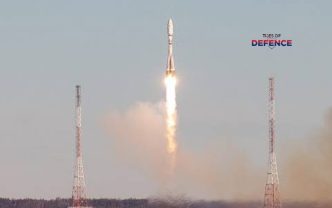
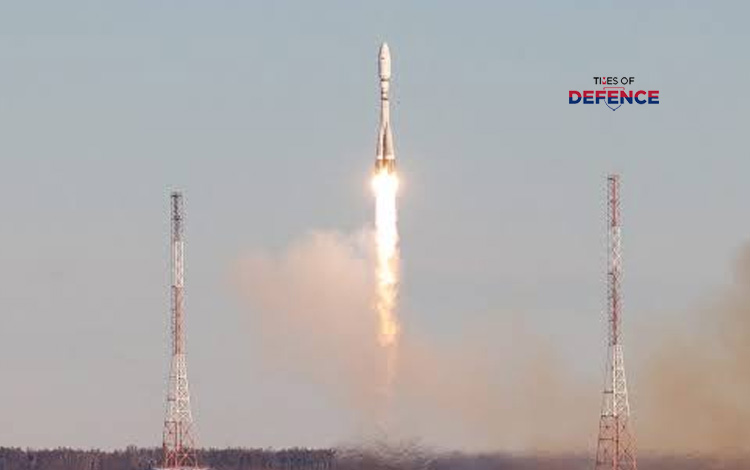
The Russian Ministry of Defense confirmed the successful orbital launch of a classified military spacecraft aboard a Soyuz-2.1b medium-class carrier rocket on November 7, 2026. Liftoff occurred from Launch Complex 43 at the Plesetsk Cosmodrome in the Arkhangelsk region.
Following stage separation, the target payload successfully achieved its pre-designated orbit and established stable telemetry contact with the Ground Automated Control Complex of the Russian Space Forces. While the Aerospace Forces (VKS) have designated the satellite under the standard numerical “Kosmos” series cataloging protocol, exact orbital parameters, payload architecture, and operational mission sets remain undisclosed.
TECHNICAL SPECIFICATIONS: SOYUZ-2.1B LAUNCH VEHICLE ARCHITECTURE
Launch System & Booster Configuration
⚡ Launch Provider & Authority: Russian Aerospace Forces (VKS) / Ministry of Defense of the Russian Federation
⚡ Launch Site: Site 43/4, Plesetsk Cosmodrome, Arkhangelsk Region
⚡ Launch Vehicle Designation: Soyuz-2.1b (3-stage medium-lift launch vehicle baseline, optional Fregat upper stage)
⚡ Propulsion Baseline:
• Stage 1 (Boosters): 4× RD-107A engines burning Naphthyl / Liquid Oxygen (LOX)
• Stage 2 (Core Stage): 1× RD-108A core engine featuring upgraded digital flight controls
• Stage 3: Upgraded RD-0124 closed-cycle engine providing significantly higher specific impulse (Isp ~359s) compared to legacy RD-0110 engines
⚡ Payload Envelope: Up to 8,200 kg to Low Earth Orbit (LEO) from Plesetsk; high-latitude inclination optimized for polar, sun-synchronous, and highly elliptical orbits (HEO) 
Payload Matrix & Tactical Orbit Profiling
💥 Satellite Designation: Classified (Assigned Kosmos-series designation post-insertion)
💥 Potential Mission Profiles:
• High-Resolution Optical / Synthetic Aperture Radar (SAR) Reconnaissance: High-inclination imaging assets (e.g., Razdan / Neitron architecture)
• Electronic Intelligence (ELINT / SIGINT): LEO/MEO signals interception payloads (e.g., Lotos-S1 / Pion-NKS constellation expansion)
• Missile Early Warning System (EKS / Tundra): High-altitude ballistic missile detection nodes in Molniya or Geostationary Orbits (GEO)
• Inspector / Co-Orbital Spacecraft: Maneuvering payloads for orbital situational awareness and proximity operations in high-density orbital planes
TIMES OF DEFENCE ASSESSMENT
The launch of another classified military spacecraft via the Soyuz-2.1b platform underscores several operational trends in Russia’s orbital strategy:
1. **Sustaining Space-Based Tactical Reconnaissance and Targeting**: High-tempo attrition and operational demands in regional theaters require Russia to continuously replenish its Low Earth Orbit (LEO) reconnaissance constellation. Deploying updated SAR and electro-optical satellites addresses critical coverage gaps, delivering real-time target designation, battle damage assessment (BDA), and radar tracking for standoff precision-guided munitions.
2. **Operational Capability of the RD-0124 Powered Upper Stage**: Utilizing the Soyuz-2.1b variant—which incorporates the high-efficiency RD-0124 third-stage engine—allows the VKS to carry heavier military payloads into higher or specialized sun-synchronous orbits. This expanded lift capacity is critical for inserting dual-sensor SIGINT assets and heavy optical reconnaissance platforms into optimal orbital planes.
3. **Resilience of High-Latitude Launch Infrastructure at Plesetsk**: By staging classified tactical launches out of Plesetsk rather than Baikonur or Vostochny, the Russian Aerospace Forces maintain direct, sovereign military control over launch operations. High-latitude liftoffs simplify direct orbital insertion into polar and high-inclination trajectories essential for polar monitoring and Northern Hemisphere coverage.

