


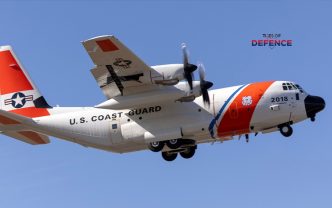
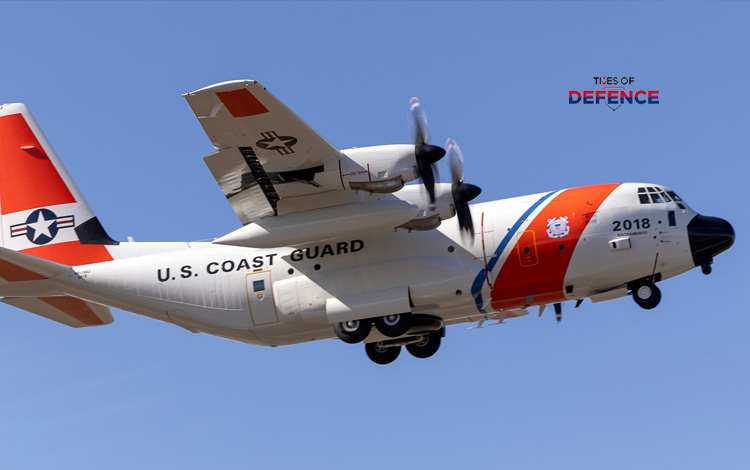
The U.S. Coast Guard (USCG) awarded an order for six baseline Lockheed Martin C-130J-30 long-range surveillance aircraft on September 24, 2026. Funded via a $735 million congressional fixed-wing aircraft allocation, the acquisition leverages existing U.S. Air Force interservice contract vehicles to streamline procurement schedules.
The transaction increases the Coast Guard’s planned C-130J program of record from 19 to 25 total airframes. Initial deliveries of the baseline C-130J-30 airframes from Lockheed Martin’s Marietta, Georgia production facility are scheduled to begin in Fiscal Year 2028, with all six aircraft scheduled for delivery by the end of FY 2030. Upon initial acceptance, the Coast Guard will issue post-delivery missionization contracts to integrate specialized maritime sensors, domain-awareness suites, and tactical communications systems, officially designating the specialized aircraft as HC-130Js.
TECHNICAL SPECIFICATIONS: USCG HC-130J LONG-RANGE SURVEILLANCE ARCHITECTURE
Airframe Kinematics & Powerplant Profile
⚡ Aircraft OEM & Integrator: Lockheed Martin Aeronautics (Marietta, Georgia)
⚡ Airframe Baseline: C-130J-30 Super Hercules (Extended Fuselage Configuration (+15 ft / 4.5 m))
⚡ Powerplant: 4× Rolls-Royce AE 2100D3 turboprop engines driving 6-bladed Dowty R391 composite propellers (4,691 shp each)
⚡ Maximum Takeoff Weight (MTOW): 164,000 lbs (74,390 kg)
⚡ Operational Performance Envelope: Max Speed: 362 knots (417 mph / 671 km/h) | Service Ceiling: 28,000 ft (with 42,000 lb payload) | Maximum Range: >4,200 nautical miles (uncared/ferry) 
Maritime Missionization & Sensor Suite (Post-Delivery HC-130J Integration)
💥 Mission Systems Integrator: L3Harris Technologies / Coast Guard Missionization Framework
💥 Command & Control Architecture: Minotaur Mission System Architecture (integrates radar, optronics, ESM, and datalinks into a common tactical picture)
💥 Search & Targeting Radar: Telephonics AN/APS-143C(V)3 multimode maritime surveillance radar (provides ISAR imaging, small-target sea search, and long-range surface tracking)
💥 Electro-Optical / Infrared (EO/IR) Suite: L3Harris WESCAM MX-15HDi turret carrying high-definition thermal imaging, daylight TV, laser rangefinder, and illuminated pointer systems
💥 Tactical Communications & Datalinks: Link-16, AIS (Automatic Identification System), VHF/UHF tactical radio, and secure Ku/Ka-band SATCOM for real-time reachback to Coast Guard Command Centers
TIMES OF DEFENCE ASSESSMENT
The procurement of six additional C-130J airframes highlights an operational expansion of the U.S. Coast Guard’s long-range maritime domain awareness capacity.
From a defense acquisition and maritime security perspective, this expansion provides three primary strategic insights:
1. **Leveraging Joint Procurement Vehicles**: Executing the $735M procurement through established U.S. Air Force multi-year contracts allows the Coast Guard to avoid independent non-recurring engineering (NRE) costs and contracting delays. Staging the baseline delivery from FY 2028 through FY 2030 creates a predictable schedule for follow-on missionization at L3Harris facilities.
2. **Transitioning Air Station Sacramento to Heavy Fixed-Wing Operations**: Delivering the first HC-130J to Air Station Sacramento, California, in mid-2026 marks the beginning of the unit’s operational transition from smaller twin-turboprop Alenia C-27J Spartans to long-range HC-130Js. Expanding the HC-130J fleet from 19 to 25 airframes ensures sufficient inventory to fully equip Sacramento alongside existing HC-130J bases at Air Station Elizabeth City (NC), Air Station Kodiak (AK), and Air Station Barbers Point (HI).
3. **Enhancing Multi-Mission Reach in Contested Maritime Zones**: The HC-130J provides critical endurance for counter-narcotics interdiction in the Eastern Pacific, long-range Search and Rescue (SAR) in Arctic and Pacific theaters, and maritime EEZ patrols. Equipped with the Minotaur mission architecture, the platform acts as an airborne sensor node, sharing real-time tactical targeting and surface tracks with Offshore Patrol Cutters (OPCs), National Security Cutters (NSCs), and Department of Homeland Security (DHS) partner agencies.

