


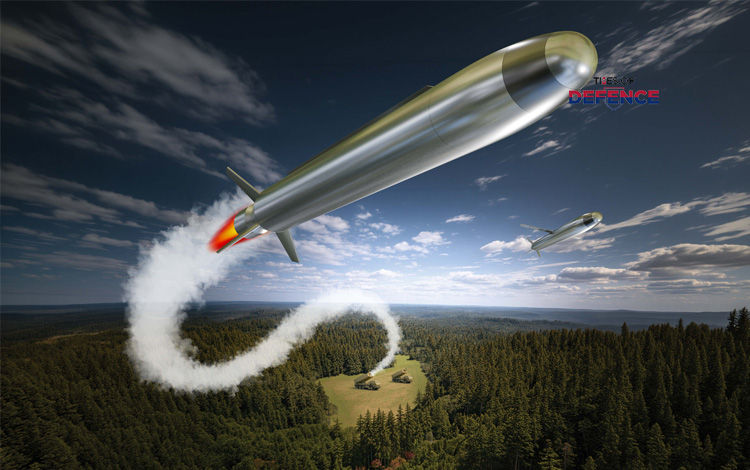
Defense technology prime Leidos convened a major industrial supply chain summit at its global headquarters on October 26, 2026, to align defense suppliers across 14 states on manufacturing requirements, production schedules, and delivery timelines for two key low-cost precision strike systems: the Low-Cost Containerized Missile (LCCM) and the AGM-190A Havoc Spear cruise missile.
The industrial ramp-up directly supports a May 13 framework agreement between the U.S. Department of War (DoW) and Leidos for an initial procurement of 3,000 LCCM units aimed at scaling long-range strike capacity. Concurrently, the summit coordinates supply-chain integration for the AGM-190A Havoc Spear (formerly known during development as the Black Arrow small cruise missile). Primary manufacturing, subcomponent assembly, and final integration for both missile families will take place across Leidos facilities in Huntsville, Alabama, and McEwen, Tennessee, supported by propulsion integration from suppliers including Pratt & Whitney.
TECHNICAL SPECIFICATIONS: LEIDOS LCCM & AGM-190A HAVOC SPEAR CRUISE MISSILE ARCHITECTURE
System Classification, Industrial Footprint & Program Framework
⚡ Lead Systems Integrator: Leidos, Inc. (Reston, Virginia)
⚡ Key Industrial Suppliers: Pratt & Whitney (Turbine Propulsion) and specialized subcomponent vendors across 14 U.S. states
⚡ Primary Production Centers: Advanced Manufacturing Facilities in Huntsville, Alabama, and McEwen, Tennessee
⚡ Procurement Contracts & Delivery Schedules:
• Low-Cost Containerized Missile (LCCM): Initial framework agreement for 3,000 weapons; initial test and evaluation deliveries begin in 2027; full-rate production (FRP) targeted for 2028–2029
• AGM-190A Havoc Spear: Initial fielding deliveries to Air Force Special Operations Command (AFSOC) underway; follow-on USSOCOM contract (awarded summer 2026 for 45 missiles) begins delivery in fall 2027 
AGM-190A Havoc Spear Kinematics & Modular Launch Profile
💥 Missile Type: Low-cost, modular standoff small cruise missile (air-launched and surface-containerized options)
💥 Mass & Physical Profile: Gross Launch Weight: ~200 lbs (~91 kg) | Modular warhead bay supporting kinetic high-explosive (HE) and non-kinetic EW/payload options
💥 Propulsion & Kinematic Envelope: High-efficiency turbojet engine (Pratt & Whitney lightweight turbine unit); standoff operational range >400 nautical miles (>740 km)
💥 Platform Integration Capabilities: High-volume deployment compatibility with AFSOC platforms including AC-130J Ghostrider, MC-130J Commando II, OA-1K Skyraider, and MQ-9A Reaper; engineered for launcher integration with M142 HIMARS, M270 MLRS, and standard ISO containerized box-launchers
💥 Guidance & Terminal Targeting Suite: GPS/INS navigation paired with anti-jamming CRPA receivers and modular electro-optical/infrared (EO/IR) or radar seekers for precision strike in GPS-denied environments
TIMES OF DEFENCE ASSESSMENT
The mobilization of Leidos’s nationwide industrial base to scale production of the LCCM and AGM-190A Havoc Spear highlights a strategic pivot toward high-volume, low-cost precision strike capabilities.
From an aerospace defense and weapon procurement perspective, this development offers three main strategic insights:
1. **Solving the Defense Supply Chain Volatility Bottleneck**: Decades of reliance on expensive, low-capacity precision weapons (such as AGM-158 JASSM or Tomahawk) have left inventory reserves vulnerable to rapid depletion in high-intensity conflicts. By organizing a 14-state supplier network anchored by major propulsion partners like Pratt & Whitney, Leidos establishes a scalable industrial base designed to churn out cruise missiles by the thousands rather than the dozens.
2. **Containerized and Flexible Launch Agnosticism**: Standardizing the LCCM architecture to launch from containerized modules, MLRS/HIMARS launchers, and tactical transport airframes (such as the MC-130J) eliminates the requirement for dedicated strategic bombers or high-end multi-role fighter platforms. This allows ground forces and special operations units to deploy long-range cruise missile barrages from dispersed, low-signature land positions or non-standard transport aircraft.
3. **Optimizing Cost Asymmetry for Saturated Standoff Strikes**: Firing multi-million-dollar cruise missiles against distributed tactical targets creates a severe cost imbalance. With design goals derived from low-cost strike initiatives ($150,000 target unit cost baseline), the AGM-190A and LCCM provide commanders with affordable, long-range magazine depth capable of saturating layered enemy air defenses and striking high-value targets at ranges exceeding 400 nautical miles.

