


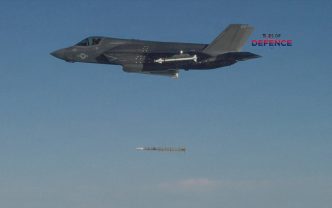
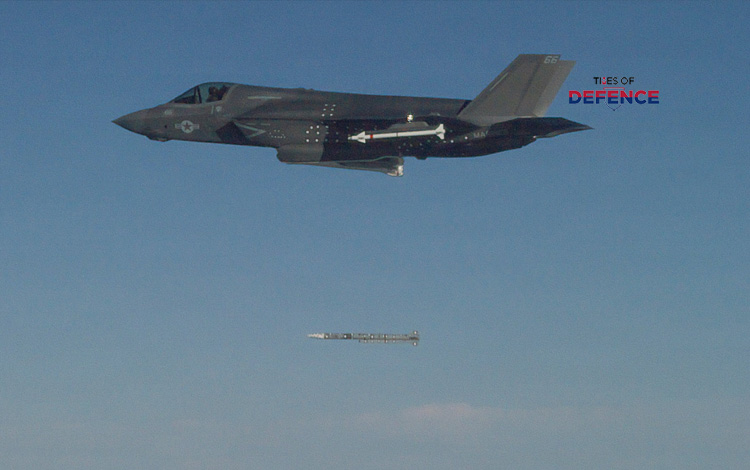
The F-35 Joint Program Office (JPO) and the combined UK/US F-35 Integrated Test Force (ITF) completed the initial unpowered jettison flight trial of MBDA’s Meteor Beyond-Visual-Range Air-to-Air Missile (BVRAAM) from an F-35B Lightning II STOVL aircraft on October 7, 2026, at Naval Air Station Patuxent River, Maryland.
Flown by a Royal Navy Test Pilot embedded within the F-35 ITF from the Air and Space Warfare Centre (ASWC), the trial verified safe dynamic separation from the F-35B’s internal weapons bay under complex aerodynamic pressure fields. The inert test asset cleared the weapons bay cleanly without igniting its solid-fuel ramjet motor or actuating flight control surfaces, marking a critical milestone toward integrating the Meteor BVRAAM into UK Royal Navy, Royal Air Force (RAF), and Italian armed forces F-35 fleets.
TECHNICAL SPECIFICATIONS: MBDA METEOR / F-35B INTERNAL WEAPONS BAY INTEGRATION
Program Governance, Test Operations & Fleet Integration
⚡ Authority & Test Agency: F-35 Joint Program Office (JPO) & F-35 Integrated Test Force (ITF – NAS Patuxent River)
⚡ Operational Test Crew: Royal Navy Test Pilot (embedded within ASWC / F-35 ITF), supported by UK RAF & Lockheed Martin engineers
⚡ Target Operators: UK Royal Navy (Fleet Air Arm), UK Royal Air Force (RAF), and Italian Air Force / Navy (Aeronautica Militare / Marina Militare) F-35B fleets
⚡ Test Location: NAS Patuxent River Over-Water Atlantic Test Range, Maryland
⚡ Qualification Roadmap: Progressive clearance envelope testing featuring unpowered jettison profiles, followed by guided separation launches, culminating in end-to-end live-fire intercepts 
Meteor BVRAAM Kinetic Architecture vs. Conventional BVRAAMs
💥 Propulsion Mechanism: Throttleable Solid-Fuel Ramjet (TBR) paired with an integrated solid-fuel boost motor
💥Kinematic Advantage:
• Solid Rocket Motors (e.g., AIM-120 AMRAAM): Burn rapidly post-launch, coasting to target on momentum; energy depletes significantly at extreme ranges
• Ramjet Sustainer (MBDA Meteor): Air-breathing intake continuously regulates thrust based on target speed and altitude, preserving peak energy for terminal maneuvers
💥 Operational Engagement Envelope: “No-Escape Zone” (NEZ) up to 3× larger than conventional solid-propellant air-to-air missiles; maximum range >200 km (108+ nmi) at speeds exceeding Mach 4
💥 Guidance & Data Link Architecture: Active X-band radar seeker with bi-directional micro-datalink integration for dynamic mid-course target updates via the F-35’s AN/APG-81 AESA radar and MADL network
TIMES OF DEFENCE ASSESSMENT
The unpowered jettison trial of the MBDA Meteor from the F-35B’s internal bay marks a strategic advance for European F-35 operators.
From an aerospace engineering and air-combat tactics perspective, this trial yields three primary operational insights:
1. **Preserving Low-Observable (Stealth) Signature while Maximizing Range**: Internal bay integration allows the F-35B to deploy the Meteor while retaining its minimal Radar Cross-Section (RCS). Internal carriage avoids the aerodynamic drag and increased radar return caused by underwing pylons, preserving stealth profiles during long-range air-to-air engagements.
2. **Expanding the “No-Escape Zone” for 5th-Gen Fighters**: Combining the F-35’s low observability and sensor fusion with the Meteor’s ramjet propulsion changes beyond-visual-range air combat dynamics. The ramjet’s continuous thrust allows the missile to accelerate during terminal guidance, preventing adversary fighters from out-running the missile at long ranges.
3. **Optimizing Interoperability across Allied European Fleets**: Integrating Meteor onto the F-35B provides common air-to-air weapon capabilities across UK and Italian land- and sea-based strike forces. Standardizing on Meteor across both Eurofighter Typhoon and F-35 fleets streamlines missile logistics and supply chain management for NATO allies.

