


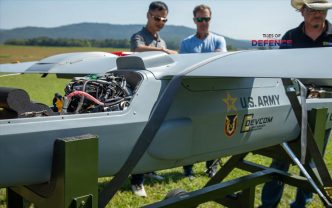
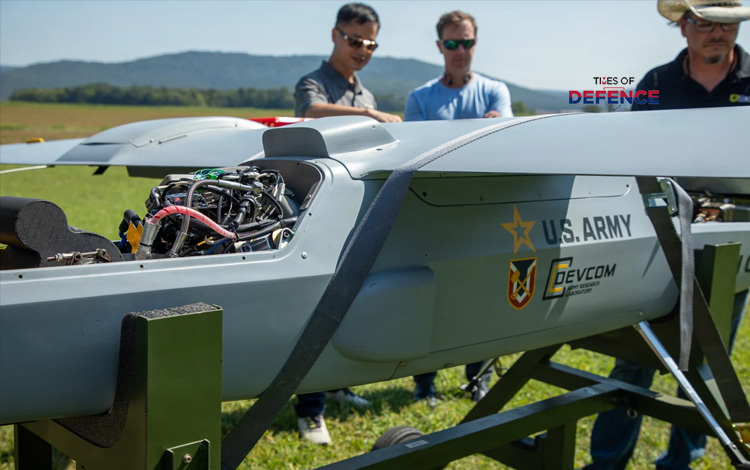
The U.S. Army Combat Capabilities Development Command (DEVCOM) Army Research Laboratory (ARL) announced on November 2, 2026, the successful flight test of the VICTOR Group 3 Vertical Takeoff and Landing (VTOL) Unmanned Aircraft System (UAS).
Conducted near Huntsville, Alabama, in collaboration with Griffon Aerospace and inter-agency partners, the flight milestone demonstrated a 3D metal-printed air-cooled rotary engine operating on single-fuel logistics (JP-8/Jet-A jet fuel). The engine functions as an airborne auxiliary power unit within a 400-volt series-hybrid-electric drive system. Developed under ARL’s multi-year Versatile Tactical Power and Propulsion initiative, the VICTOR platform and its derivative swarming operational concept—designated PULSAR—are transitioning to military joint-force partners for operational maturation, logistics field testing, and beyond-line-of-sight (BLOS) strike development.
TECHNICAL SPECIFICATIONS: DEVCOM ARL VICTOR UAS & HYBRID PROPULSION ARCHITECTURE
Program Governance, R&D Ecosystem & Industry Integration
⚡ Lead Executive Agency: U.S. Army DEVCOM Army Research Laboratory (ARL — Tactical Power and Propulsion Branch)
⚡ Lead Industry Integrator: Griffon Aerospace (Madison, Alabama)
⚡ R&D Consortium Footprint: Multi-year initiative spanning 30+ academic institutions, 13+ federal laboratories, and 20+ industrial defense contractors
⚡ Platform Classification: Group 3 VTOL Unmanned Aerial System (MGTOW up to ~600 kg / 1,320 lbs; operational envelope <18,000 ft MSL)
⚡ Technology Transfer Roadmap: Transitioning to joint military service partners; propulsion architecture integrated into PULSAR (Persistent Unmanned Aircraft System for Logistics, Strike, Autonomy, and Reconnaissance) swarm concept 
3D-Printed Heavy-Fuel Rotary Engine & Thermodynamic Suite
💥 Core Engine Geometry: Single-rotor air-cooled Wankel-type rotary engine manufactured via 3D metal additive manufacturing (Direct Metal Laser Sintering)
💥 Additive Manufacturing Optimization: Custom internal airflow/cooling channels eliminate external liquid cooling lines, radiators, and coolant pumps, significantly reducing system volume and weight
💥 Heavy-Fuel Combustion Management: High-fidelity computational fluid dynamics (CFD) spray modeling designed to optimize heavy-fuel (JP-8/Jet-A) atomization, vapor mix, and seal blow-by retention
💥 Single-Fuel Logistics Alignment: Engineered explicitly to burn standard military kerosene-based heavy fuels, eliminating reliance on volatile aviation gasoline (Avgas) at forward tactical bases
Series-Hybrid Electrical Architecture & Kinematics
🚀 Electrical Conversion Unit: Integrated high-efficiency 400-volt DC motor-generator driven directly by the rotary engine crankshaft
🚀 Propulsion Configuration: Series-hybrid drive—the rotary engine runs at an optimized RPM band to continuously charge high-voltage onboard batteries, which drive electric VTOL and forward-flight rotors
🚀 Range & Endurance Extensions: Combines high energy density of liquid jet fuel with instant torque response and multi-rotor redundancy of electric VTOL systems
🚀 Thermal & Acoustic Signature Isolation: Engine casing design and steady-state generator duty cycle lower infrared (IR) and acoustic signatures compared to open-loop 2-stroke gasoline UAV engines
TIMES OF DEFENCE ASSESSMENT
The flight demonstration of the VICTOR drone using a 3D metal-printed heavy-fuel rotary engine marks a major technical step toward operationalizing long-range hybrid drones for Army maneuver units.
From an aerospace propulsion and military logistics perspective, this milestone offers three key insights:
1. **Enforcing Military Single-Fuel Doctrine**: Mid-sized (Group 3) tactical UAVs traditionally rely on gasoline-powered 2-stroke or 4-stroke engines. Requiring dedicated Avgas supplies at forward operating sites creates severe logistics bottlenecks. Burning JP-8/Jet-A directly allows VICTOR to draw fuel directly from Army refueling trucks, JLTV tanks, or forward bulk fuel bladders.
2. **Advantages of Additive Manufacturing in Rotary Design**: Rotary engines provide high power-to-weight ratios but historically suffer from thermal management and rotor seal wear when burning heavy fuels. Using 3D metal printing allowed ARL engineers to integrate complex internal air-cooling channels directly into the engine block. This eliminates liquid cooling infrastructure (coolant, pumps, heat exchangers), drastically reducing weight while preserving engine reliability.
3. **Optimizing Series-Hybrid Propulsion Efficiency**: Utilizing the heavy-fuel engine strictly as a generator for a 400-volt electric system allows the rotary core to operate at its precise peak thermodynamic efficiency point. Electric motors handle dynamic throttle changes during vertical takeoff and hover, while the constant-RPM rotary generator delivers maximum endurance for long-range, beyond-line-of-sight (BLOS) missions.

