


The Directorate of Defense Procurement (DOPP) within the Israel Ministry of Defense (IMOD), operating alongside the Israel Defense Forces (IDF) Ground Forces, has executed a 15-year contract valued at approximately NIS 600 million (~$170 million to $192 million USD) with Elbit Systems Ltd.
Announced on November 2, 2026, the contract tasks Elbit Systems with building, equipping, operating, and supporting a state-of-the-art training and simulation center for the IDF Artillery Corps (Ahash). The turnkey facility is engineered to support the operational integration and crew qualification for two core artillery platforms: the Roem (SIGMA 155) fully automated 10×10 self-propelled howitzer and the Lahav (PULS) modular precision rocket artillery system. Under a Contractor-Owned, Contractor-Operated (COCO) support architecture, Elbit Systems will provide physical infrastructure, high-fidelity mission simulators, instructional staff, continuous software updates, and long-term MRO logistics.
TECHNICAL SPECIFICATIONS: IDF ARTILLERY SIMULATION & PLATFORM INTEGRATION ARCHITECTURE
Contractual Structure, Institutional Setup & Service Provisions
⚡ Contracting Authorities: Israel Ministry of Defense (IMOD Directorate of Defense Procurement) & IDF Ground Forces Headquarters
⚡ Industrial Prime & Systems Integrator: Elbit Systems Ltd. (Land and Armaments Division — Haifa / Yokneam, Israel)
⚡ Financial Scope & Contract Term: NIS 600 million (~$170M–$192M USD) over a 15-year performance period
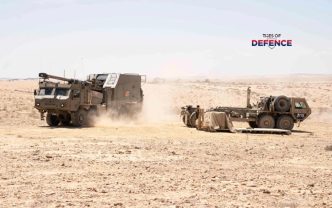
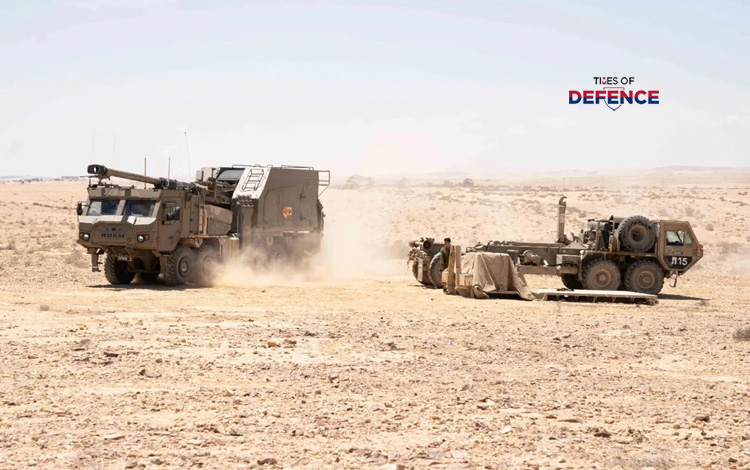
⚡ Primary Target Platforms: Roem (SIGMA 155) 155mm/52-cal 10×10 Self-Propelled Howitzer & Lahav (PULS) Autonomous Artillery Rocket System
⚡ Scope of Infrastructure: Turnkey facility construction, physical classrooms, full-mission synthetic simulators, driving simulators, virtual battle labs, on-site maintenance, and civilian instructor support
⚡ Operational Objective: Shorten crew qualification cycles, lower operational fuel/barrel wear costs, and maintain real-time integration with IDF C4I networks 
Target Platform Baseline 1: Roem (SIGMA 155) Automated Self-Propelled Howitzer
💥 Chassis & Mobility: Oshkosh 10×10 heavy tactical truck chassis featuring all-wheel drive, central tire inflation system (CTIS), and high off-road mobility
💥 Ordnance & Automation: 155mm / 52-caliber NATO-compliant ordnance featuring a fully automated, unmanned turret assembly; automated projectile and modular charge loading systems
💥 Crew Reduction & Firing Metrics: Crew Complement: Reduced to 3 personnel (Commander, Driver, Gunner) compared to 7 on legacy M109 Doher; Maximum Rate of Fire: 8 rounds per minute; Engagement Range: 40+ km using extended-range ordnance
💥 Operational Readiness Vector: Replaces legacy M109A5 Doher tracked howitzers following operational deployment during 2026 combat operations in southern Lebanon
Target Platform Baseline 2: Lahav (PULS / Precise & Universal Launching System)
🚀 Launcher Architecture: Universal multi-caliber rocket artillery launcher mounted on heavy 8×8 wheeled tactical chassis, carrying two interchangeable pod containers
🚀 Ordnance Capability: Fires AccuLAR-122 (122mm / 35 km range / 18 rockets per pod), EXTRA (306mm / 150 km range / 4 rockets per pod), and Predator Hawk (370mm / 300 km range / 2 missiles per pod)
🚀 Autonomous Target Acquisition: Automated fire control system integrated directly with IDF Ground Forces C4I networks for rapid counter-battery and deep-strike missions
TIMES OF DEFENCE ASSESSMENT
The 15-year simulation center contract between the Israeli Ministry of Defense and Elbit Systems highlights a shift toward synthetic training architectures for advanced land platforms. As automated artillery systems like the Roem (SIGMA 155) replace legacy crew-intensive platforms like the M109, synthetic training environments become critical for operational readiness.
From an engineering and defense management perspective, this initiative offers three primary strategic advantages:
1. **Mitigating Wear and Tear on High-Cost Automated Ordnance**: Automated loading systems, hydraulic rammers, and 52-caliber barrels experience significant wear during live-fire training cycles. Utilizing high-fidelity mission simulators for crew qualification allows the IDF Artillery Corps to preserve barrel life, lower ammunition costs, and minimize mechanical failure on frontline 10×10 chassis during peacetime ops.
2. **Adapting to Crew Automation Dynamics**: Transitioning from a 7-person crew on the manual M109 to a 3-person crew inside the armored cab of the Roem shifts the operator’s role from manual ammunition handling to automated C2 interface oversight. Synthetic simulators allow three-person crews to practice handling rapid 8-round-per-minute fire missions, dynamic position changes, and emergency manual overrides under realistic combat conditions.
3. **Turnkey Logistics and Long-Term Lifecycle Savings**: Partnering with Elbit under a 15-year COCO contract transfers maintenance, simulator updates, and logistics infrastructure to the OEM. This structure ensures that as software updates or new precision munitions (such as PULS rocket variants) enter service, the simulation architecture can be updated without requiring separate procurement cycles.

