


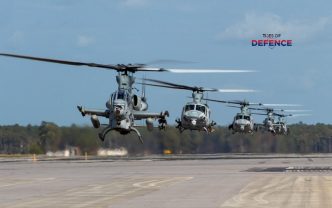
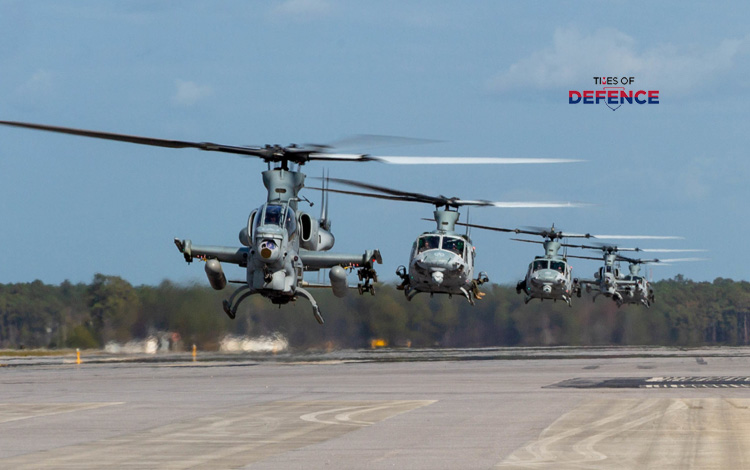
The U.S. Navy’s Light/Attack Helicopter Program Office (PMA-276) and Bell Textron Inc. have advanced into the final developmental flight testing phase for the H-1 SPINE (Structural and Power Improvements for NextGen Effects) modernization initiative.
Operating at Naval Air Station Patuxent River with Air Test and Evaluation Squadron 21 (HX-21), flight-test data from the initial two upgraded prototype platforms (one AH-1Z Viper and one UH-1Y Venom) is finalizing the Phase 3.0 technical drawing package. Formerly designated as SIEPU (Structural Improvement and Electrical Power Upgrade), the SPINE program strengthens airframe load margins, expands electrical power generation, and integrates a digital weapons bus across the Marine Corps’ legacy fleet of ~189 AH-1Z and ~160 UH-1Y helicopters. Operational fleet modifications are scheduled to commence at Bell’s Amarillo Assembly Center in Fiscal Year 2027.
TECHNICAL SPECIFICATIONS: USMC H-1 SPINE MODERNIZATION ARCHITECTURE
Program Governance, Execution Framework & Procurement Envelopes
⚡ Program Management: Naval Air Systems Command (NAVAIR PMA-276 — NAS Patuxent River, Maryland)
⚡ OEM Prime & Modification Hub: Bell Textron Inc. (Amarillo Assembly Center — Amarillo, Texas)
⚡ Test & Evaluation Squadron: Air Test and Evaluation Squadron 21 (HX-21 Blackhawks)
⚡ Inductee Fleet Scope: Fleet-wide modernization applicable to ~189 AH-1Z Viper attack helicopters and ~160 UH-1Y Venom utility helicopters (~85% component commonality)
⚡ Contracting Framework: Multi-year base contract ($33.6M initial award / $114.7M option exercise) with three option years valued at ~$300M, covering up to 49 fleet aircraft (28 AH-1Z / 21 UH-1Y)
⚡ Delivery Schedule: Inductions begin FY2027; initial modified fleet deliveries target 2028, extending fleet operational viability into the 2040s 
Structural Strengthening & Electrical Generation Enhancements
💥 Airframe Structural Hardening: Strengthened fuselage, tail boom, and dynamic component attachment nodes designed to absorb higher structural loads during high-g maneuvers and heavy external store carriage
💥 Enhanced Power Generation: Upgrade of internal electrical power architecture (generators and power distribution units) to deliver high-wattage power margins for modern avionics, active electronic protection, and directed-energy countermeasure suites
💥 Rotor & Drivetrain Margin Expansion: Drivetrain component reinforcement optimized to sustain higher gross weights without compromising speed, maneuverability, or high-altitude hot-weather performance
Digital Avionics, Smart Weapons Bus & Kinetic Payload Growth
🚀 Digital Weapons Bus Integration: MIL-STD-1760/2085-compliant digital data bus establishing direct digital interfaces between mission computers and wing stores stations
🚀 Advanced Air-to-Air Missile Integration: Native digital architecture enabling target queueing and telemetry handoff for AIM-9X Block II/II+ Sidewinder missiles (replacing legacy analog AIM-9M integration)
🚀 Networked & Stand-Off Ordnance: Capability to program, launch, and update precision-guided munitions, loitering munitions, and air-launched effects (ALEs) mid-flight
🚀 Airborne Drone C2 Integration: Cockpit avionics configured to function as airborne control nodes for uncrewed platforms (demonstrated via mid-air launch and command of Neros Archer FPV drones)
TIMES OF DEFENCE ASSESSMENT
The SPINE program is a vital operational bridge for the U.S. Marine Corps’ light attack helicopter fleet. Because production lines for the UH-1Y (ended 2020) and AH-1Z (ended 2022) are closed, modernizing existing airframes is the primary path to maintaining rotary-wing lethality in high-threat littoral theaters like the Indo-Pacific.
From an aerospace engineering and air combat perspective, SPINE offers three core strategic advantages:
1. **Unlocking Digital Weapon Integration**: Legacy H-1 store stations relied heavily on analog hardware lines, restricting the platform to unguided rockets, basic laser-guided APKWS, and older missile variants. Integrating a digital weapons bus allows the Marine Corps to deploy network-enabled weapons like the AIM-9X Block II Sidewinder and air-launched loitering munitions, letting pilots update target coordinates in real time while airborne.
2. **Support for High-Power Sensor and EW Payloads**: Modern electronic warfare suites, active electronically scanned array (AESA) tactical radars, and high-gain communication relays require far more electrical power than legacy H-1 alternators could output. Expanding internal electrical capacity enables the installation of heavy electronic warfare pods, long-range targeting systems, and dynamic jamming suites without overloading platform generators.
3. **Manned-Unmanned Teaming (MUM-T) Node Capability**: Equipping H-1 platforms with digital buses and high-bandwidth datalinks transforms the helicopters into airborne command-and-control hubs. As demonstrated in tactical exercises using FPV drones, pilot and copilot/gunner teams can launch, view, and control autonomous uncrewed systems from the cockpit, expanding search-and-strike envelopes well beyond visual line-of-sight.

