


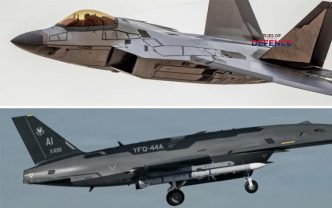
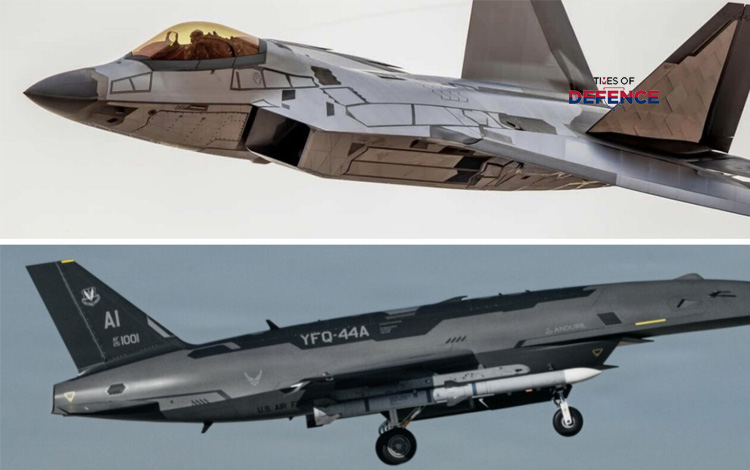
EDWARDS AFB, Calif. — The U.S. Air Force successfully executed the first airborne flight trial where a crewed Lockheed Martin F-22A Raptor fifth-generation fighter acted as an in-flight tactical controller (“airborne quarterback”) for an Anduril YFQ-44A Fury autonomous Collaborative Combat Aircraft (CCA) prototype.
During the demonstration, the F-22 pilot issued high-level operational directives from the cockpit, which were received, processed, and executed in real-time by the YFQ-44A’s onboard autonomy software (utilizing Anduril Lattice and Shield AI Hivemind architectures). The test validates Manned-Unmanned Teaming (MUM-T) concepts under Increment 1 of the Air Force’s CCA program, which seeks to field at least 500 autonomous wingmen by 2032 alongside General Atomics’ FQ-42A Vengeance. Integrating autonomous CCAs directly expands the F-22A’s combat magazine depth, sensor footprint, and survivability in contested Anti-Access/Area-Denial (A2/AD) airspace without requiring micromanagement of flight controls by the pilot.
TECHNICAL SPECIFICATIONS: ANDURIL YFQ-44A FURY & F-22A MUM-T INTEGRATION 
* Platform Nomenclature: Anduril YFQ-44A Fury (Collaborative Combat Aircraft / Group 5 UCAV)
* Primary Role: Low-cost, attritable “loyal wingman,” offboard sensor node, electronic warfare emitter, and air-to-air missile carrier
* Dimensions & Airframe Geometry:
* Length: 6.1 m (20.0 ft) | Wingspan: 5.2 m (17.1 ft)
* Max Takeoff Weight (MTOW): ~2,268 kg (5,000 lbs)
* Design Features: High-stealth composite airframe, v-tail layout, and internal bay modularity
* Propulsion & Flight Performance:
* Powerplant: 1 x Williams FJ44-4M turbofan engine (~4,000 lbf / 17.8 kN thrust)
* Maximum Speed: Mach 0.95 (~1,010 km/h)
* Service Ceiling: 15,000 m (49,200 ft) | Load Factor: Up to +9 g
* Avionics, Autonomy & Data Links:
* Autonomy Suite: Open-architecture autonomy running Anduril Lattice OS & Shield AI Hivemind Enterprise
* Command Architecture: Direct high-level tasking via tactical data link from controlling F-22A / F-35A / F-15EX platform
* Kinetic Payload & Station Options:
* External / Internal Hardpoints: Up to 4 x AIM-120 AMRAAM Beyond-Visual-Range Air-to-Air Missiles
* Precision Strike (Future): Barracuda-500 cruise missiles, GBU-39 Small Diameter Bombs (SDB), and 70 mm rocket pods
TIMES OF DEFENCE ASSESSMENT:
The successful in-flight control of the YFQ-44A Fury by an F-22A Raptor pilot marks a vital operational evolution for U.S. Air Force air superiority doctrine. Historically constrained by a fixed internal weapons bay capacity (six AIM-120 AMRAAMs and two AIM-9Xs) and legacy data link limitations, the F-22A’s combat utility is substantially multiplied when paired with autonomous CCAs acting as offboard “missile trucks” and distributed forward sensors.
By shifting the pilot’s role from manual flight control to high-level operational command, a single F-22A can direct multiple stealthy FQ-44A or FQ-42A drones into high-risk air defense envelopes to engage enemy targets or absorb incoming threats. With the U.S. Air Force targeting a fleet of at least 500 Increment 1 CCAs by 2032, this cost-effective, high-mass force structure provides essential tactical depth against peer-adversary stealth platforms and dense integrated air defense systems (IADS) in the Western Pacific.

