


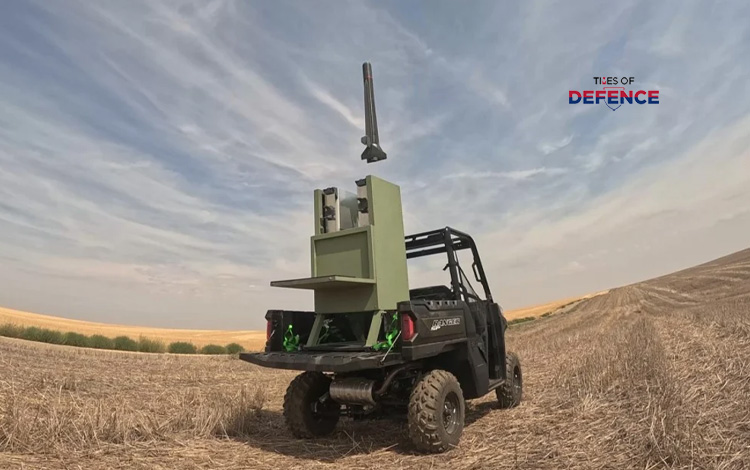
Cummings Aerospace successfully executed the first multi-pack, vehicle-mounted ripple launch and single-operator dual-flight control trial of its 3D-printed, turbojet-powered Hellhound S3 Unmanned Combat Aerial Vehicle (UCAV) at the Pendleton UAS Range.
During the August 25, 2026 flight demonstration (announced October 12, 2026), two Hellhound S3 platforms were sequentially launched in under 90 seconds from an eight-cell modular launcher integrated onto a light utility vehicle (Polaris UTV). A single operator utilizing a single Handheld Fire Control System (FCS) successfully programmed, launched, and simultaneously monitored both autonomous effectors over distinct flight paths, altitudes, and airspeed profiles. Engineered via rapid additive manufacturing (3D printing) and Commercial Off-The-Shelf (COTS) components, the 6 kg (13 lb) turbojet loitering munition delivers high-subsonic dash speeds up to 618 km/h (384 mph) over a 60+ km engagement radius. The modular open-systems architecture enables tool-free field-swapping of four payload variants—armor-piercing, high-explosive fragmentation, electronic warfare (EW), and radar decoy—in under two minutes.
TECHNICAL SPECIFICATIONS: CUMMINGS AEROSPACE HELLHOUND S3 UCAV & MULTI-PACK LAUNCHER
* Developer & Manufacturer: Cummings Aerospace (Huntsville, AL / Native American Woman-Owned Small Business)
* Classification & Operational Roles: Group 1 Multi-Mission Loitering Munition / One-Way Attack (OWA) / Counter-UAS (C-UAS) Interceptor / Low-Cost Cruise Missile
* Airframe & Production Architecture:
* Manufacturing Process: Rapid additive manufacturing (3D-printed composite airframe) with COTS component integration
* Production Capacity: Scalable to >100 units/month per production line
* Weight Parameters: System mass 6 kg (13 lbs) | Total man-portable pack (drone, canister, FCS) <11 kg (25 lbs)
* Dimensions: ~Bat-sized tubular fuselage profile with folding pop-out wings
* Propulsion, Kinematics & Endurance Envelope:
* Powerplant: Miniature high-thrust micro-turbojet engine
* Maximum Speed: 618 km/h (384 mph / ~171 m/s) high-subsonic dash velocity
* Effective Range: >60 km (37 miles) operational radius
* Launch Modalities: Vertical tube canister (man-portable), 8-pack vehicle/UGV/USV multi-launcher, or helicopter-launched effects (ALE)
* Payload Modularity & Mission Sets (Tool-Free < 2-Minute Module Swap):
* Kinetic Armor-Piercing (AP): Shaped-charge warhead targeting light armor / APCs / IFVs
* Blast-Fragmentation (HE-Frag): Anti-personnel and Counter-Group 2/3 UAS Kinetic Interception (e.g., Shahed-136)
* Electronic Warfare (EW): Tactical radio-frequency jammer module for localized EA
* Decoy / ISR Payload: Active radar frequency emitter / optical sensor module for defense saturation
* Command, Control & Multi-Agent FCS:
* Handheld Fire Control System (FCS): Single-operator interface executing multi-UAV autonomous waypoint tasking, real-time live telemetry monitoring, and dynamic in-flight re-routing or mission abort 
TIMES OF DEFENCE ASSESSMENT
The successful multi-pack ripple fire and dual-UAV control of the Hellhound S3 represents a major technological jump for squad-level precision fires and counter-drone warfare. Traditional electric propeller-driven loitering munitions (such as the Switchblade or quadcopter FPVs) are inherently limited by slow transit speeds (~100–150 km/h), making them vulnerable to small-arms fire, localized electronic warfare jammers, or target relocation.
By equipping a 3D-printed 6 kg drone with a micro-turbojet reaching 618 km/h, the Hellhound S3 drastically compresses the sensor-to-shooter timeline over a 60 km radius. This high speed allows front-line infantry to intercept fast-moving enemy Group 2/3 OWA drones (like the Shahed-136) mid-flight or strike mobile targets before they retreat into cover. Furthermore, moving from man-portable tubes to an 8-round vehicle launcher managed by a single handheld controller allows small units to deliver multi-effector saturation strikes previously requiring an entire artillery battery. As Cummings Aerospace moves toward salvo testing on Uncrewed Ground Vehicles (UGVs) and Uncrewed Surface Vessels (USVs), the low-cost 3D-printed jet architecture provides a mass-producible blueprint for resilient, high-speed tactical strike swarms.

