


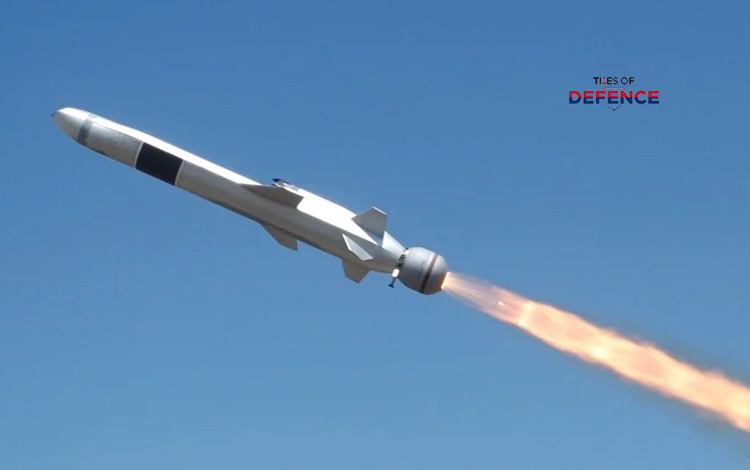
The Danish Defence Acquisition and Logistics Organisation (DALO) has signed a government-to-government follow-on procurement contract valued at approximately NOK 400 million with the Norwegian Defence Materiel Agency (FMA) and Kongsberg Defence & Aerospace to deliver an undisclosed quantity of additional Naval Strike Missiles (NSM).
Announced on October 19, 2026, the expanded agreement strengthens Denmark’s shore-based Coastal Defence System (CDS) footprint while running parallel to separate ongoing acquisitions for the Royal Danish Navy’s frigate fleet. Originally selecting the mobile NSM system in 2025 as a direct replacement for legacy anti-ship solutions, Denmark operates as the fifth NATO member state fielding the land-based mobile NSM architecture alongside Poland, the United States, Romania, and Latvia. The integrated defense battery combines Kongsberg’s advanced C4I tactical fire control system, highly mobile Transporter Erector Launchers (TELs), and precision low-observable subsonic cruise missiles capable of complex anti-ship and land-attack missions.
TECHNICAL SPECIFICATIONS: KONGSBERG NAVAL STRIKE MISSILE (NSM) & COASTAL DEFENCE SUITE
Developer & Manufacturer
⚡ Kongsberg Defence & Aerospace (Norway) 
Contract Parameters & Procurement Framework
⚡ Government-to-Government (G2G) framework between Norwegian FMA and Danish DALO (Valued at ~NOK 400 million)
Platform Integration & Deployability
🚀 Naval Integration: Royal Danish Navy *Iver Huitfeldt*-class frigates via deck-mounted canister launchers
🚀 Coastal Defence System (CDS): Mobile containerized launching infrastructure linked to tactical command-and-control fire posts
Physical Dimensions & Kinematics
💥 Length: 3.96 m (13.0 ft) with solid rocket booster | Launch Weight: 407 kg (897 lbs)
💥 Range Envelope: >185 km (>100 nautical miles) utilizing a high-subsonic sea-skimming trajectory
💥 Speed Profile: High-Subsonic (Mach 0.93) with advanced terminal evasion maneuvers
Navigation, Guidance & Terminal Seeker Architecture
🚀 Mid-Course Guidance: Inertial Navigation System (INS), GPS-aided navigation, and radar/laser altimeter for terrain-following flight
🚀 Terminal Seeker: Uncooled high-resolution Imaging Infrared (IIR) dual-band sensor
🚀 Target Recognition: Autonomous Target Recognition (ATR) database matching (operates entirely passively without active RF emissions to defeat Electronic Warfare / ESM systems)
Ordnance & Fuzing Mechanics
💥 Warhead Payload: 125 kg (276 lbs) high-explosive titanium blast-fragmentation penetrator
💥 Fuzing Mechanics: Multi-option programmable delay fuze optimized for critical structural penetration prior to detonation
TIMES OF DEFENCE ASSESSMENT
Denmark’s additional NOK 400 million investment in Kongsberg’s Naval Strike Missile fleet highlights NATO’s broader strategic focus on securing critical littoral chokepoints in northern Europe. By expanding its mobile NSM Coastal Defence batteries, the Danish Armed Forces establish a potent, highly survivable anti-access/area-denial (A2/AD) bubble across the Danish Straits. This mobile land-based deterrent seamlessly complements the Royal Danish Navy’s frigate fleet, locking down maritime transit zones between the North Sea and the Baltic Sea against hostile surface combatants.
Technically, the NSM provides decisive advantages over legacy radar-guided anti-ship missiles. Its passive dual-band Imaging Infrared (IIR) seeker and Autonomous Target Recognition (ATR) software allow the weapon to locate and strike precise target coordinates without emitting radar tracking signals that alert enemy Electronic Support Measures (ESM). Furthermore, utilizing standardized NSM effectors across both mobile land batteries and naval platforms optimizes ammunition stockpiles, simplifies logistics frameworks, and streamlines maintenance training across allied Nordic defense structures.

