


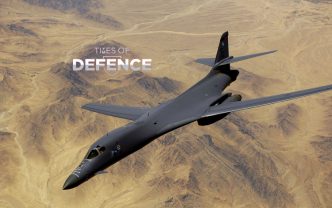
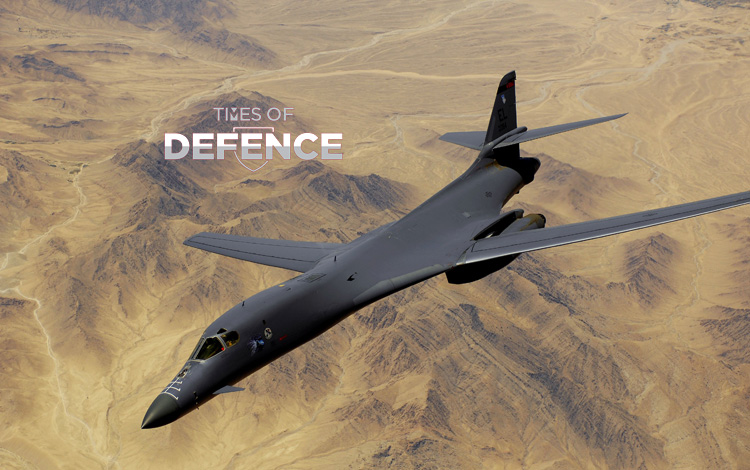
A pair of B-1B Lancer bombers suddenly thundered across the sky as Chinese President Xi Jinping arrived at Joint Base Andrews for his state visit to the United States.
The dramatic flyover took place on September 23, 2026, during a highly choreographed welcome ceremony attended by President Donald Trump and Xi Jinping.
Official U.S. Air Force imagery confirms that two B-1B Lancers assigned to the 7th Bomb Wing at Dyess Air Force Base, Texas, conducted the flyover over Joint Base Andrews.
The ceremony included a 100-foot red carpet, a 21-person honor cordon, military formations, national anthems and the bomber flyover.
The B-1B Lancer
The aircraft involved was the B-1B Lancer, one of the U.S. Air Force’s long-range heavy bombers.
The B-1B combines a variable-sweep wing with four General Electric F101-GE-102 afterburning turbofan engines.
Each engine produces more than 30,000 pounds of thrust with afterburner.
Its published maximum speed is approximately Mach 1.2, or around 900 mph, although the actual speed used during the Joint Base Andrews flyover has not been disclosed.
B-1B Lancer — Key Specifications
| Specification | B-1B |
|---|---|
| Role | Long-range multi-role heavy bomber |
| Engines | 4 × GE F101-GE-102 |
| Thrust | 30,000+ lb each with afterburner |
| Maximum speed | Approx. Mach 1.2 |
| Length | 44.5 m |
| Wingspan | 41.8 m extended / 24.1 m swept |
| MTOW | Approx. 216,600 kg |
| Payload | Up to 34,000 kg |
| Range | Intercontinental |
| Crew | 4 |
The B-1B’s variable-geometry wings can sweep from approximately 15 degrees to 67.5 degrees, allowing the aircraft to optimize its configuration for different phases of flight.
A Bomber Built for Speed
The B-1B was originally developed as a high-speed strategic bomber.
Its four afterburning engines allow it to reach supersonic speeds, while its variable-sweep wings provide the aerodynamic flexibility needed for both high-speed flight and long-range missions.
However, the aircraft flying over Andrews should not automatically be described as making a supersonic pass.
There is no official indication that the two bombers exceeded Mach 1 during the ceremony.
Likewise, claims that the aircraft used full afterburner have not been confirmed by the U.S. Air Force.
What is confirmed is that the B-1B’s F101 engines are equipped with afterburners and that the aircraft is capable of Mach 1.2.
More Than Just a Flyover
The choice of aircraft was visually striking.
The B-1B is a strategic bomber designed to deliver large conventional weapon loads over long distances. Its presence at a high-profile arrival ceremony placed one of the U.S. Air Force’s most recognizable long-range strike platforms directly into the ceremonial setting.
The Air Force describes the B-1B as a long-range, multi-role heavy bomber capable of carrying a large conventional weapons load and operating at high speed.
The aircraft can employ weapons including Joint Direct Attack Munitions and AGM-158 Joint Air-to-Surface Standoff Missiles, depending on configuration and mission requirements.
The Sound Was Real — The Supersonic Claim Is Not Confirmed
Video from the ceremony quickly spread online because of the bombers’ extremely loud passage.
Some social-media posts described the aircraft as flying at full afterburner and supersonic speed.
Those descriptions should be treated cautiously.
Confirmed:
✈️ Two B-1B Lancers conducted the flyover.
🇺🇸 They were from the 7th Bomb Wing at Dyess AFB.
📍 The flyover took place at Joint Base Andrews during Xi Jinping’s arrival.
🔥 The B-1B is equipped with afterburning engines.
💨 The aircraft is capable of Mach 1.2.
Not publicly confirmed:
❌ Full-afterburner use during the flyover.
❌ Supersonic speed during the flyover.
❌ A deliberate sonic-boom demonstration.
The distinction matters because a spectacular-looking flyby does not, by itself, establish the aircraft’s exact speed or engine setting.
The Bottom Line
The footage captured a striking moment during Xi Jinping’s arrival in Washington: two American B-1B bombers passing directly over the welcome ceremony.
The B-1B’s combination of four afterburning engines, variable-sweep wings, intercontinental range and heavy conventional payload makes it one of the most capable long-range strike aircraft in the U.S. inventory.
But the most accurate description is not “a full-afterburner supersonic pass.”
It is simpler — and still impressive:
Two B-1B Lancers roared over Joint Base Andrews during Xi Jinping’s arrival ceremony.