


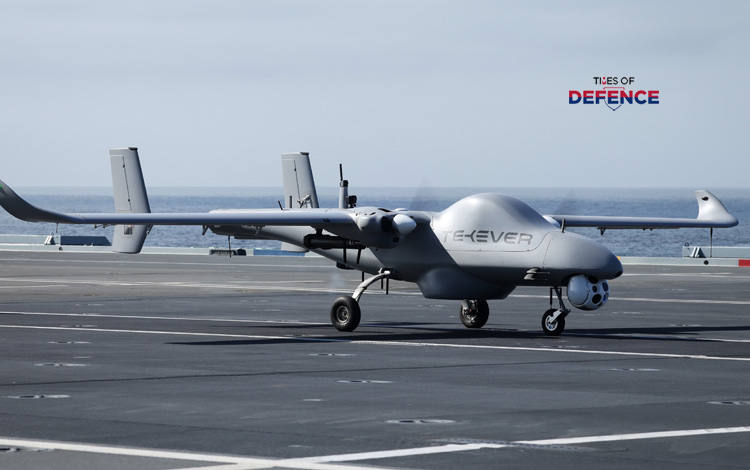
European autonomous systems developer TEKEVER has announced the successful completion of shipboard take-off and landing trials for its **AR5 fixed-wing uncrewed aircraft system (UAS)** aboard the Royal Navy’s flagship aircraft carrier, **HMS Queen Elizabeth**.
Conducted during **Heavy Lift Challenge 3** in collaboration with the Royal Navy, British Army, Royal Air Force (RAF), and industry partners, the demonstration linked shore-based flight operations from TEKEVER’s Flight Operations and Training Centre in Atouguia da Baleia, Portugal, directly to carrier deck operations. The trials validated the AR5’s ability to execute maritime Intelligence, Surveillance, Target Acquisition, and Reconnaissance (ISTAR), ship-to-shore logistics sustainment, and coordinated operations alongside catapult-launched strike drones (such as the Nyan strike drone) as part of an integrated carrier strike force. The milestone follows the UK Ministry of Defence’s (MOD) National Armaments Director Group (NAD Group) awarding TEKEVER a landmark contract valued at up to **£400 million** under the British Army’s **Project CORVUS**—starting with six AR5 systems and scaling up to 24 airframes by 2029, manufactured at TEKEVER’s new facility in Swindon.
TECHNICAL SPECIFICATIONS: TEKEVER AR5 UAS ARCHITECTURE
Airframe Design, Propulsion & Flight Performance
⚡ Prime Contractor & Developer: TEKEVER (United Kingdom / Portugal)
⚡ Airframe Dimensions & Configuration: High-wing, twin-boom composite monocoque airframe with an H-tail empennage; approximately 7.0–7.3 meters wingspan and 4.0 meters overall length
⚡ Payload & Weight Envelope: Upgraded operational variants carry up to 80 kg of modular mission payload (baseline configurations rated at 50 kg payload within a ~180 kg MTOW class)
⚡ Cruise Speed & Endurance: Typical cruising speed of 100–140 km/h with persistent flight endurance reaching up to 12 to 20 hours depending on payload weight and fuel configuration
⚡ Launch & Recovery Flexibility: Fixed tricycle landing gear paired with an Automatic Take-Off and Landing (ATOL) suite enabling autonomous operations from short, unprepared airstrips and moving carrier flight decks without catapults or arresting wires 
Sensor Suite, Communications & Multi-Domain Integration
💥 Modular ISTAR Payloads: Configurable with multi-sensor gyro-stabilized Electro-Optical / Infrared (EO/IR) gimbals, Synthetic Aperture Radar (SAR), maritime surveillance radar, and AI-enabled automated target recognition
💥 Communications & Datalinks: Dual Line-of-Sight (LoS) Software-Defined Radio (SDR) links and Beyond-Line-of-Sight (BLoS) satellite communications (SATCOM) enabling seamless over-the-horizon command and live sensor streaming
💥 UK Sovereign Industrial Footprint: Procured under Project CORVUS (up to £400M) to replace the legacy Watchkeeper fleet, backed by TEKEVER’s £400M OVERMATCH UK investment and local manufacturing in Swindon
TIMES OF DEFENCE ASSESSMENT
The carrier qualification milestone of the TEKEVER AR5 aboard HMS Queen Elizabeth highlights three pivotal shifts in British defense modernization and naval aviation:
1. **Operationalizing the Royal Navy’s “Hybrid Navy” Carrier Concept**: Demonstrating that a medium-endurance, fixed-wing UAS can fly from a shore base in Portugal, land and launch autonomously from an aircraft carrier, and coordinate with strike drones proves that Queen Elizabeth-class carriers can rapidly scale air-wing persistence without relying solely on manned F-35B sorties.
2. **Unifying Tri-Service Unmanned Procurement**: By testing an Army-procured Project CORVUS platform (the AR5) on a Royal Navy flagship alongside RAF personnel, the UK MOD is breaking down traditional single-service procurement silos in favor of interoperable, cross-domain unmanned fleets.
3. **Anchoring Combat-Proven Autonomy in Domestic UK Manufacturing**: Leveraging lessons from TEKEVER’s operational deployments in Ukraine while building up to 24 AR5 systems in Swindon under the £400 million NAD Group deal ensures rapid spiral upgrades and sovereign UK industrial resilience.

