


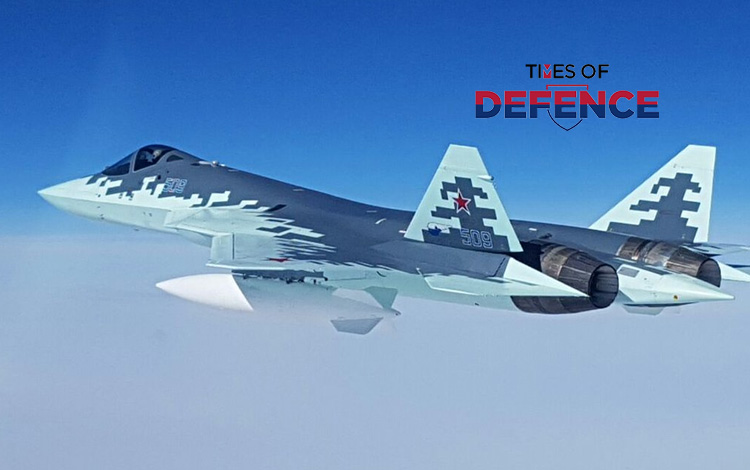
Russia’s Su-57E reportedly demonstrated an unusual long-range ferry configuration on its flight to Egypt for the El Alamein International Airshow 2026, using removable fuel tanks installed inside its internal weapons bays instead of conventional external drop tanks.
The claim comes from United Aircraft Corporation (UAC) and Rostec, which said the aircraft made the journey with one intermediate stop and arrived at El Alamein with enough fuel remaining for approximately another 1,000 km (620 miles) of flight. The aircraft subsequently conducted a demonstration sortie the following day without refueling.
The exact flight route and the country where the intermediate landing took place have not been disclosed.
Why Internal Fuel Tanks Matter
External fuel tanks are commonly used by fighter aircraft during long-range ferry flights because they provide additional fuel without consuming internal weapons-bay volume.
For a stealth aircraft, however, external tanks create a significant trade-off.
They increase aerodynamic drag and can increase radar signature, while also occupying external weapon stations. The Su-57’s approach instead places insert/removable fuel tanks inside the aircraft’s weapons bays, allowing the aircraft to retain a cleaner external configuration.
Rostec described the arrangement as consistent with the fifth-generation aircraft concept because it preserves the aircraft’s external aerodynamics while providing additional ferry fuel.
This configuration is primarily a ferry/transfer solution. With the weapons bays occupied by fuel tanks, the aircraft would not simultaneously have the normal internal weapon load available in those bays.
A 1,000-km Reserve After Landing
According to Rostec, the Su-57E arrived in Egypt after one intermediate stop with enough fuel remaining to cover approximately 1,000 km.
That reserve was then sufficient for a demonstration flight the following day.
Rostec further claimed that the fuel consumption and flight loads of the demonstration were comparable to those of a full combat sortie. This is a Rostec/UAC claim, rather than an independently verified measurement, and should therefore be treated as manufacturer-provided information.
The important point is that the flight was not simply a demonstration of the aircraft’s theoretical range. It showed the practical use of an internal auxiliary-fuel configuration during an international ferry mission.
The Aircraft: T-50-9 / “509”
The aircraft associated with the flight was T-50-9, commonly identified by its blue “509” bort number.
Aircraft records identify 509 as the T-50-9 prototype, and photographs from El Alamein confirm the aircraft’s presence at the 2026 event. It conducted flying demonstrations before being moved to the static display.
It is important to distinguish the airframe from the production export configuration: T-50-9 is a prototype/test aircraft, although it has been used extensively to demonstrate the Su-57E concept and export configuration at international air shows.
Su-57E Technical Overview
The Su-57E is the export version of Russia’s Su-57 fifth-generation multirole fighter.
Publicly reported/export-marketing specifications include:
| Parameter | Su-57E |
|---|---|
| Crew | 1 |
| Engines | 2 × afterburning turbofans |
| Maximum takeoff weight | Approx. 34,000 kg |
| Maximum speed | Around Mach 2 |
| Service ceiling | Approx. 18,800 m |
| Internal fuel | Public figures vary; around 9,700–11,000 kg is commonly reported |
| Maximum combat payload | Up to approx. 7,500 kg |
| Maximum range | Approx. 2,800 km without refueling in published export material |
| Combat radius | Public figures vary by mission/load |
| Internal weapons carriage | Yes |
| Primary role | Multirole air-superiority and strike |
The figures above come from published Russian/export material and open-source references; exact performance varies with configuration, mission profile, weapons, fuel load and environmental conditions.
Stealth and Internal Carriage
The Su-57’s internal weapons bays are central to its low-observable configuration.
Rosoboronexport currently markets the Su-57E with a range of internally compatible weapons, including the RVV-MD2, RVV-SDM, RVV-BD, Kh-38MLE, Kh-69 and Kh-58UShKE. The company specifically highlights internal carriage as a method of reducing radar signature.
The same design philosophy now appears to have been applied to ferry operations.
Instead of accepting the aerodynamic and signature penalties of external tanks, the aircraft can apparently use its weapons-bay volume for additional fuel during long-distance transfers.
The El Alamein Mission
The 2026 El Alamein International Airshow took place from 8–10 September 2026 at El Alamein International Airport on Egypt’s Mediterranean coast. It was a trade-focused aerospace, defense and space event.
Russia used the event to promote the Su-57E to potential customers in Egypt, Africa and the Middle East.
Rostec had announced before the event that the aircraft would appear in export configuration with new weapons that had not previously been publicly demonstrated.
The aircraft subsequently performed demonstration flights and was displayed alongside newly presented Russian weapons, including the S-71M and S-71K systems.
What the Flight Demonstrates
The significance of the mission is less about establishing a new official range figure and more about demonstrating configuration flexibility.
The flight suggests that the Su-57’s internal volume can be temporarily converted from weapons storage to additional fuel capacity for long-distance ferry missions.
That can provide three potential advantages:
1. Lower external drag
No large external fuel tanks are required.
2. Preserved low-observable external configuration
The aircraft avoids the external stores associated with conventional ferry configurations.
3. Greater ferry flexibility
Additional internal fuel can extend the distance between refueling stops while retaining the aircraft’s clean external shape.
However, this configuration should not be confused with the aircraft’s normal combat configuration: using the weapons bays for fuel necessarily reduces or eliminates the internal weapon load carried during the ferry flight.
What Is Confirmed — and What Is Not?
Confirmed/reported by Russian industry:
- The Su-57E flew to Egypt for El Alamein 2026.
- The aircraft used internal insert fuel tanks rather than external drop tanks.
- The journey included one intermediate stop.
- Rostec/UAC said approximately 1,000 km of fuel remained after arrival.
- The aircraft subsequently performed a demonstration flight without refueling.
- T-50-9/509 was present and flew at the event.
Not publicly disclosed:
- The exact route.
- The intermediate stopover country.
- The exact capacity of the insert tanks.
- The additional fuel quantity carried.
- The precise distance flown between fuel stops.
- The exact fuel remaining after the demonstration.
- Independent verification of Rostec’s comparison between the demonstration sortie and a combat mission.
Bottom Line
The Egypt ferry flight provides an interesting demonstration of how the Su-57E can use its internal volume for more than weapons carriage.
Rather than carrying external drop tanks, the aircraft reportedly used removable fuel tanks inside its weapons bays, allowing it to make the trip to Egypt with one stop while retaining a claimed 1,000-km fuel reserve after landing.
The configuration does not establish a new official range record, but it demonstrates a potentially useful capability for long-distance deployment while avoiding the aerodynamic and low-observable penalties associated with external fuel tanks.
