


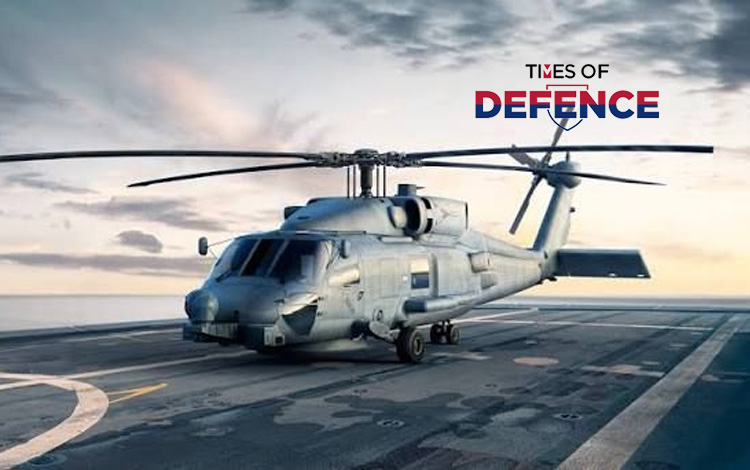
South Korea is moving to significantly expand the Republic of Korea Navy’s MH-60R Seahawk fleet, with more than 20 additional helicopters planned under the Maritime Operational Helicopter-II program. The expansion would substantially increase Seoul’s anti-submarine warfare, anti-surface warfare and maritime surveillance capabilities as the ROK Navy strengthens its ability to operate against increasingly sophisticated underwater and surface threats.
The planned acquisition is reported at approximately $2.3 billion, with the program expected to run through 2032. The South Korean plan follows the delivery and operational introduction of the first 12 MH-60Rs ordered under the earlier Maritime Operational Helicopter-I program.
In April 2026, the ROK Navy began operational deployment of its first MH-60Rs. South Korea originally approved a roughly 960 billion won ($637 million) program in 2020 to acquire 12 helicopters from Sikorsky/Lockheed Martin.
U.S. Clears a Separate 24-Aircraft FMS Package
The expansion is also supported by a major U.S. Foreign Military Sale notification.
On 18 May 2026, the U.S. State Department approved a possible sale of 24 additional MH-60R Seahawk helicopters to South Korea, with an estimated value of approximately $3 billion. The package included aircraft and associated mission equipment, training, logistics and support.
This distinction is important: the U.S. notification represents a possible FMS ceiling of 24 aircraft, while South Korean reporting has described the planned acquisition as more than 20 helicopters. Therefore, 24 should not automatically be treated as the final contracted quantity.
If the full expansion is completed, South Korea could operate a fleet of up to 36 MH-60Rs, combining the original 12 aircraft with as many as 24 additional helicopters.
A Dedicated Anti-Submarine Warfare Platform
The MH-60R is the U.S. Navy’s primary maritime helicopter for anti-submarine warfare (ASW) and surface warfare.
According to NAVAIR, its primary missions include:
- Anti-submarine warfare
- Anti-surface warfare
- Electromagnetic warfare
- Command and control
- Intelligence, surveillance and reconnaissance
- Search and rescue
- Medical evacuation
- Logistics and special warfare support
The aircraft was developed to replace the U.S. Navy’s SH-60B and SH-60F helicopters with a single platform capable of performing a broad range of maritime missions.
MH-60R Technical Specifications
The Seahawk is based on the Sikorsky S-70/H-60 family and uses a highly integrated digital mission system.
Key specifications include:
- Manufacturer: Sikorsky / Lockheed Martin
- Length: 64 ft 10 in (19.76 m)
- Height: 17 ft (5.18 m)
- Empty weight: approximately 15,170 lb (6,881 kg)
- Maximum gross weight: approximately 23,500 lb (10,660 kg)
- Crew: 3
- Engines: 2 × GE T700-GE-401C/-401D
- Maximum speed: approximately 180 knots
- Range: approximately 470 nautical miles, depending on configuration and mission
- Primary roles: ASW and ASuW
The twin-engine configuration gives the helicopter the endurance, payload and survivability required for operations from naval vessels and shore bases.
Advanced Sonar and Submarine-Hunting Capability
One of the MH-60R’s most important systems is its AN/AQS-22 Airborne Low-Frequency Sonar (ALFS).
The dipping sonar allows the helicopter to search beneath the surface for submarines while operating independently from its host ship.
The MH-60R combines sonar data with information from its other sensors and shares the resulting tactical picture through networked communications.
The aircraft’s mission architecture integrates radar, sonar, electro-optical systems and electronic-support capabilities, giving the crew a much broader picture of the maritime battlespace.
The U.S. DSCA equipment catalogue also identifies the AN/AQS-22 ALFS as an airborne low-frequency sonar system associated with MH-60R programs.
Weapons
The MH-60R can employ a combination of anti-submarine and anti-surface weapons.
Mk 54 Lightweight Torpedo
The Mk 54 lightweight torpedo is the helicopter’s principal anti-submarine weapon.
The MH-60R can detect and localize underwater targets before deploying the torpedo, allowing the helicopter to attack submarines independently of the surface ship.
AGM-114 Hellfire
The aircraft can also employ AGM-114 Hellfire air-to-surface missiles for engaging surface targets.
The combination gives the MH-60R a dual maritime strike capability:
Submarine threat → Mk 54 torpedo
Surface threat → Hellfire missile
The Royal Australian Navy, another MH-60R operator, lists both the Hellfire and Mk 54 as part of the helicopter’s weapon systems.
South Korea’s Maritime Warfare Requirement
The expansion comes at a time when the ROK Navy is developing a more capable blue-water-oriented fleet.
South Korea operates increasingly sophisticated surface combatants, including destroyers and frigates equipped with modern radar, vertical-launch missile systems and advanced combat-management systems.
The MH-60R provides these ships with an important organic airborne sensor and weapons capability.
A naval helicopter can extend a ship’s submarine-detection area far beyond the immediate reach of its hull-mounted sonar.
This is particularly important for South Korea because of the submarine threat posed by North Korea, including its growing fleet of conventional submarines and development of larger submarine platforms.
Networked Maritime Warfare
The MH-60R is not simply a helicopter carrying sonar and torpedoes.
Its greatest advantage is the integration of its sensors into a networked combat architecture.
Information collected by the helicopter can be shared with its host ship and other forces, allowing the MH-60R to function as a forward maritime sensor node.
This makes the helicopter particularly valuable for coordinated ASW operations involving:
Surface ships + maritime patrol aircraft + helicopters + underwater sensors + submarines
The ROK Navy is already introducing the MH-60R into this wider maritime surveillance and ASW architecture.
From 12 to Potentially 36 Seahawks
South Korea’s initial order consisted of 12 MH-60Rs, with deliveries completed around early 2026. The Navy subsequently began operational deployment of the type.
The new program could add more than 20 aircraft, while the U.S. FMS notification provides for up to 24.
If the maximum U.S.-approved quantity is ultimately contracted, South Korea’s MH-60R fleet could grow from the original 12 aircraft to as many as 36 helicopters.
That would represent a major increase in the ROK Navy’s organic ASW helicopter capacity.
Strategic Significance
The MH-60R expansion would give South Korea a standardized maritime helicopter fleet with sophisticated submarine-hunting, surface-attack and surveillance capabilities.
More importantly, it would increase the number of helicopters available to operate from South Korea’s expanding fleet of major surface combatants.
The acquisition also strengthens interoperability with the United States and other MH-60R operators, potentially simplifying training, logistics, maintenance and joint maritime operations.
South Korea’s move from an initial 12-aircraft fleet toward potentially more than 30 MH-60Rs represents one of the most significant expansions of its naval aviation ASW capability in recent years.
The headline figure is simple: 12 Seahawks already acquired, more than 20 additional aircraft planned, and up to 36 MH-60Rs possible if the full U.S. FMS ceiling is exercised.
