

SEOUL — The Republic of Korea (ROK) Ministry of National Defense and the Agency for Defense Development (ADD) successfully executed the first integrated flight test of an indigenously developed Hypersonic Glide Vehicle (HGV) on October 8, 2026.
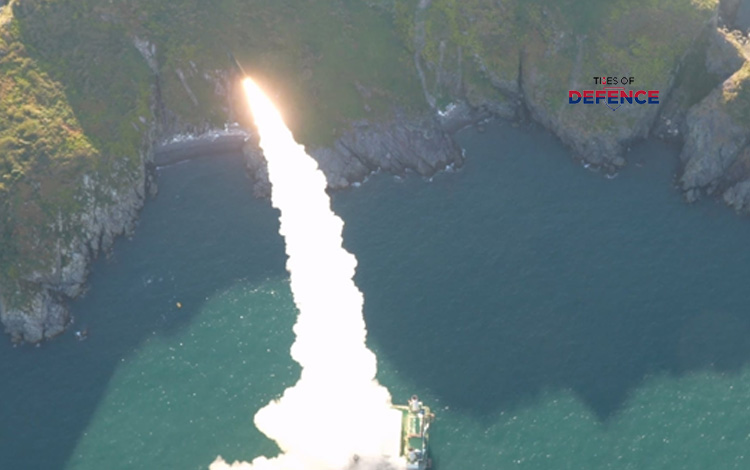
Launched via a solid-fuel booster rocket from a barge-mounted test rig at ADD’s Anheung Test Centre in Taean (approx. 130 km south of Seoul), the glide body achieved exo-atmospheric separation, re-entered the upper atmosphere, and executed sustained low-altitude lateral maneuvers at hypersonic speeds (Mach 5+) prior to striking a designated maritime impact zone in the West Sea.
The test verified critical hypersonic subsystem baselines, including thermal protection system (TPS) integrity under extreme aerodynamic heating, high-mach guidance and control surface actuation, and unpowered glide trajectory stability. The platform forms part of South Korea’s “Kill Chain” and “Korea Massive Punishment and Retaliation” (KMPR) strategic deterrence doctrine to penetrate anti-access/area-denial (A2/AD) air defense networks. 
TECHNICAL SPECIFICATIONS: ROK INDIGENOUS HYPERSONIC GLIDE VEHICLE (HGV)
* Developing Agencies: Agency for Defense Development (ADD) & ROK Defense Industrial Base
* Test Location & Date: Anheung Test Centre (Taean, South Korea) / October 8, 2026
* Launch Configuration: Barge-launched solid-propellant booster stack (derivative of Hyunmoo series booster technology)
* Flight Profile & Trajectory:
* Stage 1: Solid-fuel booster boost-phase acceleration
* Stage 2: Exo-atmospheric payload separation
* Stage 3: Dynamic pull-up / atmospheric re-entry glide phase
* Terminal Phase: Low-altitude non-ballistic cross-range maneuvers and precision sea-target impact
* Aerodynamic & Material Architecture:
* Thermal Protection System (TPS): Advanced carbon-carbon / ceramic matrix composites to endure high aero-thermal flux
* Flight Control System: Dynamic aerodynamic control surfaces for unpowered hypersonic maneuverability
* Speed Metrics: Sustained velocity exceeding Mach 5 (>6,125 km/h)
* Operational Role & Strategic Alignment:
* Primary Target Profile: High-value, heavily defended command-and-control (C2) nodes, hardened underground targets, and mobile missile assets
* Strategic Integration: Complements heavy kinetic penetration weapons (e.g., Hyunmoo-5 heavy ballistic missile) within the ROK’s three-axis strike system