


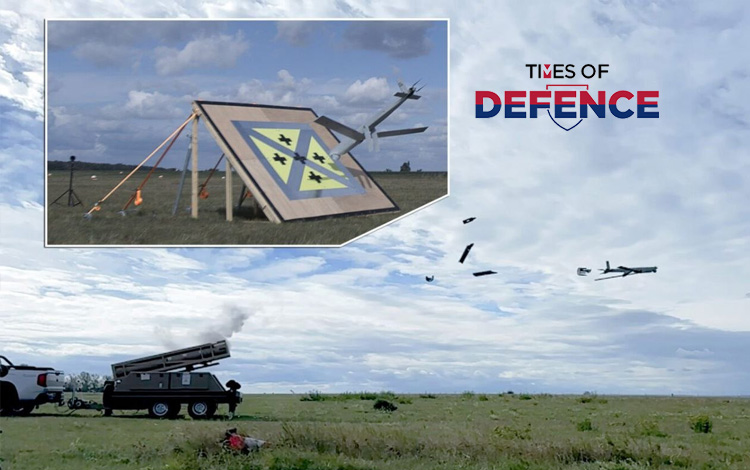
Diehl Defence and Israel’s Elbit Systems have demonstrated the long-range capabilities of the SkyStriker loitering munition in Germany, including an 80-kilometre control handover and integration with the SkyLark 1 reconnaissance UAV.
The live demonstration took place in early September 2026 and was announced by both companies on September 14. According to the companies, the test involved launching SkyStriker from a canister, conducting reconnaissance, tracking a prepared target and subsequently engaging it. The system also successfully demonstrated a “hand-over” function at a distance of 80 km, showing the transfer of control or mission information over a long-range networked engagement chain.
SkyStriker–SkyLark 1: A Reconnaissance-to-Strike Chain
One of the most significant elements of the demonstration was the cooperation between the SkyStriker and SkyLark 1 eVTOL reconnaissance UAV.
The companies describe the concept as a “Seek & Strike” capability. In this architecture, a reconnaissance platform can provide surveillance and targeting information while the loitering munition performs the subsequent detection, tracking and engagement mission.
The demonstration is significant because it shows the SkyStriker being positioned not simply as an individual loitering munition, but as an element within a broader ISR-UAV network.
SkyStriker Technical Characteristics
SkyStriker is an electrically powered loitering munition designed for long-range tactical precision effects.
Publicly reported and manufacturer-released characteristics include:
- Propulsion: Electric motor
- Maximum takeoff mass: Approximately 50 kg class
- Range: Up to approximately 250 km, depending on configuration
- Endurance: More than 2 hours in the lighter-warhead configuration
- Warhead: Up to 10 kg
- Reported attack speed: Up to approximately 550 km/h
- Launch: Canister launch
- Guidance: Autonomous navigation and target tracking, with operator involvement depending on mission configuration
- Mission concept: Reconnaissance, target acquisition, tracking and precision engagement
- Signature: Low acoustic and thermal signature due to electric propulsion
There is an important distinction between different published configurations. Elbit’s earlier material specified a 10 kg maximum warhead, while the latest German demonstration material emphasizes a configuration capable of more than two hours of loiter endurance. German defense reporting indicates that the approximately 5 kg warhead configuration can achieve more than two hours of endurance, while the heavier 10 kg configuration reduces endurance to approximately one hour.
The companies’ latest announcement describes the system’s range as over 200 km and endurance as more than two hours, while other manufacturer material gives a maximum range figure of up to 250 km. These figures should therefore be understood as configuration-dependent rather than a single fixed performance envelope.
Autonomous Target Engagement
SkyStriker is designed to locate, track and engage operator-designated targets.
During the German demonstration, the munition was launched from a canister and subsequently performed reconnaissance, target tracking and engagement against a prepared target. Elbit describes the system as capable of autonomous target tracking and precision engagement while retaining a “man in the loop” capability, including operations in environments where GPS or communications may be degraded or denied.
This combination of autonomy and human supervision is particularly relevant to modern reconnaissance-strike architectures, where unmanned systems can extend the range between sensors, command networks and effectors.
Launch Platforms
SkyStriker is designed to be launched from multiple platforms.
The system has been associated with:
- Dedicated ground canisters
- Ground vehicles
- Aircraft
- Naval platforms
- PULS
- EuroPULS
- The German MARS 3 rocket-artillery architecture
Elbit has specifically demonstrated SkyStriker integration with its PULS family, while the latest Diehl-Elbit announcement highlights EuroPULS as particularly relevant to Germany and other European countries.
This provides a potential path toward integrating long-range loitering munitions into existing rocket-artillery and precision-strike architectures rather than operating them exclusively as standalone UAV systems.
German Production Is Part of the Partnership
The German demonstration follows a strategic cooperation agreement signed by Diehl Defence and Elbit Systems in June 2026 at ILA Berlin.
Under the agreement, Elbit Systems is responsible for strategic market development, while Diehl Defence is positioned to handle manufacturing, assembly, integration and qualification in Germany if customers place orders.
The partnership is therefore aimed not only at marketing the existing SkyStriker system in Europe, but also at establishing a potential German production capability.
No German procurement contract has been publicly announced as part of the September demonstration. The companies are presenting the system to Germany and other potential European customers.
Why the 80-Km Demonstration Matters
The most notable technical result from the trial was not simply the munition’s maximum range, but the demonstrated 80-km handover capability.
An 80-km handover suggests that the weapon can participate in a distributed sensor-to-shooter architecture in which targeting information or control can be transferred between nodes at significant distances.
Combined with SkyLark 1, the concept creates a basic reconnaissance-strike chain:
Reconnaissance → Target detection → Information transfer → SkyStriker search/track → Engagement
Such architectures are increasingly important as militaries seek to connect inexpensive unmanned sensors with longer-range precision weapons.
Editorial Note
The September demonstration confirms the 80-km handover, canister launch, target tracking/engagement and SkyLark 1 integration according to Diehl Defence and Elbit Systems.
However, the 80-km figure should not be interpreted as the SkyStriker’s maximum strike range. Manufacturer material places the system’s maximum range at over 200 km, with some published specifications giving up to 250 km, depending on configuration.
Likewise, SkyStriker’s reported endurance, range and payload vary according to warhead and configuration. The system has not been publicly demonstrated in every configuration described in promotional specifications.
The German trial nevertheless represents a significant step toward combining long-range loitering munitions, tactical ISR drones and rocket-artillery systems into a networked reconnaissance-to-strike architecture.
