


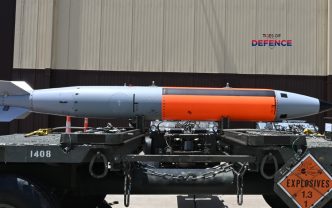
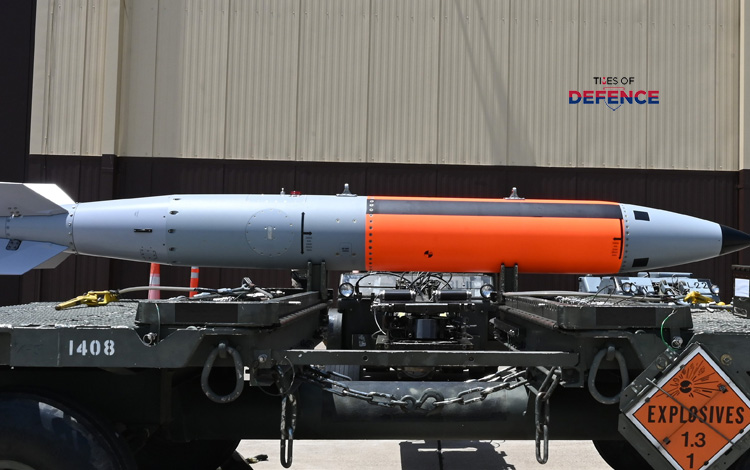
A newly released explanatory statement accompanying the Senate Appropriations Committee’s Fiscal Year 2027 draft funding bill for the Department of Energy has revealed the first entirely new designation for a U.S. air-dropped nuclear gravity bomb in more than three decades: the B94.
Identified by nuclear policy researchers in a National Nuclear Security Administration (NNSA) stockpile modernization budget line recommending $77.108 million for FY 2027, the B94 breaks a 35-year hiatus since the Cold War-era B90 Nuclear Depth/Strike Bomb was canceled in September 1991. While federal officials have not publicly detailed the weapon’s design or mission profile, defense analysts strongly assess that the B94 designation applies to the classified Nuclear Deterrent System-Air-delivered (NDS-A) program—an earth-penetrating bunker-busting munition under active development since at least 2022 to hold Hard and Deeply Buried Targets (HDBTs) at risk.
TECHNICAL SPECIFICATIONS: U.S. B94 / NDS-A NUCLEAR GRAVITY BOMB ARCHITECTURE
1. Nomenclature, Program Lineage & Stockpile Context
⚡ Alphanumeric Classification: Follows standard U.S. nuclear weapon nomenclature where the “B” prefix designates an air-dropped gravity bomb (distinct from “W” missile warheads), following sequentially after the W93 Trident II submarine-launched ballistic missile warhead
⚡ Predecessor & Legacy Comparison: Marks the first clean-sheet gravity bomb designation since the B90 (canceled in 1991); subsequent air-dropped updates—such as the B61-11 earth penetrator, B61-12 guided bomb, and B61-13 high-yield variant—remained modifications within the legacy B61 family
⚡ Budgetary Allocation: Allocated $77.108 million in the Senate Appropriations Committee’s FY 2027 draft spending bill under NNSA stockpile modernization accounts 
2. Operational Mission Profile & Target Set
💥 Primary Mission Objective: Engineered to defeat Hard and Deeply Buried Targets (HDBTs), such as fortified subterranean command centers, mountain complexes, and hardened ICBM silo fields
💥 Stockpile Replacement Role: Assessed as a potential successor to the aging B61-11 earth-penetrating bomb (yield estimated at 340–400 kilotons) and/or the megaton-class B83-1 strategic bomb, potentially combining high yield with precision tail-kit guidance
💥 Triad Modernization Integration: Complements broader U.S. strategic modernization efforts, including the Northrop Grumman B-21 Raider stealth bomber (which conducted its first weapons release test in November 2026), the LGM-35A Sentinel ICBM, and Columbia-class ballistic missile submarines
TIMES OF DEFENCE ASSESSMENT
The emergence of the B94 nuclear gravity bomb designation in Fiscal Year 2027 appropriations documents highlights three critical shifts in U.S. strategic deterrence posture:
1. Countering the Proliferation of Deeply Buried Adversary Infrastructure: Over the past two decades, Russia, China, North Korea, and Iran have invested heavily in deep underground command bunkers, mountain facilities, and hardened missile silos specifically engineered to survive conventional munitions. Developing a dedicated clean-sheet penetrator ensures Washington can hold high-value strategic nodes at risk.
2. Bridging the Capability Gap Between Yield and Penetration: Currently, the U.S. stockpile splits its anti-bunker capabilities between the earth-penetrating B61-11 and the megaton-class B83-1, while the newer B61-13 lacks deep-penetration casing. Consolidating precision guidance, structural earth-penetration, and tailored yield into the B94/NDS-A platform modernizes airborne strategic strike flexibility.
3. Synchronizing Munitions Development with the B-21 Raider: As the B-21 Raider transitions into active weapons testing, fielding a next-generation air-delivered gravity weapon tailored for internal stealth carriage guarantees that the U.S. Air Force’s premier penetrating bomber retains credible, survivable strike options in heavily defended airspace.

