


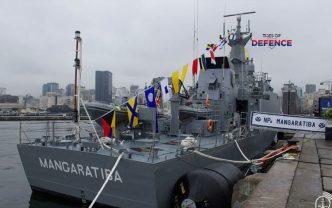
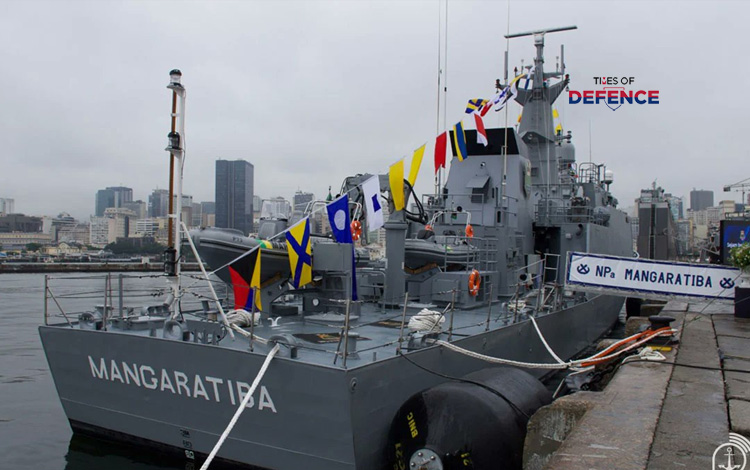
The Brazilian Navy (Marinha do Brasil) has formally commissioned its fourth Macaé-class offshore patrol vessel, NPa Mangaratiba (P73), during a naval ceremony held at the Rio de Janeiro Navy Arsenal (Arsenal de Marinha do Rio de Janeiro – AMRJ) on October 30, 2026.
Constructed under Brazil’s Patrol Vessel Acquisition Program (Programa de Obtenção de Navios-Patrulha – PRONAPA)—which aims to field 11 patrol vessels to safeguard the nation’s expansive “Blue Amazon” maritime territory—the Mangaratiba joins sister ships Macaé (P70), Macau (P71), and Maracanã (P72) in active fleet service. Based on the French Constructions Mécaniques de Normandie (CMN) Vigilante 400 CL54 design adapted for domestic Brazilian shipbuilding, the vessel will expand naval presence across the strategic Amazon River estuary and Equatorial Margin, executing maritime surveillance, anti-illicit trafficking interdiction, search and rescue (SAR), and civil support for isolated riverine and coastal communities. Construction continues at AMRJ on the fifth hull in the series, NPa Miramar (P74), which is scheduled for launch and commissioning in 2028 with enhanced mine-countermeasures (MCM) provisions.
TECHNICAL SPECIFICATIONS: BRAZILIAN NAVY MACAÉ-CLASS PATROL VESSEL (NPa MANGARATIBA P73) ARCHITECTURE
1. Hull Design, Dimensions & Propulsion
⚡ Shipbuilder & Base Design: Constructed by Arsenal de Marinha do Rio de Janeiro (AMRJ); derived from the French CMN Vigilante 400 CL54 offshore patrol vessel architecture featuring a steel hull and lightweight aluminum superstructure
⚡ Dimensions & Displacement: Full load displacement of approximately 500 tonnes, measuring 55.6 meters (182 feet) in overall length, with a beam of 9.3 meters and a shallow draft of 2.5 meters suited for littoral and estuarine waters
⚡ Powerplant & Endurance: Powered by twin MTU 16V 4000 M90 marine diesel engines driving twin shafts, generating a top speed of 21 knots, an economical cruising speed of 15 knots, and an operational range of 2,500 nautical miles (4,630 km) with 10 days of autonomous endurance 
2. Armament, Crew & Operational Mission Profile
💥 Main & Secondary Armament: Armed with a primary 40 mm Bofors Mk4 naval gun forward and two 20 mm automatic cannons for graduated escalation and maritime interdiction
💥 Complement & Boats: Operated by a crew of 35 naval personnel and equipped with rigid-hulled inflatable boats (RHIBs) for rapid boarding, inspection, and search-and-rescue tasks
💥 Strategic Deployment & Follow-On Upgrades: Assigned to reinforce maritime security in the Amazon River estuary and Equatorial Margin; subsequent class hulls starting with NPa Miramar (P74) incorporate modular bays for unmanned surface vehicles (USVs) and remotely operated vehicles (ROVs) for mine-countermeasures duties
TIMES OF DEFENCE ASSESSMENT
The commissioning of the patrol vessel Mangaratiba (P73) by the Brazilian Navy highlights three key strategic priorities in South Atlantic and Amazonian maritime security:
1. Securing the Equatorial Margin and Amazon Estuary: Brazil’s northern maritime frontier—encompassing the Amazon River mouth and resource-rich Equatorial Margin offshore energy basins—faces persistent challenges from illegal fishing, narcotics smuggling, and transnational crime. Deploying a dedicated 500-tonne patrol platform significantly strengthens persistent state presence in these vital waters.
2. Revitalizing Sovereign Naval Shipbuilding Capacity: Overcoming past budgetary delays, the completion of Mangaratiba at the Rio de Janeiro Navy Arsenal demonstrates renewed institutional momentum behind domestic hull fabrication, supply-chain localization, and shipyard workforce retention under the PRONAPA framework.
3. Evolving Modular Multi-Mission Utility Across Future Hulls: By leveraging the proven CMN Vigilante 400 CL54 baseline while integrating unmanned mine-countermeasures capabilities into the upcoming Miramar (P74), the Brazilian Navy is establishing a standardized, cost-effective fleet capable of adapting to both constabulary and asymmetric naval warfare demands.

