



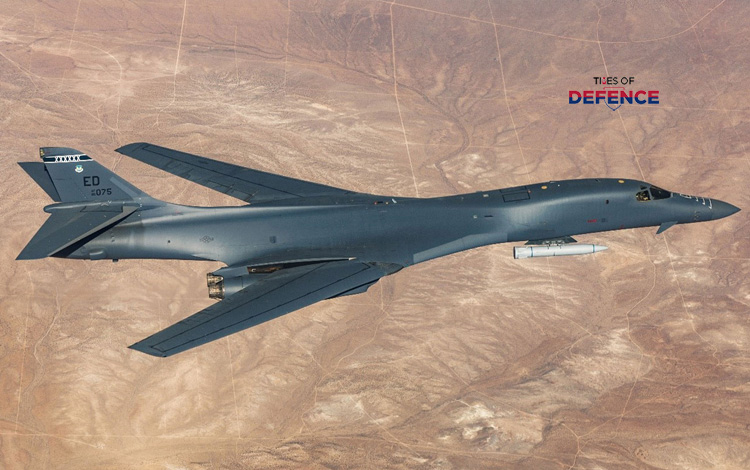
Boeing Defense, Space & Security announced on November 17, 2026, that its Load Adaptable Modular (LAM) external weapons pylon being developed for the United States Air Force B-1B Lancer supersonic strategic bomber has successfully passed its Critical Design Review (CDR).
The engineering milestone confirms that the LAM pylon architecture is technically mature and establishes a formal system product baseline accepted by the U.S. Air Force B-1 program office. With CDR complete, the program advances directly into hardware and software fabrication, aircraft modification, and ground and flight integration testing. By reactivating six dormant under-fuselage hardpoints originally engineered for the Air-Launched Cruise Missile (ALCM)—and deactivated during the bomber’s conversion to conventional-only operations under Strategic Arms Reduction Treaty (START) protocols—the modular pylon enables the B-1B to carry oversized external munitions, including hypersonic strike weapons, while dramatically expanding its total combat loadout.
TECHNICAL SPECIFICATIONS: BOEING LOAD ADAPTABLE MODULAR (LAM) PYLON ARCHITECTURE
1. Structural Integration, Modularity & Carriage Capacity
⚡ Prime Contractor & Platform: Boeing Defense, Space & Security; integrated onto the U.S. Air Force B-1B Lancer supersonic variable-sweep-wing bomber fleet
⚡ Hardpoint Utilization: Mounts onto six existing under-fuselage attachment points originally built for external Air-Launched Cruise Missile (ALCM) carriage, restoring external stores capability without requiring major structural airframe redesigns
⚡ Station Load Rating: Each LAM pylon is engineered to carry heavy single munitions weighing up to 7,500 pounds (3,400 kg)—or dual-carriage configurations of two 2,000-pound-class weapons—effectively boosting the B-1B’s external and overall precision-strike capacity
⚡ Flightline Reconfigurability: Incorporates adjustable, “click-in-place” mechanical attach points and standardized digital/electrical interfaces, allowing ground crews to rapidly reconfigure pylons on the flightline for diverse weapons providers without specialized depot tooling 
2. Hypersonic Compatibility & Standoff Munitions Expansion
💥 Hypersonic Strike Integration: Enables the B-1B to carry oversized air-breathing and boost-glide hypersonic weapons—such as the AGM-183A Air-Launched Rapid Response Weapon (ARRW) and Hypersonic Attack Cruise Missile (HACM)—that exceed the dimensional limits of the aircraft’s internal rotary launchers
💥 Expanded Standoff Salvo Volume: Allows a single B-1B sortie to carry up to 36 long-range cruise missiles—combining 24 internal weapons with 12 external AGM-158 JASSM-ER or Long-Range Anti-Ship Missiles (LRASM)
💥 Fleet Sustainment & Testbed Relief: Relieves hypersonic flight-testing bottlenecks on the U.S. Air Force’s B-52 test fleet while extending the B-1B’s operational relevance through 2040 and beyond alongside the incoming B-21 Raider
TIMES OF DEFENCE ASSESSMENT
The successful Critical Design Review of Boeing’s Load Adaptable Modular pylon for the B-1B Lancer highlights three critical strategic imperatives in U.S. long-range strike modernization:
1. Unlocking Hypersonic Strike Capacity Without Waiting for New Airframes: Because hypersonic boost-glide and cruise missiles are physically too large for existing internal bomber bays, reactivating the B-1B’s dormant external hardpoints provides an immediate, cost-effective operational delivery platform for Mach 5+ standoff weapons.
2. Maximizing Salvo Mass for Contested Indo-Pacific Scenarios: Increasing a single B-1B’s standoff cruise missile load from 24 to 36 weapons—a 50 percent boost in precision firepower—allows Air Force Global Strike Command to generate overwhelming anti-ship and land-attack salvos from fewer forward-deployed tankers and airfields.
3. Bridging the Bomber Transition Gap Through 2040: As the B-21 Raider progresses through testing toward full operational capability, modular external upgrades ensure the remaining 45 active B-1B Lancers remain lethal, flexible multi-mission “arsenal planes” capable of adapting to emerging munitions over the next decade and a half.

