


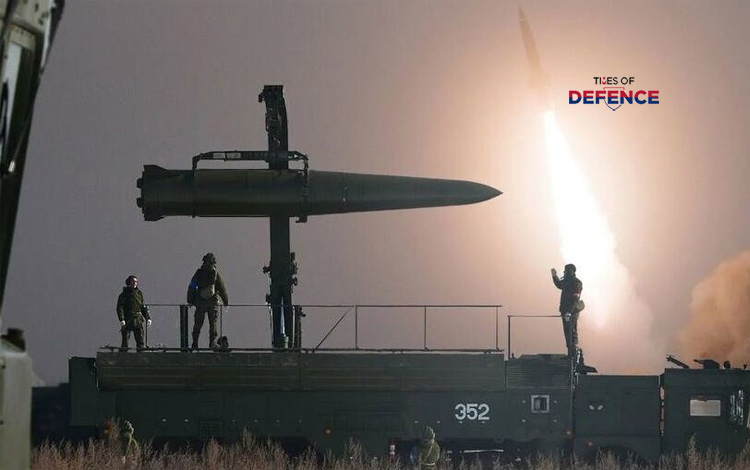
The Russian Armed Forces have introduced upgraded terminal guidance packages on their **9M723 Iskander-M** short-range ballistic missiles, enabling high-precision strikes against critical transport infrastructure despite intensive Ukrainian electronic warfare (EW) jamming.
According to Ukrainian presidential adviser and radio-technology specialist Serhii “Flash” Beskrestnov, alongside technical data compiled by Ukraine’s Defense Intelligence (HUR) *War&Sanctions* portal, recent strikes on Kyiv’s Dnipro River crossings utilized missiles fitted with the **9E436 optical correlation homing head** and the **9B918 active radar homing head**. The upgraded munitions were employed during ballistic attacks on Kyiv’s Pivdennyi (Southern) Bridge in late October and the Pivnichnyi (Northern) Bridge on the night of November 6–7, 2026—where four of six launched missiles reportedly impacted the crossing—causing severe deck damage and disrupting vital east-west transport corridors.
TECHNICAL SPECIFICATIONS: UPGRADED 9M723 ISKANDER-M ARCHITECTURE
Airframe, Propulsion & Quasi-Ballistic Flight Profile
⚡ Prime Developer & Manufacturers: Designed by KBM (Kolomna); missiles produced by Votkinsk Machine Building Plant; launched from 8×8 MZKT-79306 Astrolog Transporter-Erector-Launcher (TEL) vehicles
⚡ Physical Dimensions & Mass: Length of 7.3 m, diameter of 0.92 m, and launch weight of ~3,800 kg
⚡ Propulsion & Performance Envelope: Single-stage solid-propellant rocket motor achieving burnout velocities up to ~2,100 m/s (Mach 6+); operational range of 400–500+ km (extending to 550+ km on newer 9M723-2 variants)
⚡ Terminal Maneuverability: Flies a depressed quasi-ballistic trajectory at altitudes under 50 km, executing high-G terminal pull-ups and aerodynamic course corrections (at dive angles of 60°–80°) to complicate interception by Patriot and SAMP/T batteries
⚡ Warhead & Accuracy: Carries a 480–700 kg unitary high-explosive, cluster, bunker-busting penetrator, or thermobaric warhead with a Circular Error Probable (CEP) of 5–7 meters when utilizing terminal homing 
GNSS-Independent Terminal Seeker Upgrades
💥 9E436 Optical Correlation Homing Head: Manufactured by Russia’s TsNIIAG JSC with participation from NII Televideniya JSC; captures real-time electro-optical imagery of the target zone during terminal descent and correlates it against pre-loaded digital terrain reference maps (DSMAC) to correct accumulated inertial navigation drift
💥 9B918 Active Radar Homing Head: Manufactured by NPP Radar MMS JSC; conducts active radar terrain scanning during the final seconds of descent, identifying distinct structural signatures (such as bridge spans over water) to execute autonomous mid-course and terminal trajectory adjustments completely immune to GLONASS/GPS spoofing and jamming
TIMES OF DEFENCE ASSESSMENT
The operational integration of 9B918 active radar and 9E436 optical seekers onto Iskander-M warheads highlights three critical developments in modern missile warfare:
1. **Neutralizing Nationwide GNSS Spoofing Advantages**: Ukraine’s nationwide navigation jamming network has degraded satellite-guided munitions across the theater. By pairing inertial guidance with active radar and optical scene-matching seekers in the final seconds of flight, Russia has restored meter-level terminal accuracy against fixed infrastructure without relying on satellite signals.
2. **Exploiting High-Contrast Radar Signatures on Bridge Infrastructure**: Bridges spanning wide waterways like the Dnipro River present high-contrast geometric radar returns against water surfaces, making them ideal targets for active radar seekers like the 9B918—even at night or under heavy cloud cover where optical sensors face limitations.
3. **Escalating Logistical Attrition Across Strategic Chokepoints**: While single ballistic strikes rarely collapse massive reinforced-concrete river crossings outright, achieving repeatable pinpoint hits on bridge decks and approaches degrades rail and road throughput, forcing Ukrainian logistics onto narrower, more vulnerable transit bottlenecks.

